
1
Two coins are tossed. What is the chance of two tails?
MATHEMATICS · GRADES 10-12
This document was made by AI and there may be mistakes. If a question or answer looks wrong, use the Flag a mistake button to let Brett know so he can fix it.
This is how you work out your real chances in a card game, a raffle, or a sports draw. You need one rule when you want one thing or another to happen (see Probability of Complementary Events), and a different rule when you need both to happen together. Knowing which rule fits the question stops you from guessing at odds that are actually easy to work out.
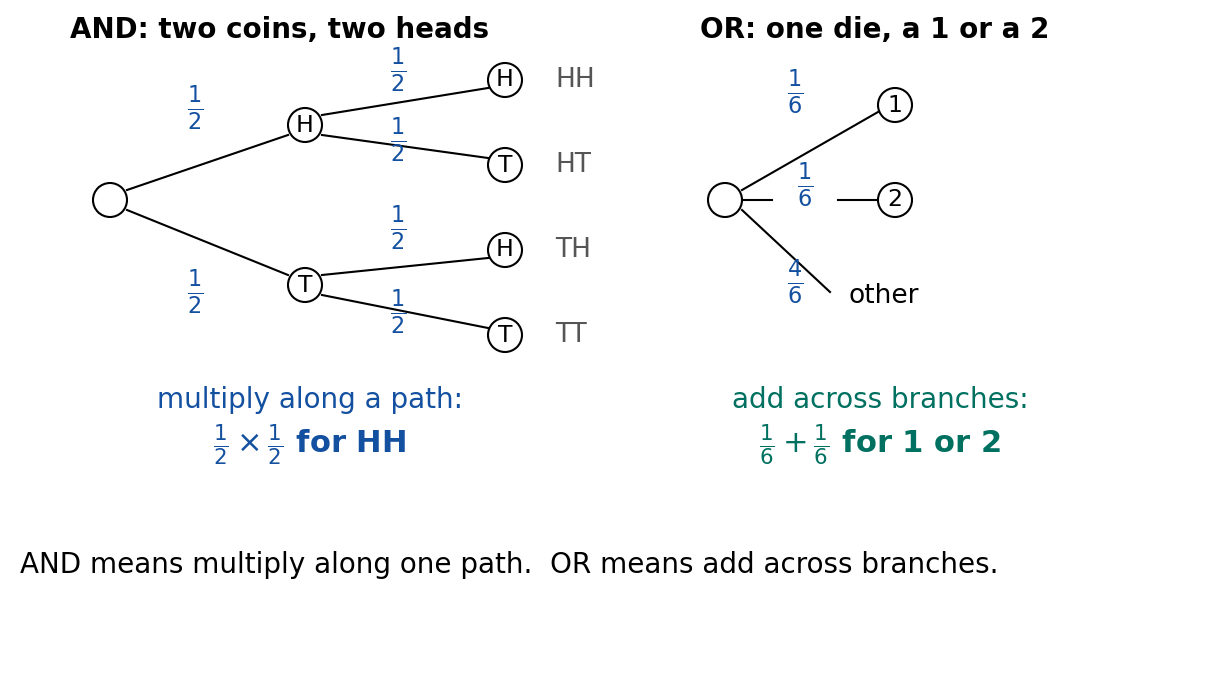
One die is rolled. Use the addition rule for a 1 or a 2.
Solution
A die has six faces, so the chance of rolling a 1 is one face out of six: 16. The chance of rolling a 2 is the same: 16
These are mutually exclusive, which means one roll cannot show both a 1 and a 2 at the same time, so the two chances add: 16 + 16
That gives 26. Divide the top and bottom by 2 to simplify: 26 = 13
So the answer is 13
Two coins are tossed. Use the multiplication rule for two heads.
Solution
Each coin has two sides, so the chance of heads on one toss is one side out of two: 12
The tosses are independent, which means one toss does not affect the other, so the chances multiply: 12 × 12
That gives 14
So the answer is 14
Two coins are tossed. What is the chance of two tails?
A bag holds 3 red marbles and 2 blue marbles. What is the chance of picking a red marble or a blue marble?
State the addition rule for mutually exclusive events.
State the multiplication rule for independent events.
Two dice are rolled. What is the chance the total is 7?
One card is drawn from a deck. What is the chance of a queen or a jack?
A coin is tossed and a die is rolled. What is the chance of heads and a 6?
One die is rolled. What is the chance of an even number?
Three coins are tossed. What is the chance of three heads?
When do you add probabilities, and when do you multiply?
Your score: 0 / 10
1. 14
2. 1
3. P(A or B) = P(A) + P(B)
4. P(A and B) = P(A) × P(B)
5. 16
6. 213
7. 112
8. 12
9. 18
10. Add for or, when the events are mutually exclusive; multiply for and, when the events are independent