
1
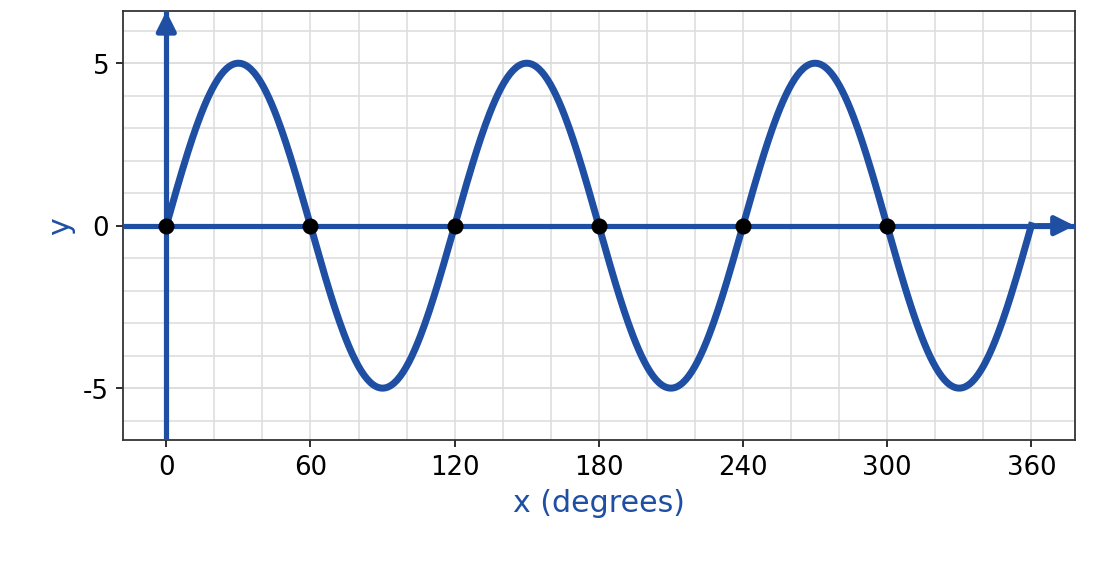
Find the amplitude and the period of the function graphed below.
MATHEMATICS · GRADES 10-12
This document was made by AI and there may be mistakes. If a question or answer looks wrong, use the Flag a mistake button to let Brett know so he can fix it.
This is how you describe a sound wave, a radio signal, or the swing of a playground swing. Amplitude tells you how tall the wave is, which is how loud a sound is or how far a swing goes. Period tells you how long one full repeat takes, which is what sets the pitch of a note or the timing of a signal.
Amplitude and period: for y = a sin (bx) or y = a cos (bx), amplitude = |a| and period = 360b.
The amplitude is how tall the wave is, and the period is how long one full repeat takes.
Find the amplitude and period of y = 3 sin x.
Solution
Amplitude is the number in front of sin, ignoring the sign: 3
Period = 360 ÷ 1 = 360 degrees.
Amplitude 3, period 360 degrees.
Find the amplitude and period of y = 2 cos (2x).
Solution
Amplitude is 2, the number in front of cos.
The number multiplying x is 2, so the wave repeats twice as fast.
Period = 3602 = 180 degrees.
Find the amplitude and the period of the function graphed below.
A sound wave is modelled by y = 0.4 cos(2x), where y is the air pressure change. What are the amplitude and period of the wave?
A radio signal follows y = 6 sin x. What is the greatest value of y, and what is the least value?
A playground swing moves so its distance from the middle follows y = 1.5 sin(4x), where y is in metres. How far does the swing go from the middle, and after how many degrees does the motion repeat?
Which has the greater amplitude, y = 2 sin x or y = 3 cos(2x)? Give the amplitude of each and the period of each.
Write a sine function with amplitude 4 and period 180 degrees.
A pendulum swings as y = -3 cos x. What are its amplitude and period?
The height of a tide above its middle level follows y = 2.5 sin(x2). Find its amplitude and period.
Two notes are modelled by y = sin(6x) and y = sin(2x). Which one repeats faster, and what is the period of each?
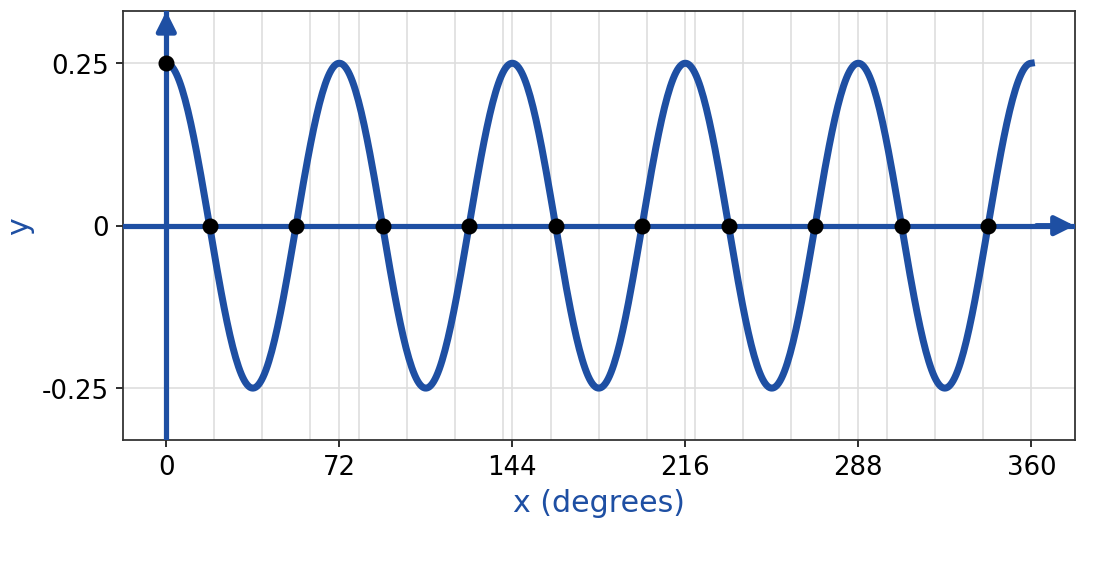
A tuning fork vibrates as shown in the graph below. Find its amplitude and period.
Your score: 0 / 10
1. Amplitude 5, period 120 degrees
2. Amplitude 0.4, period 180 degrees
3. 6 and -6
4. 1.5 metres from the middle; it repeats after 90 degrees
5. y = 3 cos(2x) has the greater amplitude; periods 360 degrees and 180 degrees
6. y = 4 sin(2x)
7. Amplitude 3, period 360 degrees
8. Amplitude 2.5, period 720 degrees
9. y = sin(6x) repeats faster; periods 60 degrees and 180 degrees
10. Amplitude 0.25, period 72 degrees