1
What is the area under y = 2 from x = 0 to x = 3?
MATHEMATICS · GRADES 10-12
This document was made by AI and there may be mistakes. If a question or answer looks wrong, use the Flag a mistake button to let Brett know so he can fix it.
This is how you work out a total from a graph. The total distance travelled from a speed graph, or the total water used from a flow graph, is the area underneath the curve. It is how engineers and scientists turn a picture of how fast something was changing into the total amount that actually happened.
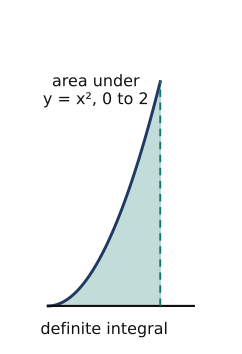
Find the area under
Solution
The function is non-negative on this interval, which means it never drops below zero, so the area under it is the integral.
The antiderivative of 2x is x². Put in the two ends, 2 and 0: 2² − 0² = 4 − 0 = 4
Area = 4 units²
Find the area under
Solution
The region is a rectangle: 5 × 1 = 5
Integral of 1 from 0 to 5 is 5.
Area = 5 units²
What is the area under y = 2 from x = 0 to x = 3?
What is the area under y = x from 0 to 2?
What is the area under y = 3x² from x = 0 to x = 1?
What is the value of the integral of y = −2 from 0 to 4?
When does the integral of a function give the area under its graph directly?
What is the area under y = x² from x = 0 to x = 3?
What is the area under y = x + 1 from 0 to 2?
What is the area under y = 2x from 1 to 3?
The area under y = 2 from 0 to 3 is 6. If the height doubles to y = 4, what is the new area?
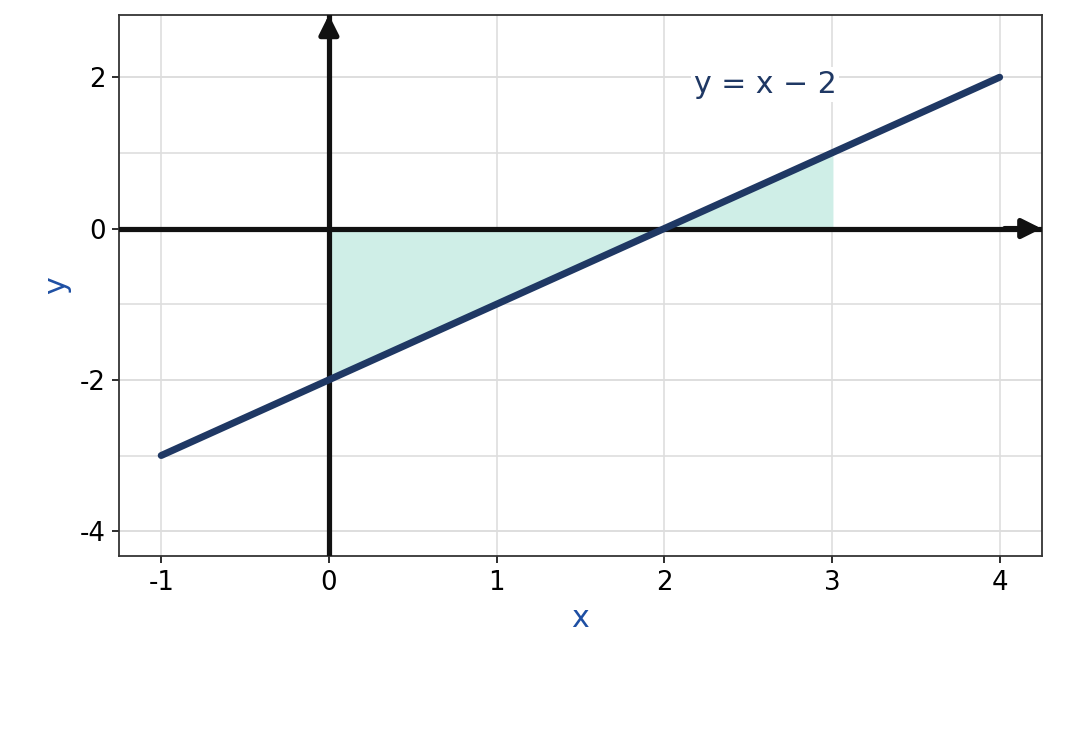
A graph dips below the x-axis. What must you do to get the true area from the integral?
Your score: 0 / 10
1. 6
2. 2
3. 1
4. -8
5. When the function is non-negative on the interval
6. 9
7. 4
8. 8
9. 12
10. Take the absolute value