
1
A theatre has rows with 3, 6, 9, 12 seats in the first four rows. How many seats are in the first 4 rows in total?
MATHEMATICS · GRADES 10-12
This document was made by AI and there may be mistakes. If a question or answer looks wrong, use the Flag a mistake button to let Brett know so he can fix it.
This is how you add up a whole run of steady weekly savings or payments at once. Adding each week separately works, but it is slow and easy to slip up on over a long run. The series shortcut gives you the total in one go, which is what you need when you are working out what a savings plan is worth after a year.
Arithmetic series: the sum of the first n terms is n2 times (2a + (n - 1) × d), where a is the first term and d is the common difference.
A series is the sum of the terms of a sequence, and this formula gives the total without adding term by term.
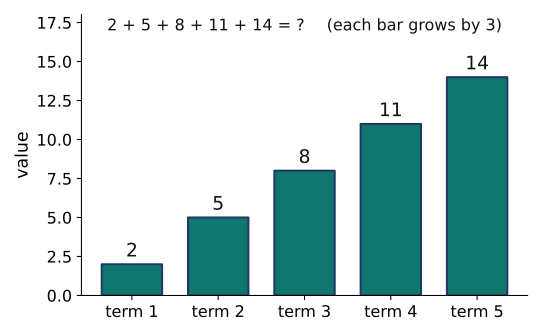
Find the sum of the first
Solution
Add the terms: 2 + 5 + 8 + 11 + 14
Group them: 2 + 14 = 16, 5 + 11 = 16, leaving 8.
Sum = 16 + 16 + 8 = 40
Use the formula for the sum of the first 10 terms
Solution
First term a = 1, difference d = 2, number of terms n = 10
Put the numbers in: n is 10, so n over 2 is 5; 2a is 2 times 1, which is 2; and (n minus 1) times d is 9 times 2, which is 18.
Sum = n2 × (2a + (n - 1) × d) = 5 × (2 + 18)
Sum = 5 × 20 = 100
A theatre has rows with 3, 6, 9, 12 seats in the first four rows. How many seats are in the first 4 rows in total?
A student saves 1, 2, 3, 4, 5 dollars over five weeks. How much has she saved in total?
A series has first term 5 and common difference 3. What is the sum of the first 4 terms?
Use the series formula to find the sum of the first 8 terms of 2, 5, 8, and so on.
Three friends each score 7 points in a game. What is the sum of their scores?
A machine stamps 1 part every minute for 10 minutes. How many parts is that in total?
A sequence lists numbers. What do you call the sum of its terms?
A runner covers 20, 18, 16, 14, 12 metres in five sprints. How many metres is that in total?
What is the sum of the first 6 terms of 3, 7, 11, and so on?
Add the numbers 1 to 20. What is their sum?
Your score: 0 / 10
1. 30
2. 15
3. 38
4. 100
5. 21
6. 10
7. A series
8. 80
9. 78
10. 210