1
What goes on the front of a flashcard?
PRACTICAL AND FINANCIAL LITERACY
This document was made by AI and there may be mistakes. If a question or answer looks wrong, use the Flag a mistake button to let Brett know so he can fix it.
This is how you make study cards that quiz you one fact at a time. You put a question on one side and the answer on the other, like a vocabulary word or a times table fact, and you test yourself until the answer comes fast. The cards you keep missing are the ones you study most, so your time goes where it is needed. It is a simple tool, but it works because it forces you to remember instead of just rereading.
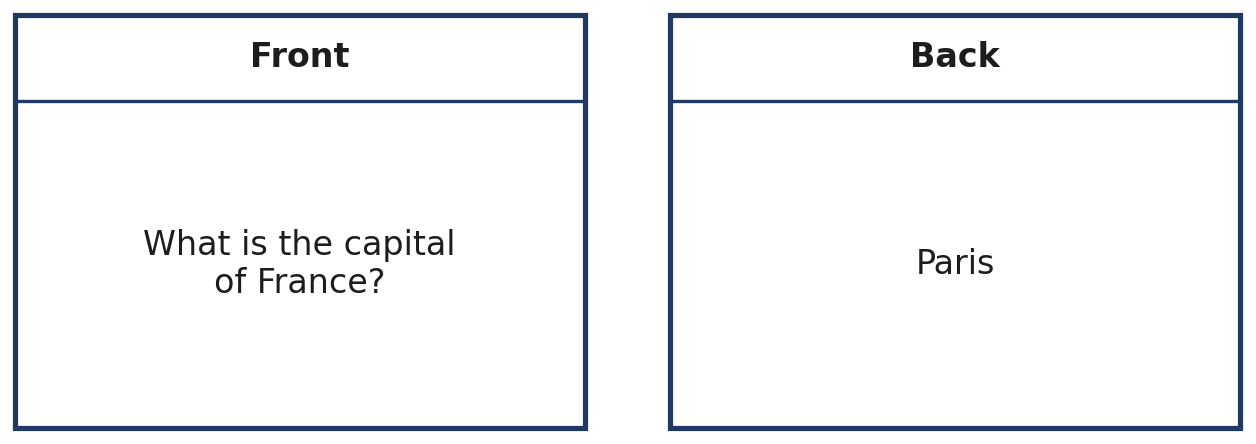
How do you make a flashcard for “Paris is the capital of France”?
Solution
Front: a question with one right answer. “What is the capital of France?”
Back: one short answer. “Paris.”
One fact per card, then test yourself front to back, and shuffle the cards so you remember the answers, not the order.
After testing, you have a pile of cards you know and a pile you missed. What do you study first next session?
Solution
Start with the missed pile.
Missed cards get more reviews; known cards get fewer, but still sometimes.
Then mix the known cards back in, so nothing is forgotten.
What goes on the front of a flashcard?
What goes on the back of a flashcard?
How many facts should one flashcard hold?
Why shuffle the cards?
After testing, what do you do with the cards you missed?
Your card front says “The capital of France”. What is wrong with this front?
What is a good flashcard question for “Water boils at 100°C”?
When should you test yourself with flashcards?
What should you do with cards you always get right?
True or false: reading the front and back of a card together counts as testing yourself.
Your score: 0 / 10
1. A question or prompt
2. One short answer
3. One
4. So you recall the answers, not their order
5. Review them again sooner.
6. It is a heading, not a question; it should ask “What is the capital of France?”
7. “At what temperature does water boil?”
8. After learning, and again later, spread out over time
9. Review them less often, but still sometimes.
10. False