
1
Share 10 apples among 2 children. How many apples does each child get?
MATHEMATICS · KINDERGARTEN TO GRADE 3
This document was made by AI and there may be mistakes. If a question or answer looks wrong, use the Flag a mistake button to let Brett know so he can fix it.
This is how you share something out fairly, one by one. You deal snacks around the group so everyone gets the same amount, and nobody gets more than anyone else. Going one by one keeps it fair and makes it easy to see when the sharing is done. It is the first idea behind division, and it is how you settle any argument about who got more.
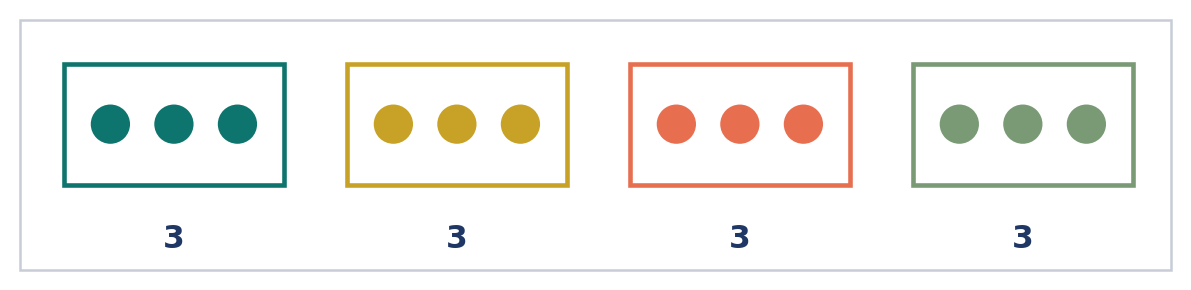
Share 12 biscuits among 4 children. How many biscuits does each child get?
Solution
This is equal sharing: deal the biscuits out one at a time, round and round, until they are all gone.
12 ÷ 4 = 3, so each child gets 3 biscuits.
Check it with multiplication: 4 × 3 = 12
Share 17 counters among 4 children. How many does each child get, and how many are left over?
Solution
Deal them out one at a time: 4 children × 4 counters = 16 counters shared.
17 − 16 = 1 counter left over.
So each child gets 4 counters, with 1 left over.
Share 10 apples among 2 children. How many apples does each child get?
Share 14 counters among 3 children. How many counters are left over?
12 apples are shared equally and each child gets 3 apples. How many children are there?
Each child gets 4 biscuits. There are 5 children. How many biscuits are there in all?
Share 13 counters among 4 children. How many does each child get, and how many are left over?
4 children share 14 apples equally. How many more apples are needed so each child gets 4 apples?
Tom shares 16 blocks equally among 4 children, then finds 4 more blocks and shares those equally too. How many blocks does each child get in all?
Three children share 16 apples and get 5, 5, and 6 apples. Are the shares fair? Answer yes or no.
Three children share 12 counters equally. Then one more child joins and they share the same counters again equally. How many counters does each child get now?
Mia has 9 stickers. She wants to share them equally among 4 friends. Can she share them equally with none left over? Answer yes or no.
Your score: 0 / 10
1. 5
2. 2
3. 4
4. 20
5. 3 each, 1 left over
6. 2
7. 5
8. No
9. 3
10. No