1
A shop sells 4 shirts and 3 pairs of pants. How many outfits?
MATHEMATICS · GRADES 10-12
This document was made by AI and there may be mistakes. If a question or answer looks wrong, use the Flag a mistake button to let Brett know so he can fix it.
This is how you count up all the combinations, like outfits from your shirts and pants or meals from a menu, without listing every single one. Instead of writing out every possible combination, you multiply the number of choices at each step and get the total straight away. That is how a restaurant knows how many meal combinations its menu offers, how a shop counts the ways to build a custom order, and how you work out how many passwords or lock codes are possible.
Fundamental counting principle: if one choice has m options and the next has n options, there are m × n combinations in total.
Multiply the number of choices at each step.
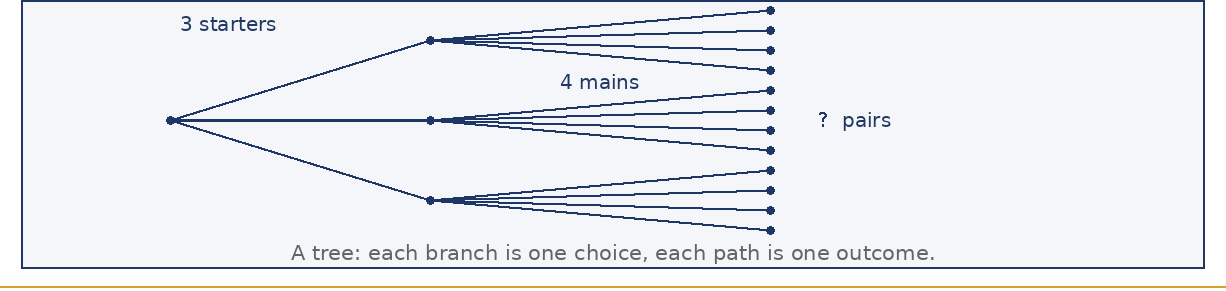
A menu has 3 starters
Solution
Choose a starter first: 3 choices.
For each starter, choose a main: 4 choices.
Multiply: 3 × 4 = 12 pairs
A code has 2 letters,
Solution
Multiply the choices stage by stage: 26 × 26 × 10
26 × 26 = 676
676 × 10 = 6760 codes
A shop sells 4 shirts and 3 pairs of pants. How many outfits?
A code has 2 letters. There are 676 possible codes. How many choices are there for each letter?
Which gives more outcomes: rolling a die and tossing a coin, or tossing a coin three times?
A meal has 2 soups, 5 mains, 3 desserts. How many meals?
A password has 3 digits, each 0 to 9. How many passwords?
What is the fundamental counting principle?
A car comes in 3 colours and 2 engines, but 1 colour is sold out. How many versions are there now?
How many 2-letter codes can be made from 26 letters if the two letters must be different?
A license plate has 2 letters (26 each) and 2 digits (10 each). How many plates?
A wardrobe has 6 tops and 4 skirts. Only 2 of the tops are red. How many outfits use a red top?
Your score: 0 / 10
1. 12
2. 26
3. Die and coin
4. 30
5. 1000
6. Multiply the number of choices at each stage
7. 4
8. 650
9. 67600
10. 8