
1
Is 2, 6, 18, 54 geometric?
MATHEMATICS · GRADES 10-12
This document was made by AI and there may be mistakes. If a question or answer looks wrong, use the Flag a mistake button to let Brett know so he can fix it.
This is how quantities grow when they multiply by the same factor each step, like money earning interest or a social media post being shared again and again. A small change each step turns into a huge change over time, because every step builds on the last one. That is why interest on savings or a loan can grow so fast, why a rumour or a video can reach thousands of people in days, and why a disease can spread quickly once each person passes it on.
Geometric sequences: each term is the last term times the same fixed number, the common ratio.
A sequence is geometric when dividing any term by the one before it always gives the same number.
Is
Solution
Divide neighbours: 63 = 2, 126 = 2, 2412 = 2
The ratio is the same every time.
Yes, geometric with common ratio 2.
Find the next two terms of 100,
Solution
The ratio is 50100 = 12
Multiply 25 by 12 to get 12.5, then multiply by 12 again to get 6.25.
The next two terms are 12.5 and 6.25.
Is 2, 6, 18, 54 geometric?
What is the common ratio of 2, 6, 18, 54?
Find the next term of 5, 10, 20
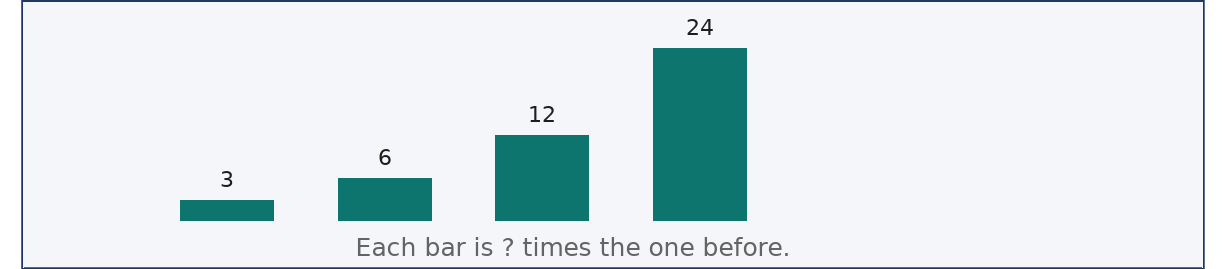
In the geometric sequence 3, 6, __, 24, what is the missing term?
Find the next two terms of 81, 27, 9
What is the common ratio of 81, 27, 9?
Find the next term of 1, -2, 4
What stays the same in a geometric sequence?
Find the next two terms of 10, 30, 90
Is 1, 1, 1, 1 geometric?
Your score: 0 / 10
1. Yes
2. 3
3. 40
4. 12
5. 3 and 1
6. 13
7. -8
8. The ratio between consecutive terms
9. 270 and 810
10. Yes, with common ratio 1