1
For angle A, which side is across from A?
MATHEMATICS · GRADES 10-12
This document was made by AI and there may be mistakes. If a question or answer looks wrong, use the Flag a mistake button to let Brett know so he can fix it.
This is how you name the sides of a right triangle before measuring anything, like a builder naming the long side of a roof slope before working out its length. Every side gets its name from where it sits next to the angle you are looking at, and getting the names right is what makes the rest of the trig work. A builder uses these names to work out roof slopes and ramp lengths, and a surveyor uses them to measure distances across land you cannot walk straight across.
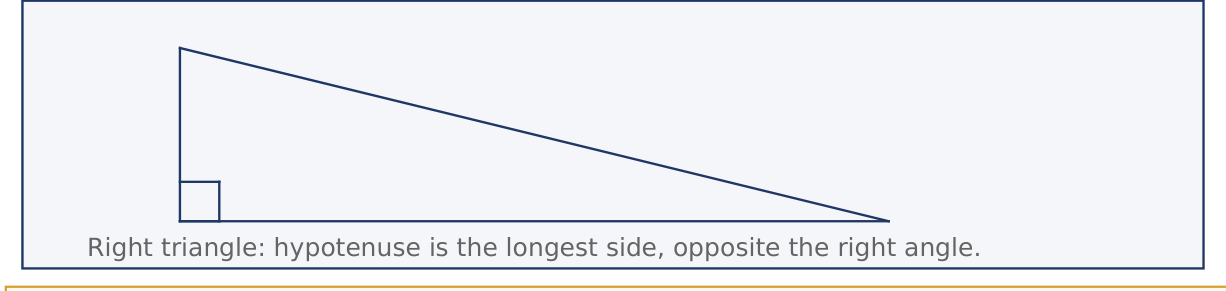
Hypotenuse, opposite, and adjacent: in a right triangle, the hypotenuse is the side across from the right angle and is always the longest side.
For the angle you are working with, the opposite side is across from that angle, and the adjacent side is next to it.
In
Solution
This is a label-the-sides question, and the one rule to remember is the order: label the hypotenuse first, then the opposite, then the adjacent.
The hypotenuse sits across from the right angle, and it is the longest side of the three. Label it first.
The opposite side is the one across from angle A. The adjacent side is the one next to angle A that is not the hypotenuse.
Now
Solution
The hypotenuse does not change: it is still the side across from the right angle.
But the other two labels swap. The side that was opposite angle A is now next to angle B, so it is the adjacent side for B.
And the side that was adjacent for A is now across from angle B, so it is the opposite side for B. Opposite and adjacent always depend on which angle you choose.
For angle A, which side is across from A?
For angle A, which side is next to A but is not the hypotenuse?
Look at the triangle. Is the hypotenuse the same side for angle A and for angle B, or a different side for each angle?
If the side opposite A is 3 and the hypotenuse is 5, what is sin A?
If the side adjacent to A is 4 and the hypotenuse is 5, what is cos A?
If the opposite side is 3 and the adjacent side is 4, what is tan A?
For the other acute angle B, what was the opposite side for A now called?
A ladder leans against a wall. The ladder is the hypotenuse. The height up the wall is the side opposite the angle at the ground. If the ladder is 10 m and the height is 6 m, what is sin of the angle at the ground?
True or false: opposite and adjacent depend on which angle you choose.
Which ratio uses the opposite and adjacent sides, with no hypotenuse in it?
Your score: 0 / 10
1. The opposite side
2. The adjacent side
3. The same side for both angles
4. 35
5. 45
6. 34
7. Adjacent
8. 35
9. True
10. Tangent (tan)