
1
Two fair coin flips are independent. Find P(tails, then tails).
MATHEMATICS · GRADES 7-9
This document was made by AI and there may be mistakes. If a question or answer looks wrong, use the Flag a mistake button to let Brett know so he can fix it.
This is how you work out the odds when one event does not affect the next, like flipping a coin twice or rolling two dice. Each flip or roll starts fresh, so the odds stay the same no matter what happened before. You use it for coin tosses, dice games, and lottery draws, and for any run of chances where one result does not change the next, like the weather on two different days.
For independent events, multiply the probabilities: P(A and B) = P(A) × P(B).
First check that one event does not affect the next. If it does, the events are not independent and you cannot just multiply.
Find P(heads, then heads) on two fair coin flips
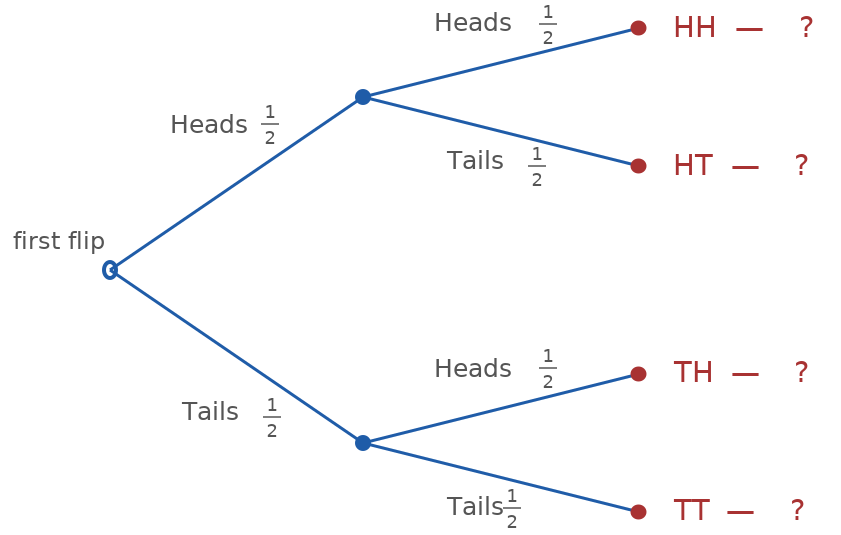
Solution
Check independence: the first flip does not affect the second, so they are independent.
Multiply: 12 × 12 = 14
P is 14
Find
Solution
The rolls are independent.
Multiply: 16 × 16 = 136
P is 136
Two fair coin flips are independent. Find P(tails, then tails).
A spinner is half red and half blue. It is spun twice, and the spins do not affect each other. Find P(red, then red).
Two fair dice are rolled. Find P(5, then 5).
Maya flips a coin and rolls a die. The flip does not affect the roll. Find P(heads, then 6).
A fair coin is flipped three times. Find P(heads, heads, heads).
A bag has 2 red marbles and 2 blue marbles. A marble is drawn, replaced, then drawn again. Find P(blue, then blue).
Two fair coin flips are shown in a tree diagram. The second flip has the same branches and the same probabilities whatever the first flip was. Are two fair coin flips independent? Answer yes or no.
Two cards are drawn without replacement. The second draw has different probabilities depending on the first draw. Are drawing cards without replacement independent? Answer yes or no.
A fair die is rolled three times. Find P(rolling a 6 three times in a row).
A die is rolled twice. Find P(rolling an even number, then an odd number).
Your score: 0 / 10
1. 14
2. 14
3. 136
4. 112
5. 18
6. 14
7. Yes
8. No
9. 1216
10. 14