1
For f(x) = x², what is the instantaneous rate of change at x = 3?
MATHEMATICS · GRADES 10-12
This document was made by AI and there may be mistakes. If a question or answer looks wrong, use the Flag a mistake button to let Brett know so he can fix it.
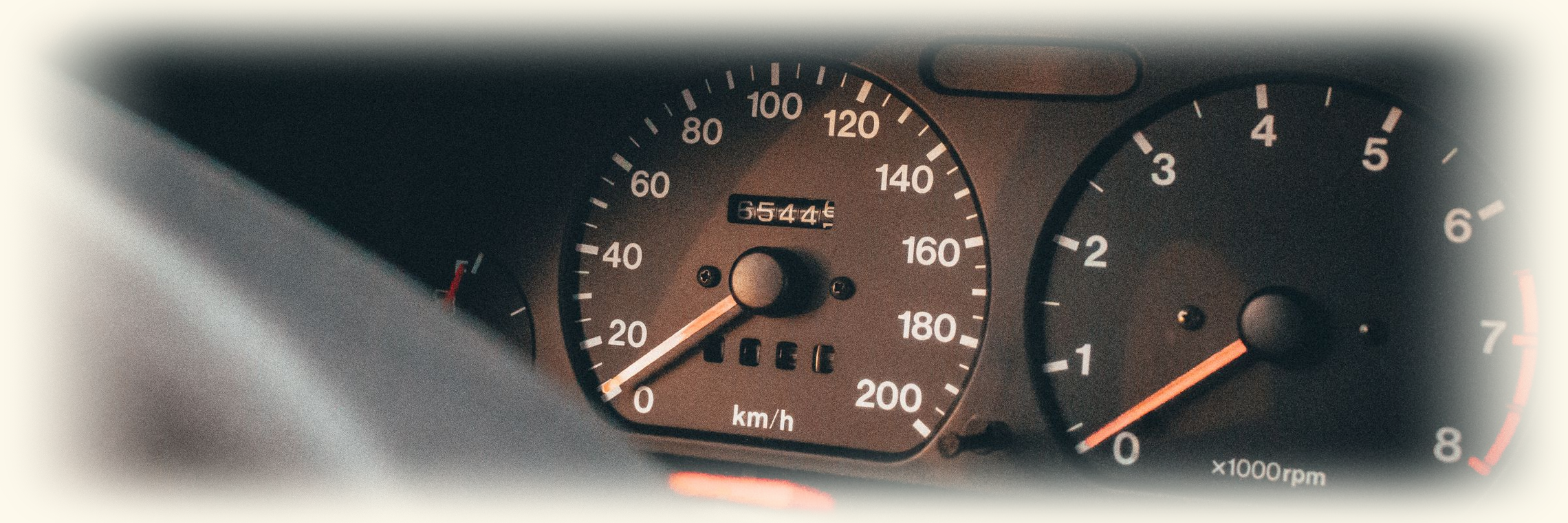
This is how you read the speed at one exact moment, like the number on a car speedometer, rather than the average speed over a whole trip. An average can hide a lot, because a car that averaged 60 kilometres an hour might have been doing 100 on the highway and 20 in town. The speedometer reading is the instantaneous rate, and the same idea tells you how fast a population is growing right now, or how quickly a temperature is dropping at this exact minute.
The instantaneous rate of change at a point is the derivative at that point.
Find the derivative, then put in the x value. That number is the rate at that exact moment, like the reading on a speedometer.
For f(x) = x²,
Solution
The instantaneous rate is the derivative: f'(x) = 2x.
At x = 2, f' = 4
So the rate is 4 at that moment.
For f(x) = 3x,
Solution
The derivative of 3x is 3, a constant.
So at x = 10 the rate is 3.
A straight line has the same instantaneous rate everywhere.
For f(x) = x², what is the instantaneous rate of change at x = 3?
For f(x) = x², at which x is the instantaneous rate of change equal to 0?
For f(x) = 5x, what is the instantaneous rate of change at any x?
What is another name for the instantaneous rate of change?
What does it mean if the instantaneous rate of change is negative?
On a graph, the instantaneous rate of change at a point is the slope of which line?
For f(x) = 7, what is the instantaneous rate of change at any x?
For f(x) = x², how does the instantaneous rate of change at x = 3 compare with the rate at x = 1?
Average rates of f(x) = x² near x = 2 over shorter and shorter intervals. How is the instantaneous rate of change found from average rates?
Use the average rate of change over [2, 2.1] to estimate the instantaneous rate of change of f(x) = x² at x = 2.
Your score: 0 / 10
1. 6
2. x = 0
3. 5
4. The derivative
5. The function is decreasing there
6. The slope of the tangent line
7. 0
8. Greater
9. By shrinking the interval to zero
10. 4.1