1
Maya invests $200 and it grows to $220. What is the return?
percent
MATHEMATICS · GRADES 10-12
This document was made by AI and there may be mistakes. If a question or answer looks wrong, use the Flag a mistake button to let Brett know so he can fix it.
This is how you compare investments fairly, by seeing how much each one gained compared with what you put in, like choosing between two savings accounts. A raw dollar gain means little on its own, because ten dollars on a hundred is very different from ten dollars on a thousand. Comparing returns properly is how you choose between savings accounts, judge whether an investment beat inflation, or decide if a business venture was actually worth the money you put in.
Return = gainstarting amount, where gain = final amount - starting amount.
A positive return means the investment grew, and a negative return means it shrank.
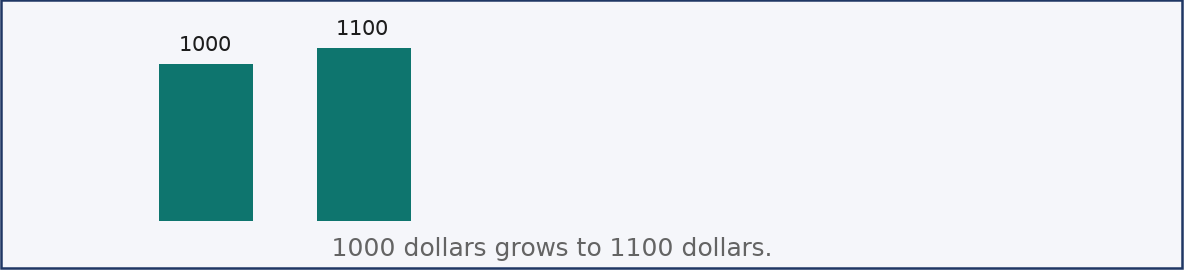
You invest
Solution
Gain = $1100 - $1000 = $100
Return = gainstarting amount = 1001000
Return = 0.10, or 10 percent
You invest
Solution
Gain = $600 − $500 = $100
Return = 100500 = 0.20
Return = 20 percent
Maya invests $200 and it grows to $220. What is the return?
A stock bought for $400 falls to $360. What is the return?
Write the return formula using the final value and the starting value.
A savings account starts at $1000 and grows to $1250 in a year. What is the return?
A bike bought for $250 sells for $300. What is the return?
A fund reports a return of -8 percent. What does that tell you?
A bond grows from $800 to $1000. What is the return?
A pension grows from $2000 to $2100. What is the return?
An account shows a 0 percent return for the year. What happened to its value?
A coin collection bought for $150 sells for $180. What is the return?
Your score: 0 / 10
1. 10 percent
2. -10 percent
3. (Final value - starting value)starting value
4. 25 percent
5. 20 percent
6. The investment lost money
7. 25 percent
8. 5 percent
9. The value did not change
10. 20 percent