1
The base arm sits on 0 of the outer scale, and the other arm crosses the outer scale at 145. What is the angle?
°
MATHEMATICS · GRADES 4-6
This document was made by AI and there may be mistakes. If a question or answer looks wrong, use the Flag a mistake button to let Brett know so he can fix it.
This is how you measure an angle exactly, like checking a corner is square before cutting wood or drawing a shape to size. A protractor turns an angle into a number you can read off, which is what lets you copy it, compare it, or build it somewhere else. A carpenter uses it to check a corner before cutting, a student uses it to draw a shape to size, and a builder uses it to set the angle of a roof or a ramp.
Put the centre of the protractor exactly on the vertex, line the base up with one arm on the zero mark, and read the scale where the other arm crosses it.
Use the scale that starts at the arm you lined up.
Measure the angle in the diagram. The base arm sits on 0 of the inner scale, and the other arm crosses the inner scale at 60.
Solution
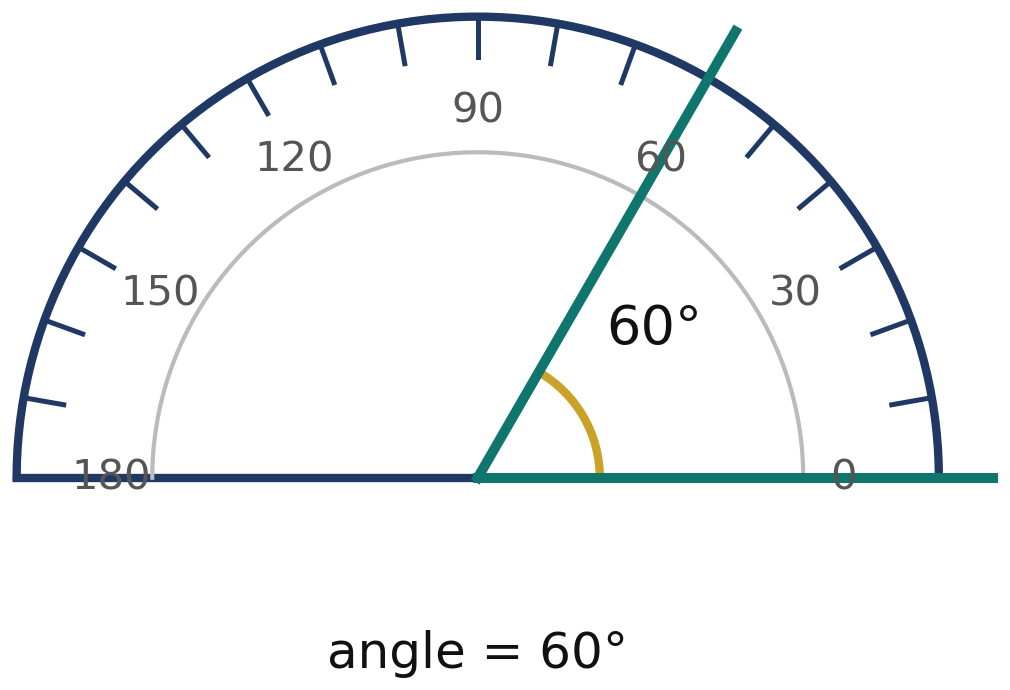
Use the scale whose 0 lines up with the base arm. The base arm sits on 0 of the inner scale, so read the inner scale.
The other arm crosses the inner scale at 60, so the angle is 60°
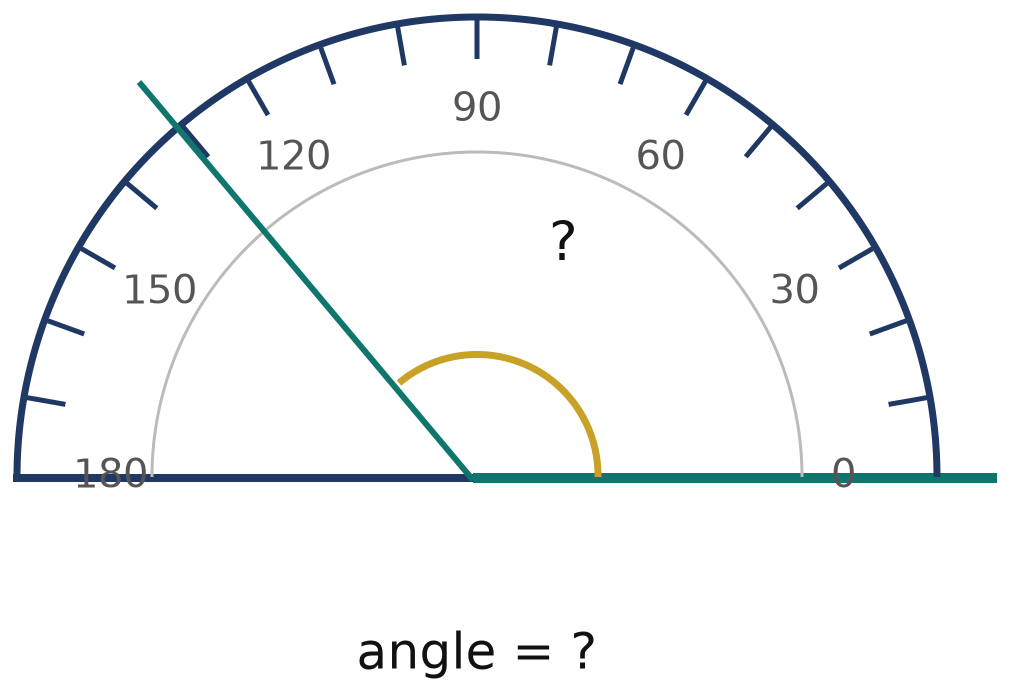
Measure the angle in the diagram. The base arm sits on 0 of the outer scale. The other arm crosses the outer scale at 130 and the inner scale at 50.
Solution
The two scales always add to 180, so one of the two readings is a trap. The base arm sits on 0 of the outer scale, so read the outer scale and ignore the inner one.
The other arm crosses the outer scale at 130, so the angle is 130°, not 50°
The base arm sits on 0 of the outer scale, and the other arm crosses the outer scale at 145. What is the angle?
The base arm sits on 0 of the outer scale. The other arm crosses the outer scale at 125 and the inner scale at 55. What is the angle?
A protractor shows the smaller angle between two arms is 70°. What is the reflex angle?
An angle measures 150°. What kind of angle is it?
Which of these is a reflex angle?
90°
180°
200°
The arm of an angle crosses the scale at 180°. What kind of angle is it?
You place the protractor centre on the vertex, but the base line is not on either arm. What must you fix before you read the angle?
The base arm points up, not along the bottom of the page. The other arm crosses the scale at 40°. What is the angle?
The base arm should sit on 0 of the inner scale, but it sits on 10 instead. The other arm crosses the inner scale at 80. What is the true angle?
You need to draw a 135° angle. The mark falls at 45 on the outer scale. What is the reading on the inner scale?
Your score: 0 / 10
1. 145°
2. 125°
3. 290°
4. Obtuse
5. 200°
6. A straight angle
7. Line the base up with one arm, on the zero mark
8. 40°
9. 70°
10. 135°