
1
A muffin tray holds 9 rows of 6 muffins. How many muffins are there in all?
MATHEMATICS · KINDERGARTEN TO GRADE 3
This document was made by AI and there may be mistakes. If a question or answer looks wrong, use the Flag a mistake button to let Brett know so he can fix it.
This is how you learn your times tables by heart, so bigger multiplication and division in shopping, cooking and school become quick and reliable. Times tables are the foundation everything else in maths is built on, and knowing them by heart frees you from counting on your fingers for every sum. You use them every day without noticing, from working out the cost of several items to doubling a recipe to checking a bill in your head.
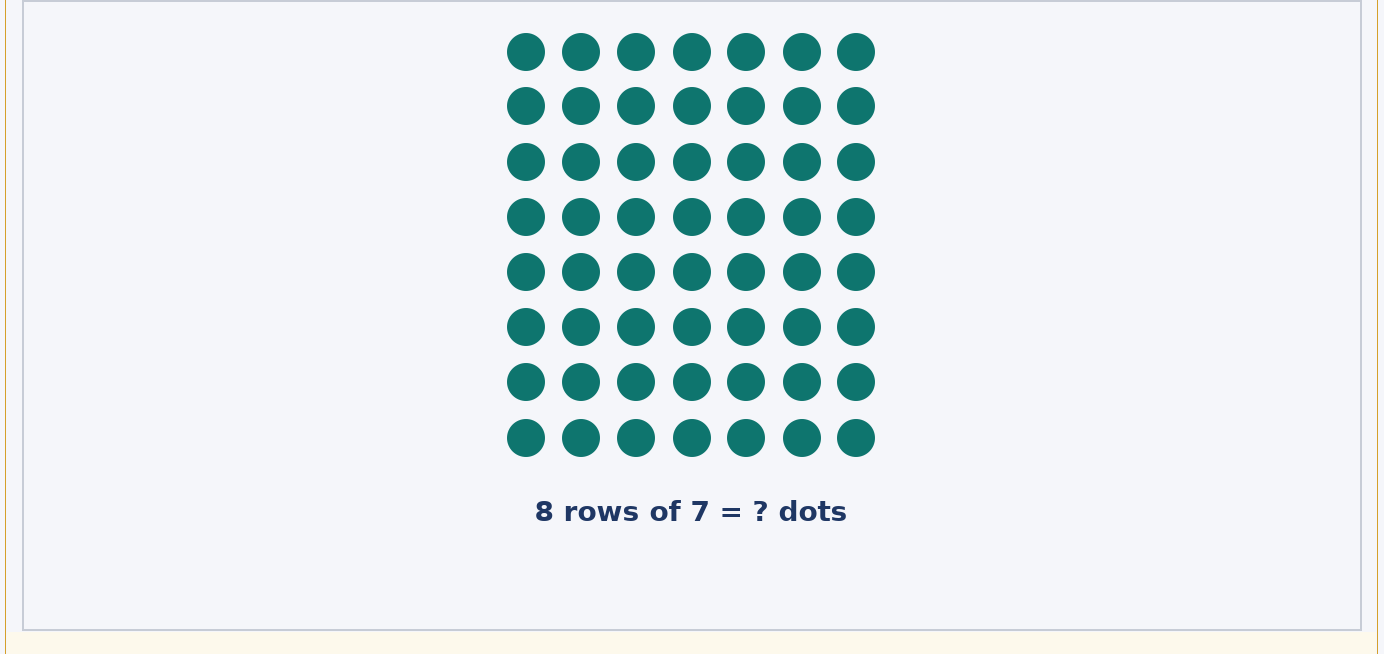
8 × 7 = ?
Solution
Break 8 into 4 + 4, and use a fact you know: 4 × 7 = 28
Double it: 28 + 28 = 56
So 8 × 7 = 56
12 × 6 = ?

Solution
Break 12 into 10 + 2
10 × 6 = 60 and 2 × 6 = 12
12 × 6 = (10 × 6) + (2 × 6) = 60 + 12 = 72
Add them: 60 + 12 = 72, so 12 × 6 = 72
A muffin tray holds 9 rows of 6 muffins. How many muffins are there in all?
You know 4 × 8 = 32. What is 8 × 8?
11 × 5 = 55. What is 11 × 10?
A bus has 48 seats in 12 equal rows. How many seats are in each row?
A tile floor has 9 rows of 9 tiles. How many tiles are there in all?
10 × 12 = 120 and 2 × 12 = 24. What is 12 × 12?
What is 9 × 8? Use the fact that 9 × 8 is the same as 8 × 9.
Which is greater: 11 × 7 or 10 × 8?
10 packs hold 12 stickers each. How many stickers are there in all?
Sam says 11 × 6 = 60 because 10 × 6 = 60. What is 11 × 6 really?
Your score: 0 / 10
1. 54
2. 64
3. 110
4. 4
5. 81
6. 144
7. 72
8. 10 × 8
9. 120
10. 66