1
A pet shop keeps a picture graph of its animals. How many cats are there?
MATHEMATICS · KINDERGARTEN TO GRADE 3
This document was made by AI and there may be mistakes. If a question or answer looks wrong, use the Flag a mistake button to let Brett know so he can fix it.
This is how you read a chart made of pictures, like a class survey where each smiley face stands for five students who chose that lunch. A pictograph turns a pile of numbers into a picture you can read at a glance, which is why it shows up in classrooms, newspapers, and weather charts. The key tells you what each picture is worth, so you can count up the real totals without a calculator. It is the simplest kind of graph, and the first step to reading the bigger charts you meet everywhere else.
In a picture graph, each picture stands for a set number of items.
Count the pictures, then multiply by what each picture stands for to find the total.
3 apple pictures,
Solution
Count the pictures: 3 pictures.
Each picture stands for 2 apples.
Multiply: 3 × 2 = 6 apples in total.
4 star pictures,

Solution
Count the pictures: 4 pictures.
Each picture stands for 5 stars.
Multiply: 4 × 5 = 20 stars in total.
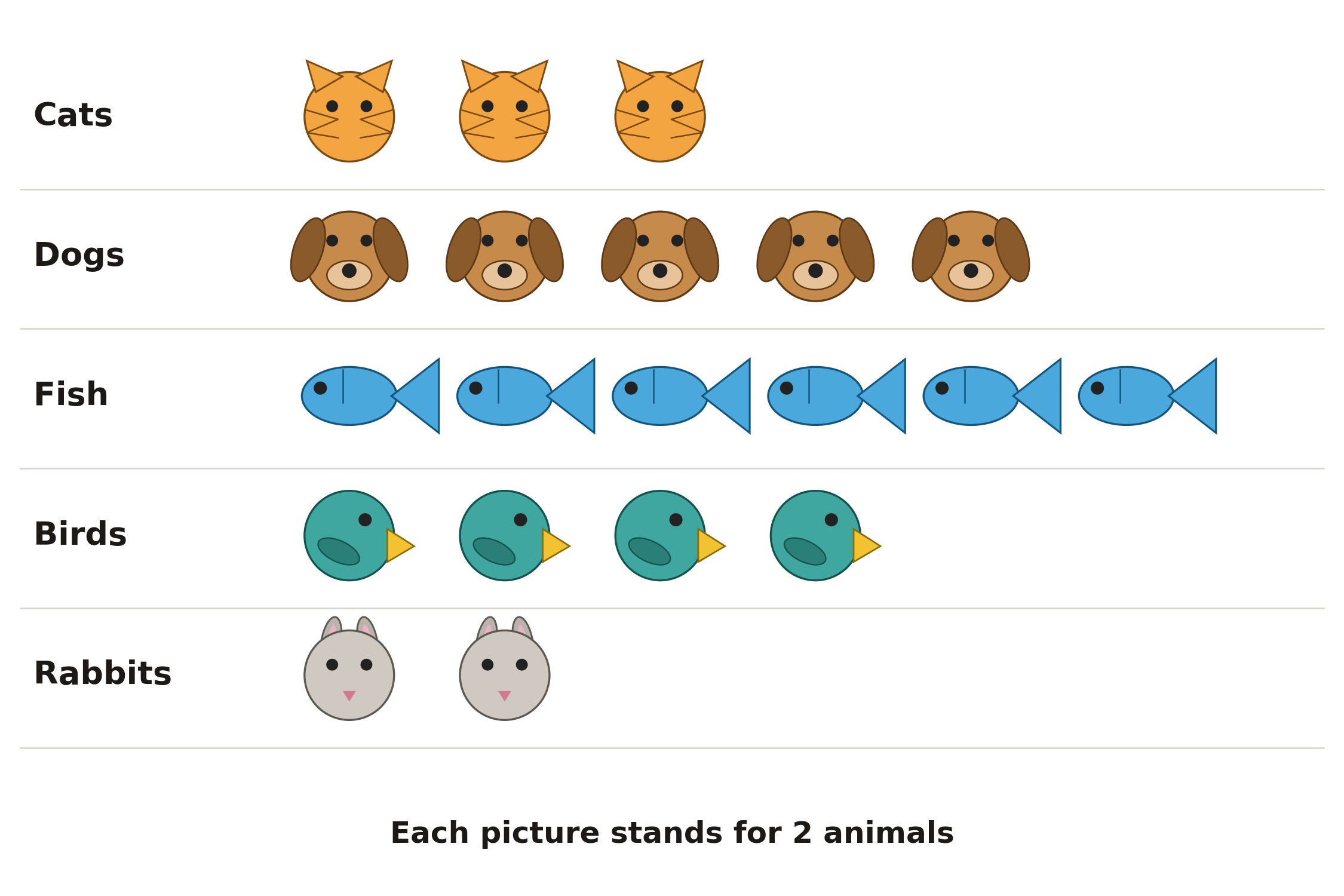
Pet shop picture graph. Each picture stands for 2 animals.
A pet shop keeps a picture graph of its animals. How many cats are there?
In the same pet shop graph, how many dogs are there?
Which animal does the pet shop have the most of?
How many fish are in the pet shop?
How many birds are in the pet shop?
How many rabbits are in the pet shop?
How many cats and rabbits are there together?
How many animals are in the pet shop in all?
How many more dogs than rabbits are there?
If each picture stood for 3 animals instead of 2, how many fish would there be?
Your score: 0 / 10
1. 6
2. 10
3. Fish
4. 12
5. 8
6. 4
7. 10
8. 40
9. 6
10. 18