
1
A poll asks 1000 voters out of 1 million. What is the population and what is the sample?
MATHEMATICS · GRADES 10-12
This document was made by AI and there may be mistakes. If a question or answer looks wrong, use the Flag a mistake button to let Brett know so he can fix it.
This is how pollsters predict an election by asking a few thousand voters instead of every single person in the country. Asking everyone would take too long and cost too much, so a well chosen sample stands in for the whole population. A food company tastes a few spoonfuls from a batch instead of eating the whole pot, and a factory tests a few parts off the line instead of every one. The trick is picking a sample that truly represents the whole group, because a biased sample gives a wrong answer no matter how big it is.
The population is the whole group you want to know about.
A sample is the part of it you actually measure, and you use it to estimate the population. When you measure the whole population, that is a census, not a sample.
Sampling methods have names: systematic means picking every nth person on a list; stratified means picking some people from each group; voluntary response means people choose for themselves whether to answer; random means every person has the same chance of being picked.
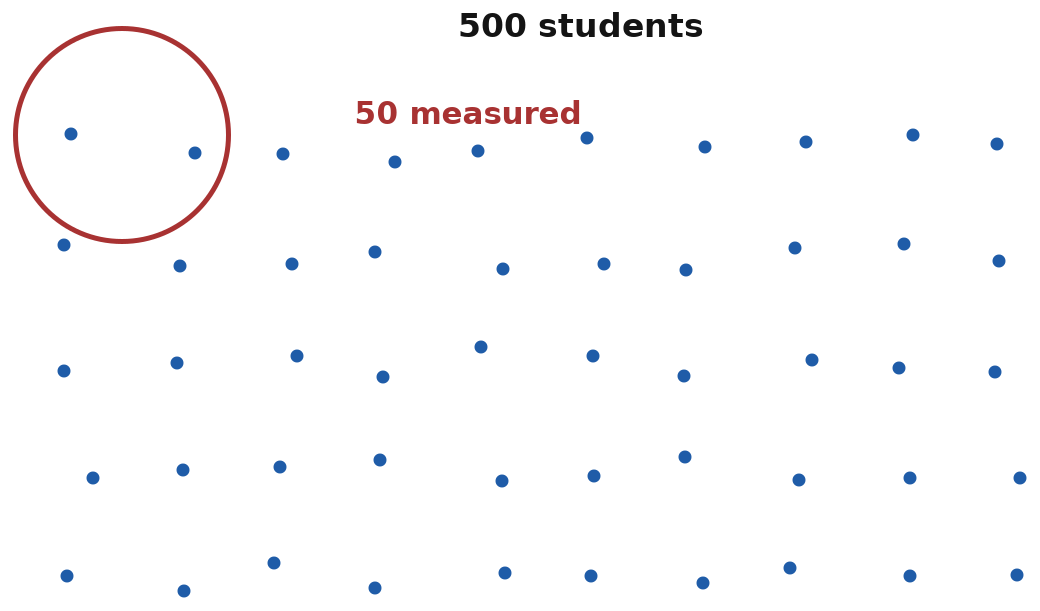
A school wants the average height of all its 500 students, and measures 50 of them. Identify the population and the sample.
Solution
The population means everyone you are trying to learn about: all 500 students. The sample is the part you actually measure: the 50 students measured.
The sample is used to estimate the population.
A factory checks every light bulb it makes. Is that a population or a sample?
Solution
Every bulb is checked, so nothing is left out. That is the whole population, measured in full.
Checking every bulb like that is a census, not a sample.
A poll asks 1000 voters out of 1 million. What is the population and what is the sample?
A teacher tests the whole class. Is that a population or a sample?
A survey about school lunch asks only students in the lunch line. Is the sample biased?
What is a census?
Why use a sample instead of the whole population?
A researcher picks every 10th person on a list. What sampling method is that?
A radio station asks listeners to call in with their opinion. What kind of sample is that?
A school surveys 20 students from each grade. What sampling method is that?
A sample of 30 patients shows a new drug works. Can you claim it works for all patients?
A researcher puts every student's name in a hat and draws 20 names. What sampling method is that?
Your score: 0 / 10
1. Population 1 million, sample 1000
2. Population
3. Yes
4. Measuring the whole population
5. It is faster and cheaper
6. Systematic
7. Voluntary response
8. Stratified
9. No, the sample is too small
10. Random