
1
f(x) = (x - 1)(x - 7). For which x values is it defined?
MATHEMATICS · GRADES 10-12
This document was made by AI and there may be mistakes. If a question or answer looks wrong, use the Flag a mistake button to let Brett know so he can fix it.
This is how you describe things that level off or break suddenly, like the average cost per item dropping as you buy more, or a drug's concentration in the body over time. Buying in bulk drops the average cost per item, but it never drops to zero, it just levels off. A medicine rises in the blood after a dose and then falls away, and a tank filling up approaches full without ever quite passing it. These are all situations where the behaviour changes as the numbers grow, and a rational function is the shape that describes that.
The domain of a rational function is all real numbers except the values that make the denominator zero.
To find them, set the denominator equal to zero and solve.
For f(x) = (x + 1)(x - 2) ,

Solution
Set the denominator to zero: x - 2 = 0, so x = 2.
Exclude that value from the domain.
So the domain is all real numbers except 2.
For f(x) = 1x² ,
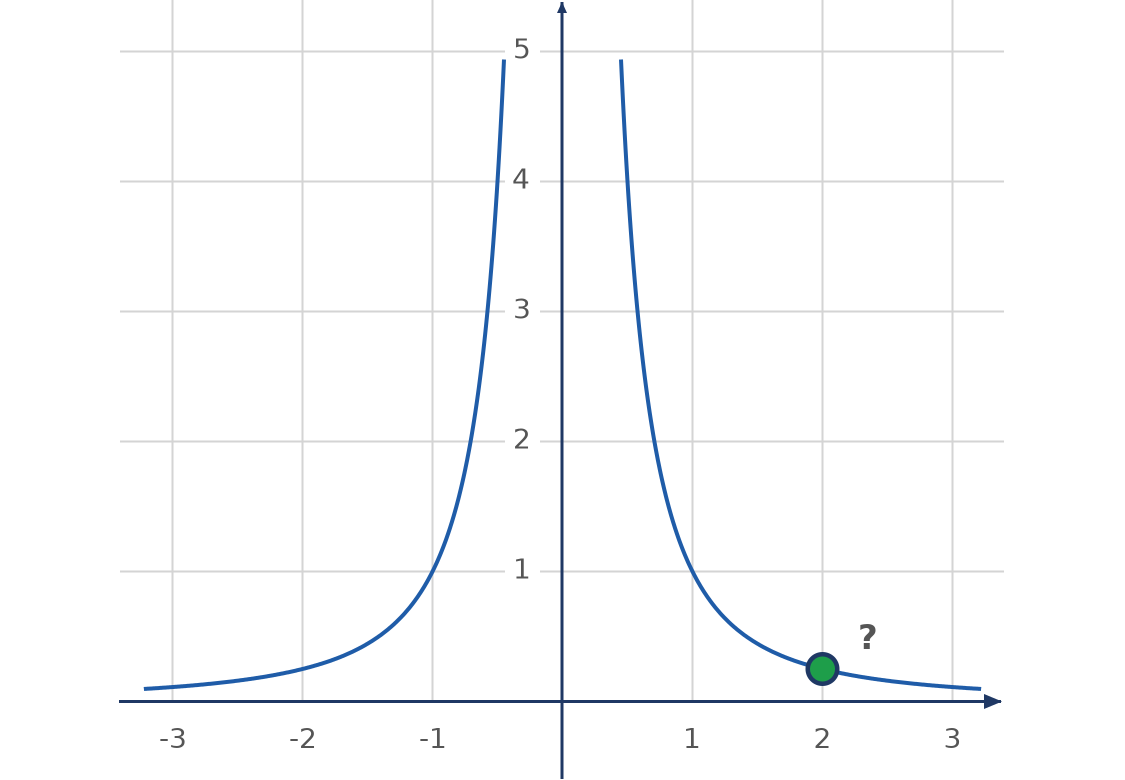
Solution
Set the denominator to zero: x² = 0, so x = 0 is excluded.
The domain is all real numbers except 0.
At x = 2, f(2) = 14
f(x) = (x - 1)(x - 7). For which x values is it defined?
f(x) = 3(x - 2)². Find the domain and the value at x = 1 .
f(x) = 1(x - 2)(x + 3). Find the domain.
For f(x) = 1(x - 4)², what happens to f(x) as x gets closer and closer to 4?
What is f(5) for f(x) = 2(x - 5)?
f(x) = 3x². Find the domain and the value at x = 3 .
f(x) = (x + 1)x² − 9. Find the domain.
f(x) = (x - 2)(x + 3). What is f(2)?
f(x) = (x + 4)(x - 1). Find the domain and the value at x = 3 .
f(x) = 5(x + 8). Find the domain and the value at x = 2 .
Your score: 0 / 10
1. All real numbers except 7
2. All real numbers except 2; f(1) = 3
3. All real numbers except 2 and −3
4. f(x) grows without bound
5. Undefined
6. All real numbers except 0; f(3) = 13
7. All real numbers except 3 and −3
8. 0
9. All real numbers except 1; f(3) = 72
10. All real numbers except -8; f(2) = 12