
1
{(1, 5), (2, 6), (3, 7)}. Is it a function? Answer yes or no.
MATHEMATICS · GRADES 10-12
This document was made by AI and there may be mistakes. If a question or answer looks wrong, use the Flag a mistake button to let Brett know so he can fix it.
This is how you tell whether each input has exactly one output, like a vending machine where each button gives one snack versus a menu where one price could mean several dishes. A vending machine button that always gives the same snack is a function, while a price on a menu that could mean several dishes is not. A student number that points to one student is a function, while a first name shared by three students is not. Knowing the difference tells you whether an input pins down a single answer or leaves it open.
A relation is a function if every input has exactly one output.
If one input has two different outputs, it is a relation but not a function. The same output twice is fine.
Is
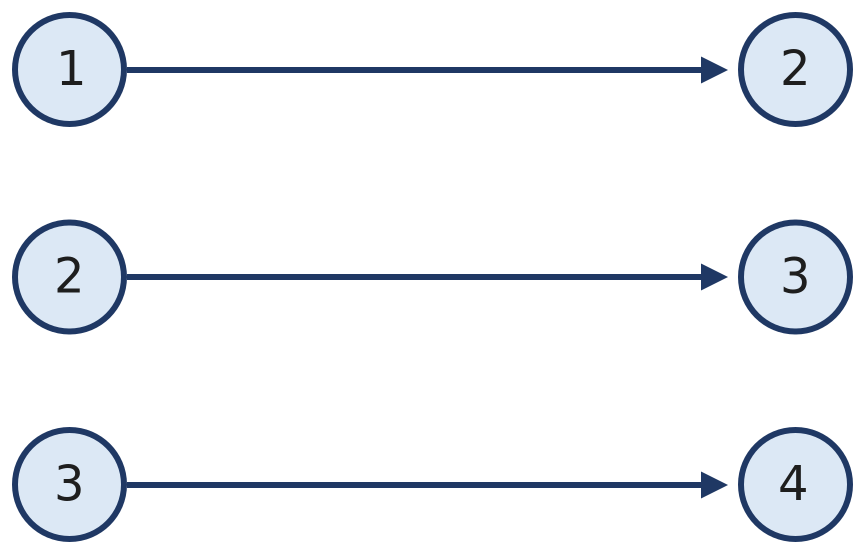
Solution
Check each input: 1 goes to 2, 2 goes to 3, 3 goes to 4.
No input appears with two different outputs.
So yes, it is a function.
Is
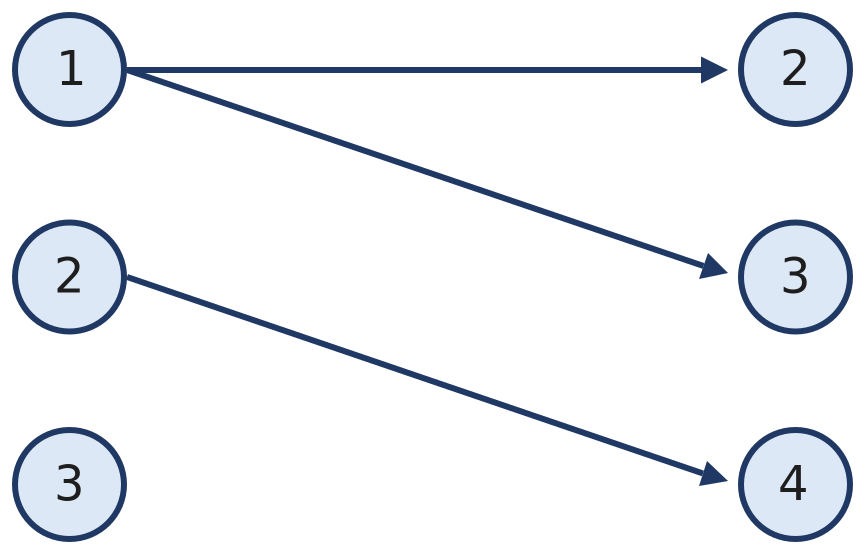
Solution
Check each input: 1 goes to 2 and also to 3.
One input has two different outputs, which breaks the function rule.
So no, it is a relation but not a function.
{(1, 5), (2, 6), (3, 7)}. Is it a function? Answer yes or no.
{(1, 5), (1, 6)}. Is it a function? Answer yes or no.
{(2, 3), (4, 3), (6, 3)}. Is it a function? Answer yes or no.
For the relation {(1, 2), (2, 3), (3, 4)}, what is the domain?
Which ordered pair could you add to {(1, 2), (2, 3)} and still have a function?
A vending machine has one snack behind each button. Is the button-to-snack pairing a function? Answer yes or no.
Which of these is a function?
A student notices two inputs sharing one output. Why is that allowed, when one input with two outputs is not?
For the relation {(1, 4), (2, 4), (3, 4)}, what is the range?
Three are functions and one is not. Which one is not a function:
Your score: 0 / 10
1. yes
2. no
3. yes
4. {1, 2, 3}
5. (3, 4)
6. yes
7. {(1, 2), (2, 3)}
8. A function gives one output for each input, but different inputs may share an output
9. {4}
10. {(1, 1), (1, 2)}