
1
Nitrogen-14 has atomic number 7 and mass number 14. How many protons, neutrons and electrons does a neutral nitrogen-14 atom have?
SCIENCE FOUNDATIONS
This document was made by AI and there may be mistakes. If a question or answer looks wrong, use the Flag a mistake button to let Brett know so he can fix it.
This is how you identify any element and count its particles, like reading a label that tells you exactly what an atom is made of. The atomic number tells you how many protons an atom has, and that number is what makes carbon carbon and oxygen oxygen. The mass number tells you the total of protons and neutrons, so you can work out how many neutrons are inside. A periodic table is really a set of labels, and these two numbers are what each label says.
Atomic number and mass number: the atomic number is the number of protons in an atom, and the mass number is the number of protons plus neutrons. Neutrons = mass number - atomic number.
In a neutral atom the number of electrons equals the number of protons.
Find the particles in
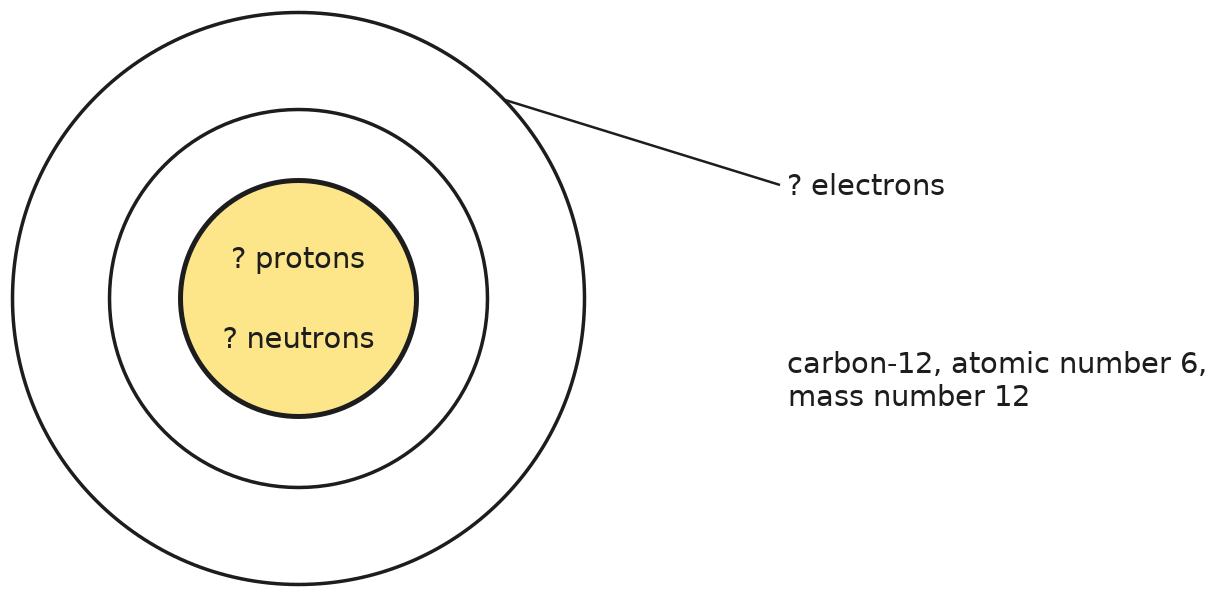
Solution
Protons equal the atomic number: 6
Electrons equal protons in a neutral atom: 6
Neutrons = mass number - atomic number:
12 - 6 = 6
The result is 6 protons, 6 neutrons, 6 electrons.
Find the particles in sodium-23 (atomic number 11,
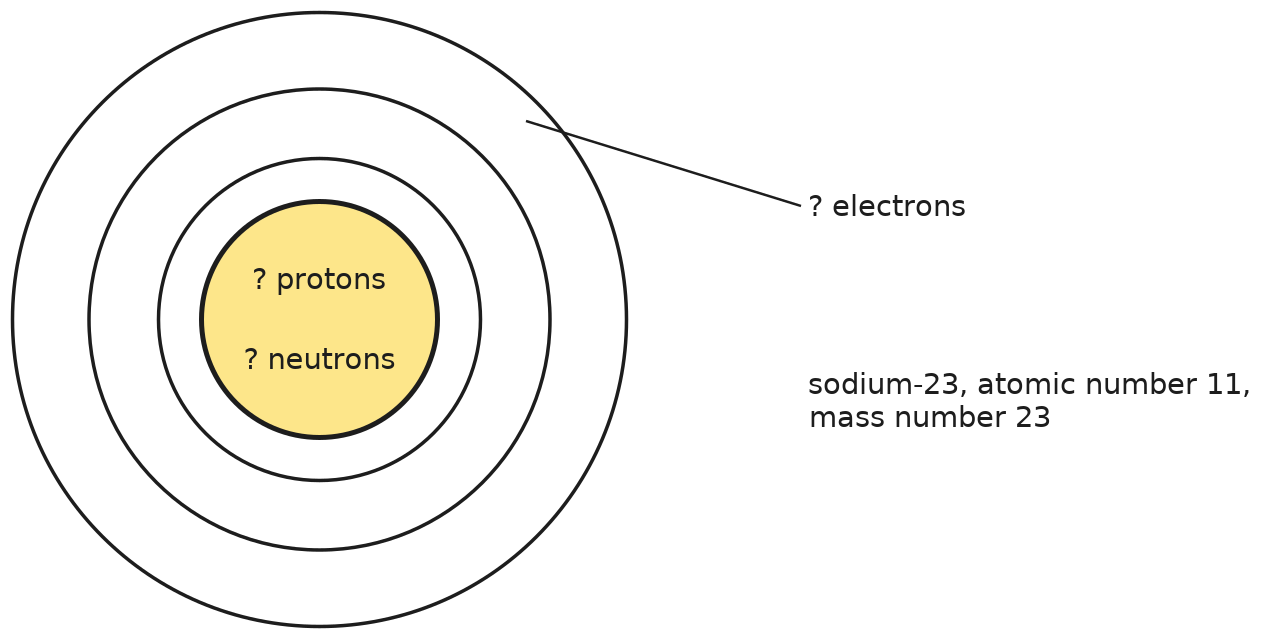
Solution
Protons equal the atomic number: 11
Electrons equal protons in a neutral atom: 11
Neutrons: 23 - 11 = 12
The result is 11 protons, 12 neutrons, 11 electrons.
Nitrogen-14 has atomic number 7 and mass number 14. How many protons, neutrons and electrons does a neutral nitrogen-14 atom have?
An atom has 8 protons and 8 neutrons. What is its mass number?
An atom has mass number 19 and 10 neutrons. How many protons does it have?
Two atoms have the same atomic number but different mass numbers. What are they called?
What does the atomic number tell you?
What does the mass number tell you?
How do you find the number of neutrons in an atom?
What identifies an element?
A neutral atom has 9 protons. How many electrons does it have?
An atom has atomic number 8 and mass number 18. How many neutrons does it have?
Your score: 0 / 10
1. 7 protons, 7 neutrons, 7 electrons
2. 16
3. 9
4. Isotopes
5. The number of protons
6. Protons plus neutrons
7. Mass number minus atomic number
8. Its atomic number
9. 9
10. 10