1
Describe a nitrogen atom with 7 protons, 7 neutrons and 7 electrons. Where is each particle, and what is the overall charge?
SCIENCE FOUNDATIONS
This document was made by AI and there may be mistakes. If a question or answer looks wrong, use the Flag a mistake button to let Brett know so he can fix it.
This is how you explain what everything around you is made of, from the air you breathe to the phone in your hand, by the tiny particles inside each atom. Every atom has protons and neutrons in its centre and electrons moving around them, and the number of protons decides which element it is. The air, the water, and the metal in your phone are all built from the same three particles, just put together in different numbers. Once you know the particles, the whole material world starts to make sense as different arrangements of the same small pieces.
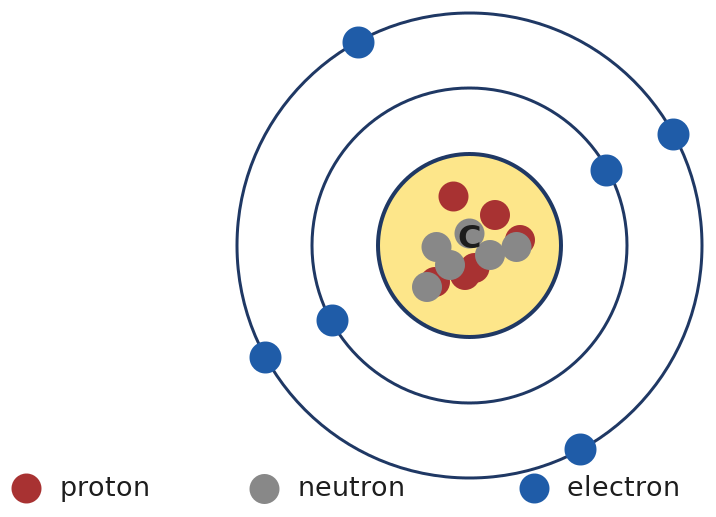
A carbon atom has 6 protons, 6 neutrons,
Solution
This is a where-are-the-particles question: name each particle and where it sits, then the charge, then the mass number.
Nucleus: 6 protons (+) and 6 neutrons (no charge).
Around the nucleus: 6 electrons (−), 2 in the first shell and 4 in the second.
Charge: 6 (+) and 6 (−) balance, so the atom is neutral.
Mass number = 6 + 6 = 12
The result is neutral carbon atom, mass number 12.
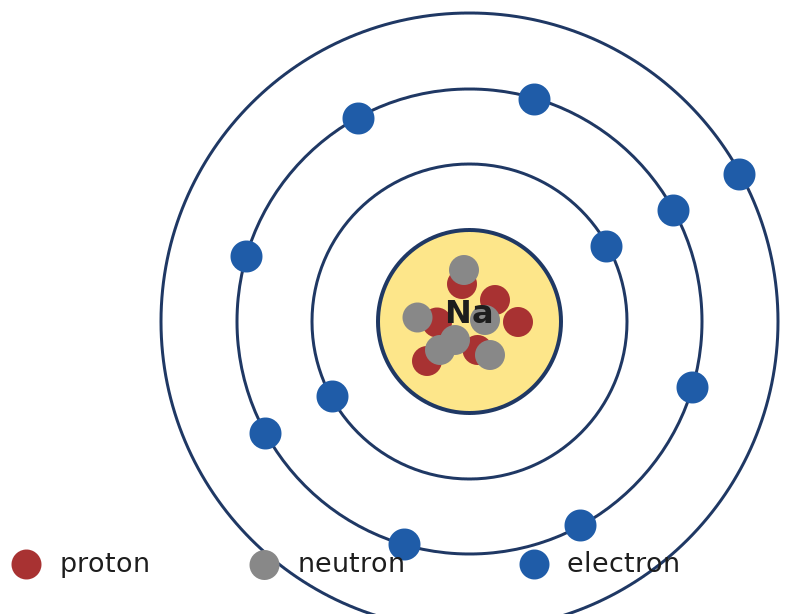
A sodium atom has 11 protons, 12 neutrons, and
Solution
Nucleus: 11 protons (+) and 12 neutrons (no charge).
Around the nucleus: 11 electrons (−), 2 in the first shell, 8 in the second, and 1 in the third.
Charge: 11 (+) and 11 (−) balance, so the atom is neutral.
Mass number = 11 + 12 = 23
The result is neutral sodium atom, mass number 23.
Describe a nitrogen atom with 7 protons, 7 neutrons and 7 electrons. Where is each particle, and what is the overall charge?
An atom has 8 protons and 10 electrons. What is its overall charge?
How many electrons are in the first shell of a potassium atom?
An atom has 12 protons and 12 neutrons. What is its mass number?
Charge of a proton?
Charge of a neutron?
Charge of an electron?
Which particles give an atom most of its mass?
An atom has 6 protons and 6 electrons. What is its charge?
Where are electrons found in an atom?
Your score: 0 / 10
1. 7 protons and 7 neutrons in the nucleus, 7 electrons around the nucleus, neutral
2. Negative
3. 2
4. 24
5. Positive
6. No charge
7. Negative
8. Protons and neutrons
9. Neutral
10. Around the nucleus