1
A 5 kg ball drops from 20 m. What is its speed at the ground? Ignore air resistance and use g = 9.8 m/s²
m/s
SCIENCE FOUNDATIONS
This document was made by AI and there may be mistakes. If a question or answer looks wrong, use the Flag a mistake button to let Brett know so he can fix it.
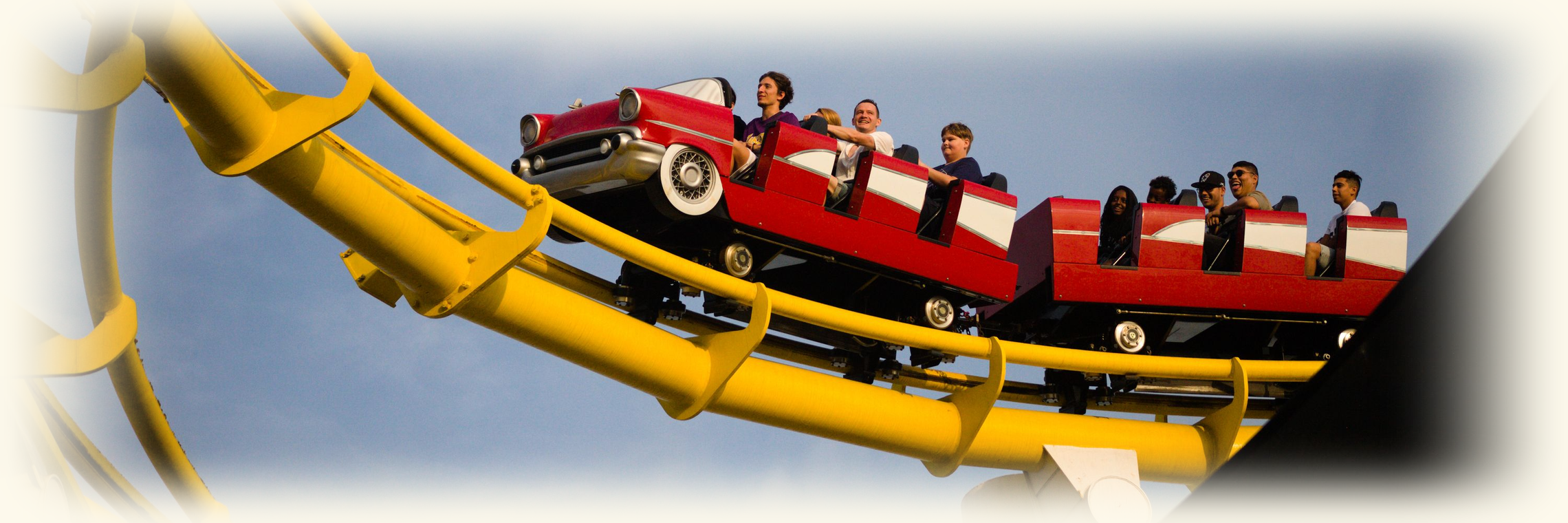
This is how you explain that energy never disappears, like a roller coaster trading height for speed and back again, with some energy always ending up as heat. A hydro dam turns the energy of falling water into electricity, and a phone battery slowly turns its stored energy into heat and light. Nothing creates energy from nothing, so an engineer has to account for where every bit of it goes. Knowing this tells you why a machine can never give back more energy than you put into it.
Conservation of energy: energy cannot be created or destroyed, it can only change form.
In a closed system (one where no energy comes in or goes out) the total energy stays the same, so the energy at the start equals the energy at the end.
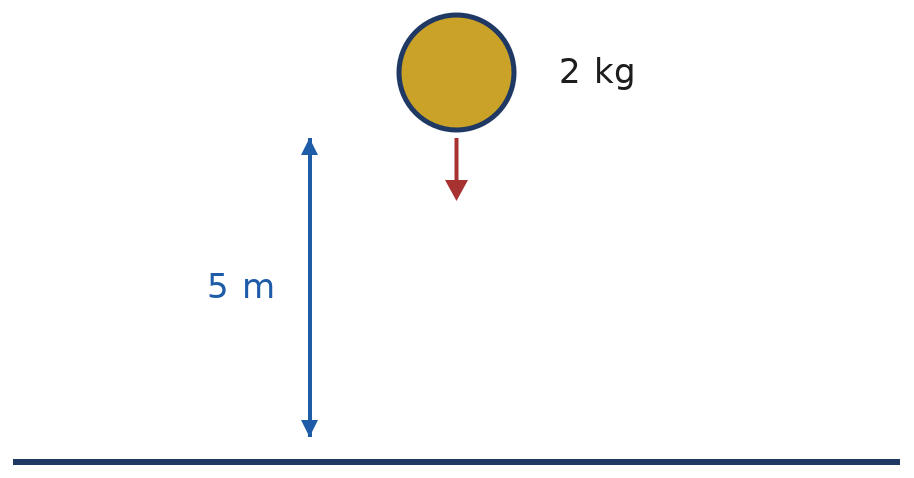
A 2 kg ball drops
Solution
Start energy: potential only, mass times g times height:
2 × 9.8 × 5 = 98 J
End energy: kinetic only, one half of mass times v²:
12 × 2 × v². One half of 2 is 1, so this is just v².
Set equal:
v² = 98
v = 98square root of 98 = 9.9 m/s
The result is speed about 9.9 m/s.
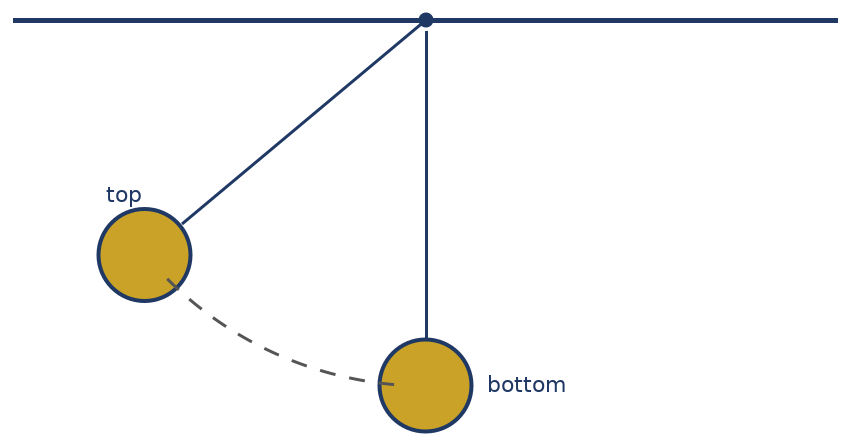
A pendulum swings: what happens to energy at the top and bottom?
Solution
At the top: height is greatest, so potential energy is greatest, speed is zero.
At the bottom: height is lowest, so kinetic energy is greatest.
Total stays the same throughout the swing.
The result is potential greatest at top, kinetic greatest at bottom.
A 5 kg ball drops from 20 m. What is its speed at the ground? Ignore air resistance and use g = 9.8 m/s²
A 1 kg ball drops from 10 m. How much gravitational potential energy does it lose by the time it reaches the ground? Use g = 9.8 m/s².
A 4 kg ball is moving at 5 m/s. What is its kinetic energy?
A pendulum swings from side to side. At which point is it moving fastest?
A child on a swing is at the highest point. Which energy is greatest there, and which is greatest at the lowest point?
Conservation of energy in one line?
Does total energy change in a closed system?
Where does friction energy go?
A ball at rest at height: which energy does it have?
Which of these is an example of energy changing from kinetic to potential?
Your score: 0 / 10
1. 19.8m/s
2. 98 J
3. 50J
4. At the bottom of the swing
5. Potential at the top, kinetic at the bottom
6. Total energy stays constant
7. No
8. Heat
9. Potential
10. A ball rolling up a hill and slowing down