1
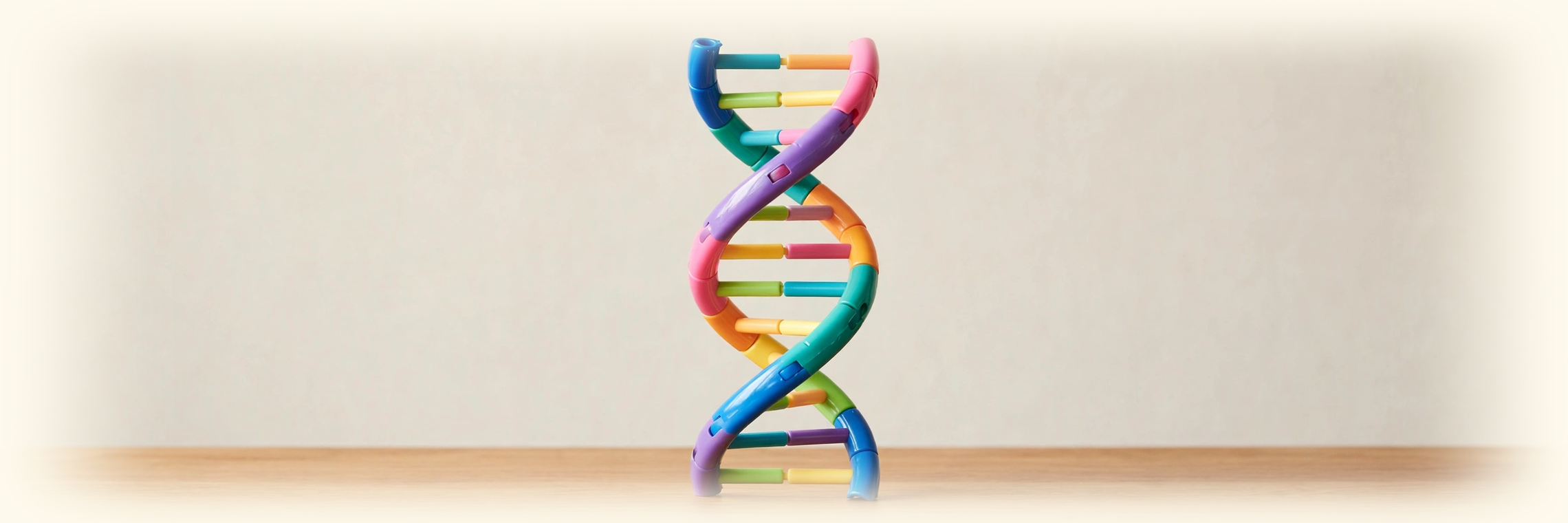
DNA shape?
SCIENCE FOUNDATIONS
This document was made by AI and there may be mistakes. If a question or answer looks wrong, use the Flag a mistake button to let Brett know so he can fix it.
This is how the instructions for building and running your body are stored, in a twisted ladder of code that is copied every time a cell divides. The order of the code letters is what makes your instructions different from anyone else's. A forensic lab uses those differences to match a DNA sample to a person. Knowing the structure tells you how so much information fits into something so small, and how it can be read and copied reliably.
Write the complementary strand for A T C G.
Solution
Pair each base: A with T, T with A, C with G, G with C.
Write the partners in order: T A G C.
Check: every pair follows A-T and C-G.
The result is complementary strand T A G C.
Write the complementary strand for G G A T.
Solution
Pair each base: G with C, G with C, A with T, T with A.
Write the partners in order: C C T A.
Check: every pair follows the rules.
The result is complementary strand C C T A.
DNA shape?
A pairs with what?
What holds the two strands of DNA together?
Complementary strand for C A T G?
A DNA strand reads T T C G. What was the original strand it pairs with?
Backbone made of what?
What carries instructions?
How many strands in DNA?
What is a base?
Adenine, thymine, cytosine, guanine: what are they?
Your score: 0 / 10
1. Double helix
2. Thymine
3. The base pairs
4. G T A C
5. A A G C
6. Sugar and phosphate
7. The base sequence
8. Two
9. A letter unit in the DNA sequence
10. The four DNA bases