
1
How many electrons does the first shell hold?
SCIENCE FOUNDATIONS
This document was made by AI and there may be mistakes. If a question or answer looks wrong, use the Flag a mistake button to let Brett know so he can fix it.
This is how you predict whether two elements will react or sit quietly side by side, because only the electrons in the outer shell take part in the reaction. A chemist knows sodium reacts violently with water while neon does nothing, just from how their outer shells are filled. A jeweller counts on gold's full outer shell to explain why it never tarnishes. Knowing electron shells tells you why elements behave the way they do, instead of having to memorise each one separately.
Electron shells and configurations: electrons fill shells from the inside out, lowest energy first.
The first shell holds at most 2 electrons, the second at most 8, and the third at most 8. The electrons in the outermost shell are the valence electrons.
Write the electron configuration of oxygen

Solution
Fill the first shell: 2 electrons.
Fill the second shell with the rest: 6 electrons.
Write it shell by shell: 2, 6
The result is 2, 6.
Write the electron configuration of sodium
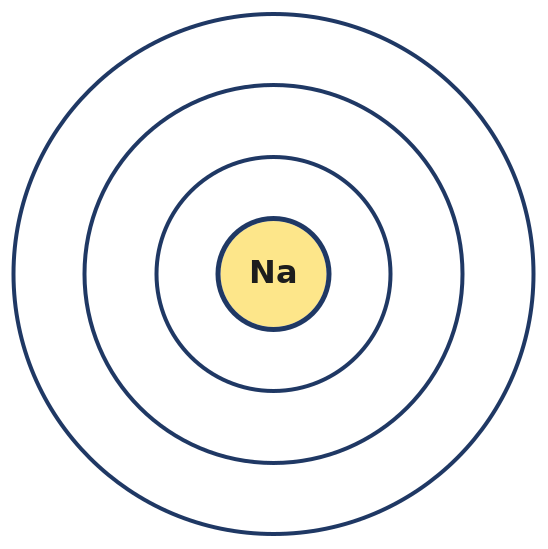
Solution
Fill the first shell: 2 electrons.
Fill the second shell: 8 electrons, leaving 1.
Put the last electron in the third shell: 2, 8, 1
The result is 2, 8, 1.
How many electrons does the first shell hold?
How many does the second shell hold?
Nitrogen has 7 electrons. Configuration?
Which element has the electron configuration 2, 8, 1?
Why does neon not react with other elements?
How many outer electrons does oxygen have?
Chlorine has 17 electrons. How many more electrons does it need to fill its outer shell?
Which shell fills first?
Which of these has a full outer shell?
What are outer shell electrons called?
Your score: 0 / 10
1. 2
2. 8
3. 2,5
4. Sodium
5. Its outer shell is full
6. 6
7. 1
8. The first (innermost) shell
9. Neon (2, 8)
10. Valence electrons