
1
Acceleration of free fall near Earth?
SCIENCE FOUNDATIONS
This document was made by AI and there may be mistakes. If a question or answer looks wrong, use the Flag a mistake button to let Brett know so he can fix it.
This is how you work out how fast a dropped phone is moving when it hits the ground, or how long a skydiver falls before the parachute opens. A construction worker knows that a dropped tool speeds up the whole way down, which is why a hard hat matters even for a short drop. An engineer designing a crash test dummy drop needs to know the speed at impact before choosing the padding. Knowing free fall tells you why the height of the drop matters so much more than the weight of what falls.
Free fall: in free fall near Earth, everything accelerates downward at 9.8 m/s², no matter its mass, when air resistance is ignored.
A dropped object starts with velocity zero, and its velocity grows by 9.8 m/s every second.
A ball is dropped from rest. Velocity after

Solution
List knowns: u is 0, a is 9.8 downward, t is 2.
Use:
v = u + a × t
Substitute:
v = 0 + 9.8 × 2 = 19.6 m/s downward
The result is velocity 19.6 m/s downward.
A ball is dropped from rest. Distance fallen in 2 s?
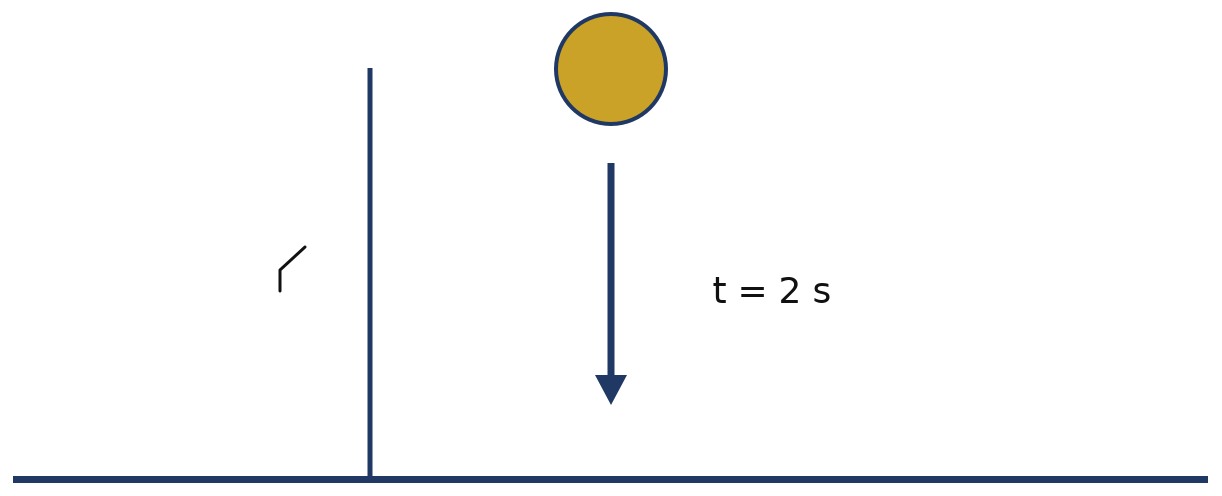
Solution
List knowns: u is 0, a is 9.8, t is 2.
Use:
s = 12 × a × t² (u = 0)
Substitute:
s = 12 × 9.8 × 4 = 19.6 m
The result is distance 19.6 m.
Acceleration of free fall near Earth?
Dropped from rest: initial velocity?
Velocity after 3 s of free fall?
Distance fallen in 3 s of free fall?
Does mass affect free fall acceleration (ignoring air)?
A ball is dropped from rest and hits the ground at 29.4 m/s. How long did it fall?
A ball is dropped from rest. It falls 19.6 m. How long did it fall?
What is ignored in ideal free fall?
A ball thrown up: acceleration at the top?
Velocity at the top of a throw?
Your score: 0 / 10
1. 9.8 m/s² downward
2. 0
3. 29.4 m/s downward
4. 44.1
5. No
6. 3
7. 2
8. Air resistance
9. 9.8 m/s² downward
10. 0