
1
Boyle's law: what is constant?
SCIENCE FOUNDATIONS
This document was made by AI and there may be mistakes. If a question or answer looks wrong, use the Flag a mistake button to let Brett know so he can fix it.
This is how you explain why a car tire reads higher pressure on a hot afternoon, or why a spray can warns you never to heat it. A diver knows that air squeezed into a tank at depth takes up much less space than it does at the surface. A baker watches dough rise as warm gas expands inside it. Knowing gas laws tells you how pressure, volume, and temperature push each other around, so you can predict what a gas will do before you heat it, squeeze it, or let it expand.
Gas laws: Boyle's law, P1 × V1 = P2 × V2 at fixed temperature; Charles's law, V1T1 = V2T2 at fixed pressure; and the combined gas law, P1V1T1 = P2V2T2.
Temperature must be in kelvin.
A gas at 100 kPa
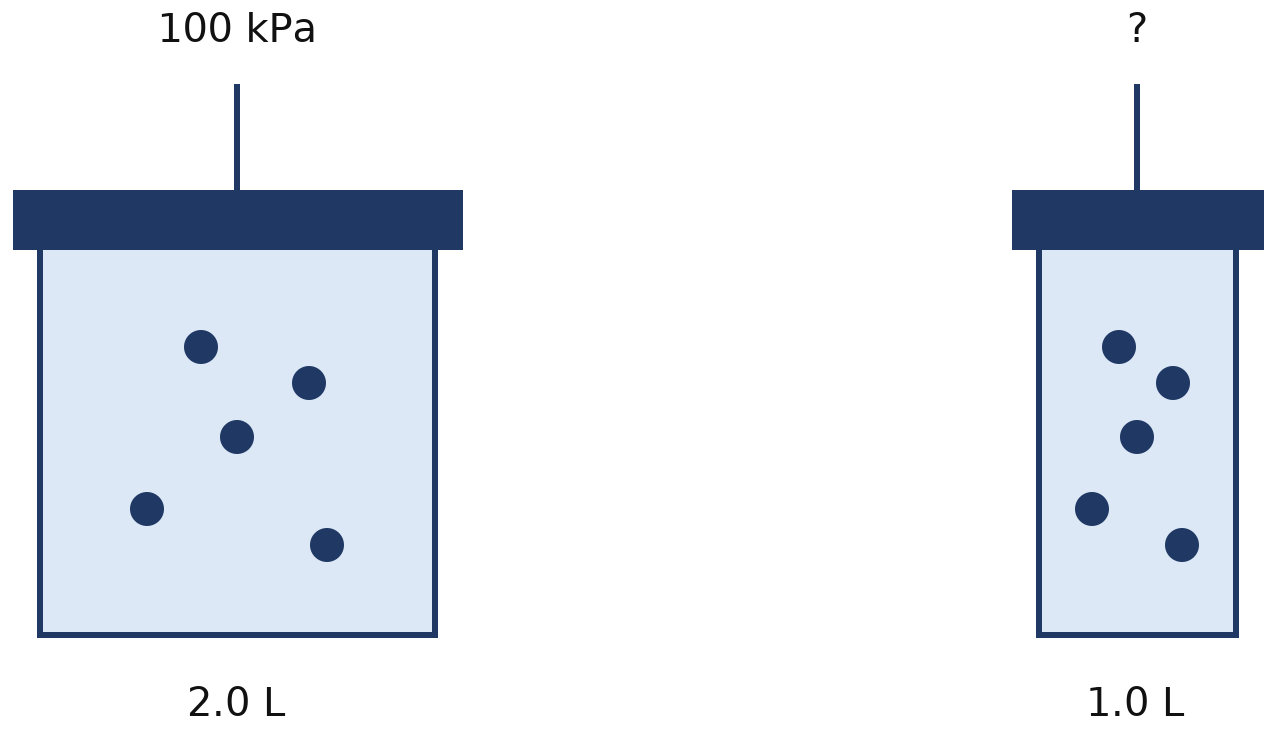
Solution
Use Boyle:
P1 × V1 = P2 × V2
Substitute:
100 × 2.0 = P2 × 1.0
Solve:
P2 = 200 kPa
The result is 200 kPa.
A gas at 300 K
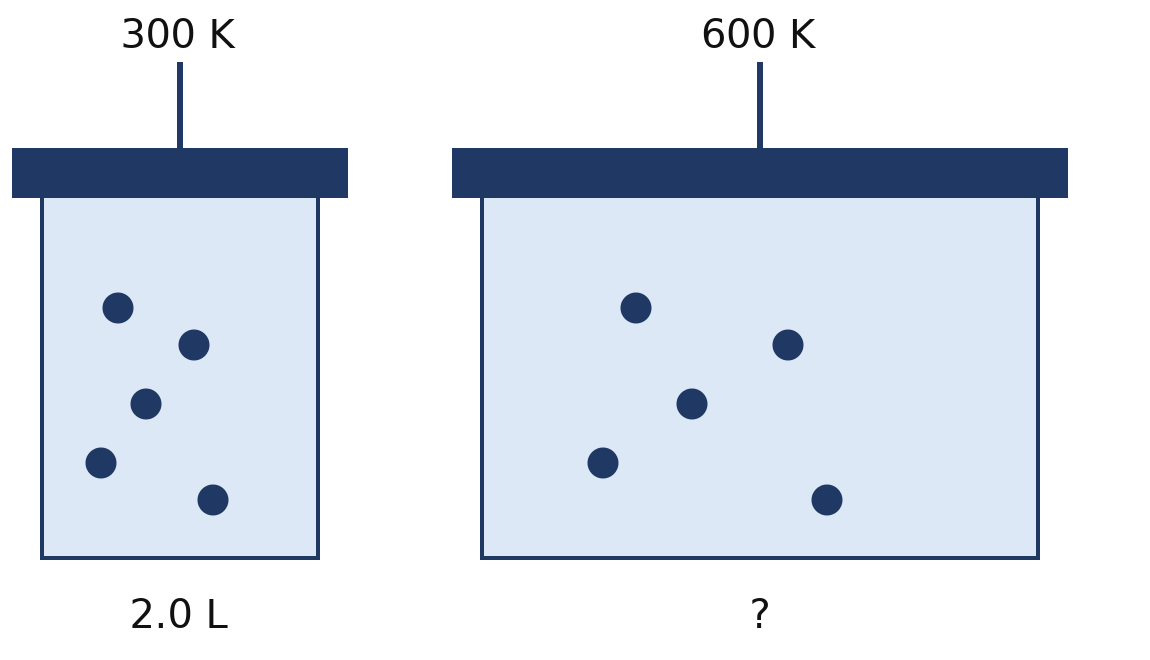
Solution
Use Charles: V1T1 = V2T2
Substitute: 2.0300 = V2600
Solve:
V2 = 4.0 L
The result is 4.0 L.
Boyle's law: what is constant?
Charles's law: what is constant?
150 kPa, 2.0 L compressed to 1.0 L: new pressure?
300 K, 3.0 L heated to 600 K: new volume?
Temperature must be in what unit?
If pressure doubles at fixed temperature, volume does what?
If temperature doubles in kelvin at fixed pressure, volume does what?
Combined gas law equation?
Convert 27 degrees C to kelvin.
A gas expands from 1.0 L to 2.0 L at fixed temperature. Pressure becomes?
Your score: 0 / 10
1. Pressure times volume
2. Volume divided by temperature
3. 300
4. 6.0
5. Kelvin
6. Halves
7. Doubles
8. P1V1T1 = P2V2T2
9. 300
10. Half the original