1
Half-life definition?
SCIENCE FOUNDATIONS
This document was made by AI and there may be mistakes. If a question or answer looks wrong, use the Flag a mistake button to let Brett know so he can fix it.
This is how doctors work out how long a medicine or a radioactive tracer stays active in your body, and how scientists date ancient bones and rocks. A nuclear medicine tech times a scan so the tracer is still strong enough to show up but fades away soon after. An archaeologist dates a piece of charcoal by how much of its carbon has already decayed. Knowing half-life tells you how fast something fades, and how long to wait before it is effectively gone.
Half-life calculations: a half-life is the time for half of a sample to decay.
After each half-life, half of what was left remains, so after two half-lives 14 remains and after three half-lives 18 remains.
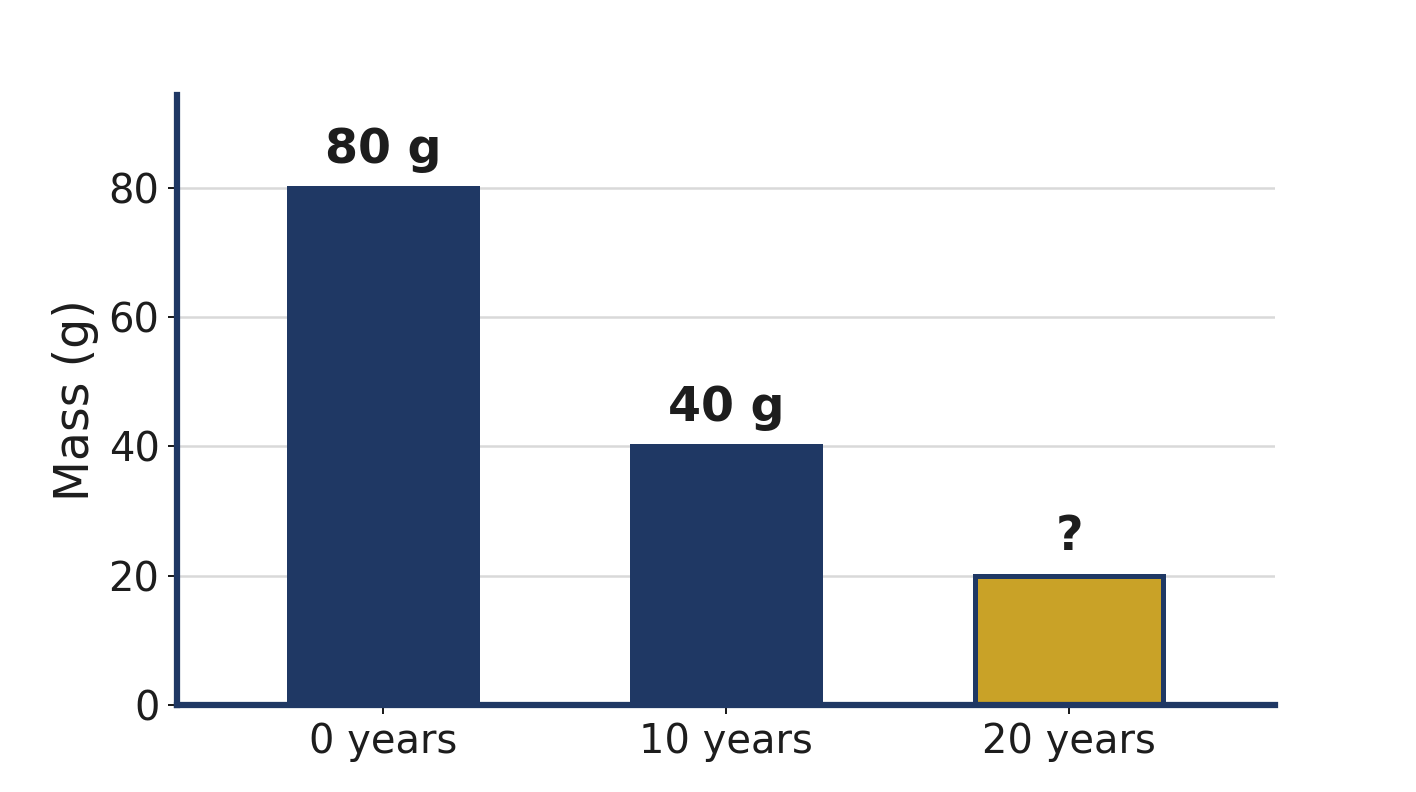
A sample of 80 g has a half-life
Solution
Count half-lives:
20 ÷ 10 = 2 half-lives
Halve step by step: 80 to 40 after one, 40 to 20 after two.
State the remaining mass.
The result is 20 g remains.
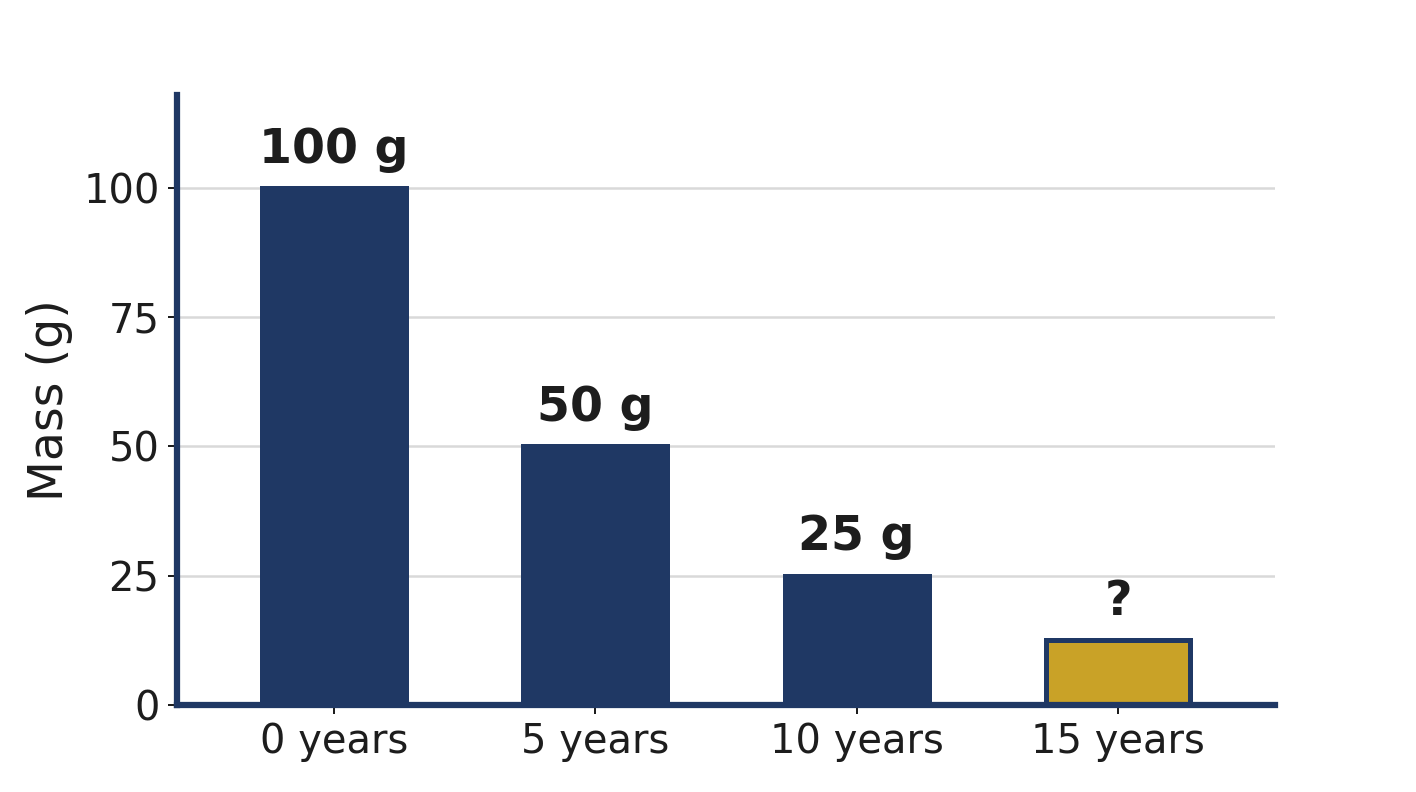
A sample of 100 g has a half-life
Solution
Count half-lives:
15 ÷ 5 = 3 half-lives
Halve step by step: 100 to 50, to 25, to 12.5.
State the remaining mass.
The result is 12.5 g remains.
Half-life definition?
120 g, half-life 8 years, after 24 years?
A sample has a half-life of 6 years. How many half-lives pass in 18 years?
After one half-life, what fraction remains?
A sample of 64 g decays to 16 g. How many half-lives have passed?
A sample has a half-life of 4 days. How long until only one eighth of it remains?
A sample decays from 200 g to 25 g. Its half-life is 2 hours. How long did that take?
After 3 days, 6.25 g remains from a 50 g sample. What is the half-life?
Does half-life depend on sample size?
A sample of 80 g has a half-life of 10 years. After 40 years, what fraction of the original sample remains?
Your score: 0 / 10
1. The time for half of a sample to decay
2. 15 g
3. 3
4. One half
5. 2
6. 12 days
7. 6 hours
8. 1 day
9. No
10. 116