1
H2 + Cl2 -> 2HCl is at equilibrium. More Cl2 is added. Which way does the equilibrium shift, and does more or less HCl form?
SCIENCE FOUNDATIONS
This document was made by AI and there may be mistakes. If a question or answer looks wrong, use the Flag a mistake button to let Brett know so he can fix it.
This is how factories squeeze more ammonia fertiliser out of a reaction, by changing the pressure or removing product so the balance shifts toward making more of it. When a reaction is pushed out of balance, it shifts to fight the change, like a see-saw tipping back toward level. A winemaker uses the same idea to stop a fermentation from going too far. Knowing Le Chatelier's principle tells you which knob to turn when you want more product, and what will happen if conditions change on their own.
Le Chatelier's principle: when a system at equilibrium is disturbed, it shifts to undo the change.
Adding a reactant shifts the equilibrium toward the products, and raising the pressure shifts it toward the side with fewer gas molecules. A catalyst speeds up both directions and does not change the equilibrium position.
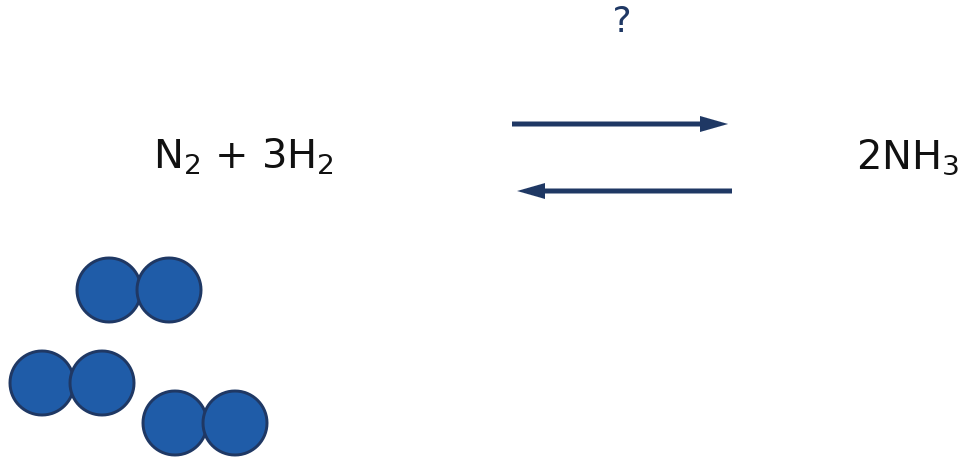
N2 + 3H2 -> 2NH3 at equilibrium: what happens if more N2 is added?
Solution
Name the disturbance: more reactant added.
Apply the rule: the system shifts to use up the added reactant.
Direction: toward products, making more ammonia.
The result is shift right, more ammonia forms.
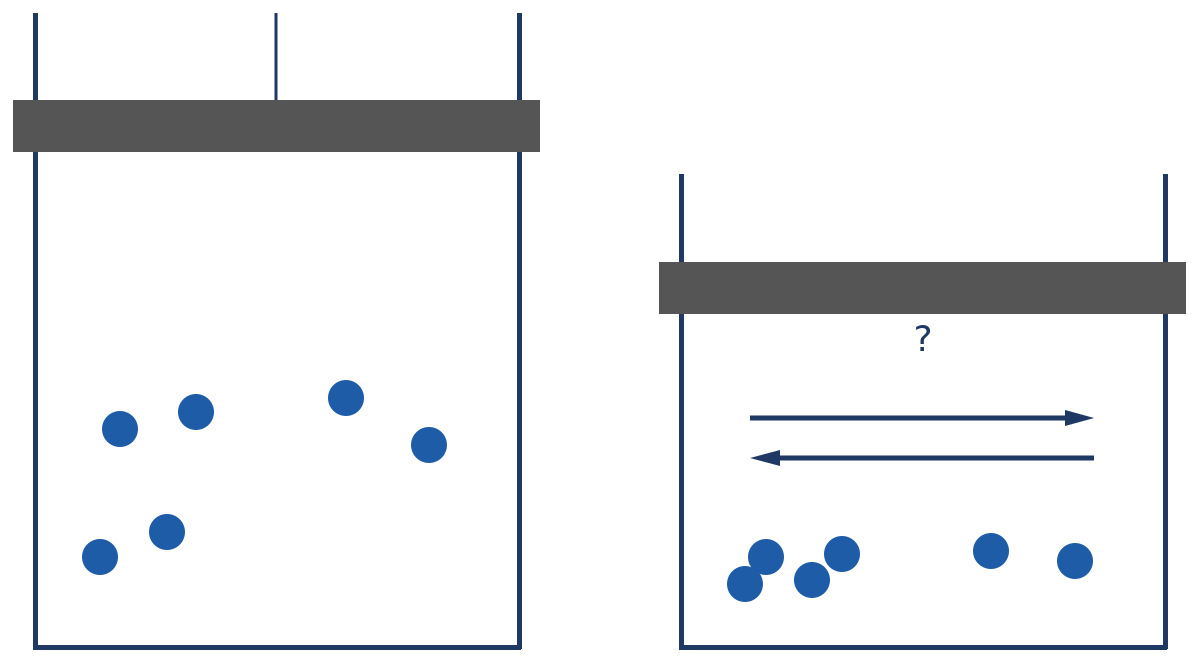
Same reaction: what happens if pressure is raised?
Solution
Count gas molecules: left has 4, right has 2.
Raising pressure favours the side with fewer gas molecules.
Direction: toward products.
The result is shift right, more ammonia forms.
H2 + Cl2 -> 2HCl is at equilibrium. More Cl2 is added. Which way does the equilibrium shift, and does more or less HCl form?
H2 + Cl2 -> 2HCl is at equilibrium. More HCl is added. Which way does the equilibrium shift, and does more or less HCl form?
2SO2 + O2 -> 2SO3 is at equilibrium. The pressure is raised. Which way does the equilibrium shift, and why?
2SO2 + O2 -> 2SO3 is at equilibrium. The pressure is lowered. Which way does the equilibrium shift, and why?
N2 + 3H2 -> 2NH3 is at equilibrium and the forward reaction is exothermic. The temperature is raised. Which way does the equilibrium shift?
H2 + I2 -> 2HI is at equilibrium. Some HI is removed. Which way does the equilibrium shift?
In one line, what does Le Chatelier's principle say a system at equilibrium does when it is disturbed?
Does adding a catalyst change the equilibrium position? Explain.
H2 + I2 -> 2HI is at equilibrium. The pressure is raised. Which way does the equilibrium shift, and why?
For N2 + 3H2 -> 2NH3 at equilibrium, the pressure is raised and more N2 is added at the same time. Which way does the equilibrium shift? Explain.
Your score: 0 / 10
1. Shift right, more HCl forms
2. Shift left, less HCl forms
3. Shift right, the right side has fewer gas molecules (2 versus 3)
4. Shift left, the left side has more gas molecules (3 versus 2)
5. Shift left, toward the endothermic side
6. Shift right, toward products
7. It shifts to partly undo the disturbance
8. No, it only speeds up reaching equilibrium
9. No shift, both sides have the same number of gas molecules (2 versus 2)
10. Shift right, both changes favour the product side