1
A ruler is marked every 1 mm. A length measures 15.7 cm. What is the uncertainty, and how is the length reported?
SCIENCE FOUNDATIONS
This document was made by AI and there may be mistakes. If a question or answer looks wrong, use the Flag a mistake button to let Brett know so he can fix it.
This is how you report a measurement honestly, like the length of a board cut for a shelf, by saying how far off the reading could be instead of pretending it is exact. A carpenter who cuts a board to 60 centimetres knows the tape might be off by a millimetre either way, and plans the joint with that in mind. A pharmacist weighing a dose reports the range the scale can actually guarantee. Knowing measurement and uncertainty tells you how much to trust a number, and when a tiny difference is real or just the wobble of the tool.
Measurement and uncertainty: uncertainty = smallest division of the instrument2.
A ruler marked every millimetre has an uncertainty of 0.5 mm, and a finer scale always gives a smaller uncertainty.
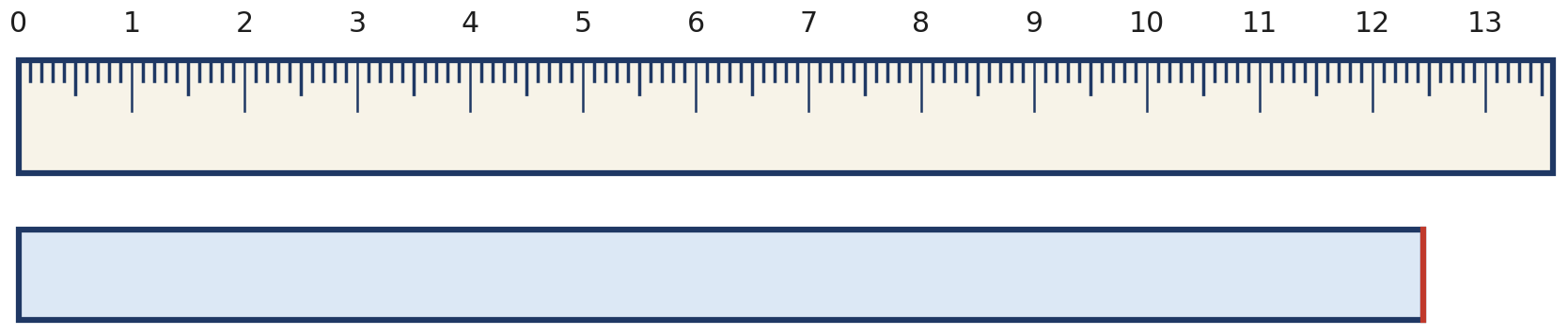
Read a ruler marked every millimetre: length
Solution
Find the smallest division: 1 mm, which is 0.1 cm.
Take half of it as the uncertainty:
0.1 ÷ 2 = 0.05 cm
Write the result as 12.4 cm, ±0.05 cm.
The result is 12.4 cm ±0.05 cm.
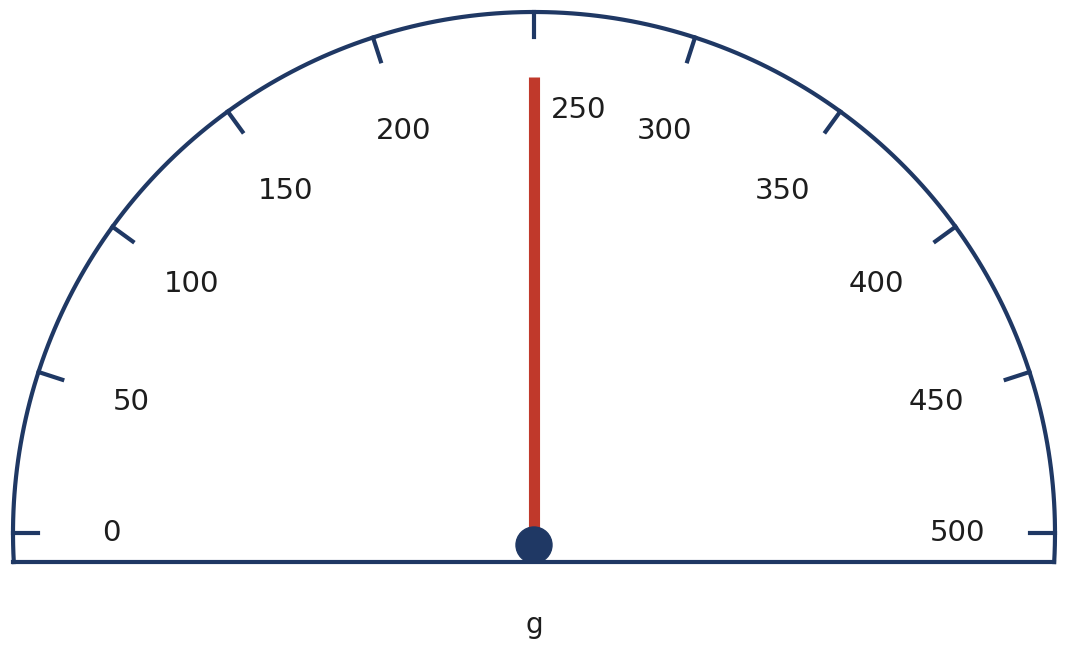
Read a balance to the nearest gram: mass
Solution
Find the smallest division: 1 g.
Take half of it as the uncertainty:
1 ÷ 2 = 0.5 g
Write the result as 250 g, ±0.5 g.
The result is 250 g ±0.5 g.
A ruler is marked every 1 mm. A length measures 15.7 cm. What is the uncertainty, and how is the length reported?
A student measures a board with a ruler marked every 1 mm and records the length as 15.70 cm. Is this reported correctly? Explain.
A mass is reported as 180 g ± 0.5 g. Between which two values could the true mass lie?
A balance reads to the nearest 10 g. One student says the uncertainty is 10 g, and another says it is 5 g. Who is right, and why?
A time is reported as 12.34 s ± 0.005 s. A second timing of the same event gives 12.36 s. Do the two measurements agree? Explain.
Why report uncertainty at all?
Which is more precise: a ruler marked in millimetres or one marked in centimetres?
Thermometer A reads to the nearest 0.5 degrees C and thermometer B reads to the nearest 0.1 degrees C. What are their uncertainties?
What is the smallest division of an instrument?
Can uncertainty ever be zero? Explain.
Your score: 0 / 10
1. Uncertainty 0.05 cm; 15.7 cm ±0.05 cm
2. No, the ruler can only be read to 0.1 cm, so 15.70 cm claims more precision than the ruler gives.
3. 179.5 g and 180.5 g
4. The second student: uncertainty is half the smallest division, 10 ÷ 2 = 5 g.
5. No, 12.36 s lies outside 12.335 s to 12.345 s, so they disagree.
6. To show how much the reading could really vary
7. The millimetre ruler
8. A: 0.25 degrees C, B: 0.05 degrees C
9. The smallest marked step on the instrument
10. No, every instrument has a limit