1
Trace meiosis in a diploid cell with 10 chromosomes. How many cells form, how many chromosomes does each have, and are they identical?
SCIENCE FOUNDATIONS
This document was made by AI and there may be mistakes. If a question or answer looks wrong, use the Flag a mistake button to let Brett know so he can fix it.
This is how a mother and father each pass on half their genetic instructions, so a child gets a unique mix of both parents instead of a copy of either one. Without halving the instructions first, each generation would end up with twice as many as the last. A breeder crossing two plants counts on this shuffling to produce new combinations in the seeds. Knowing meiosis tells you why siblings share parents but are not identical, and why every child is a fresh mix.
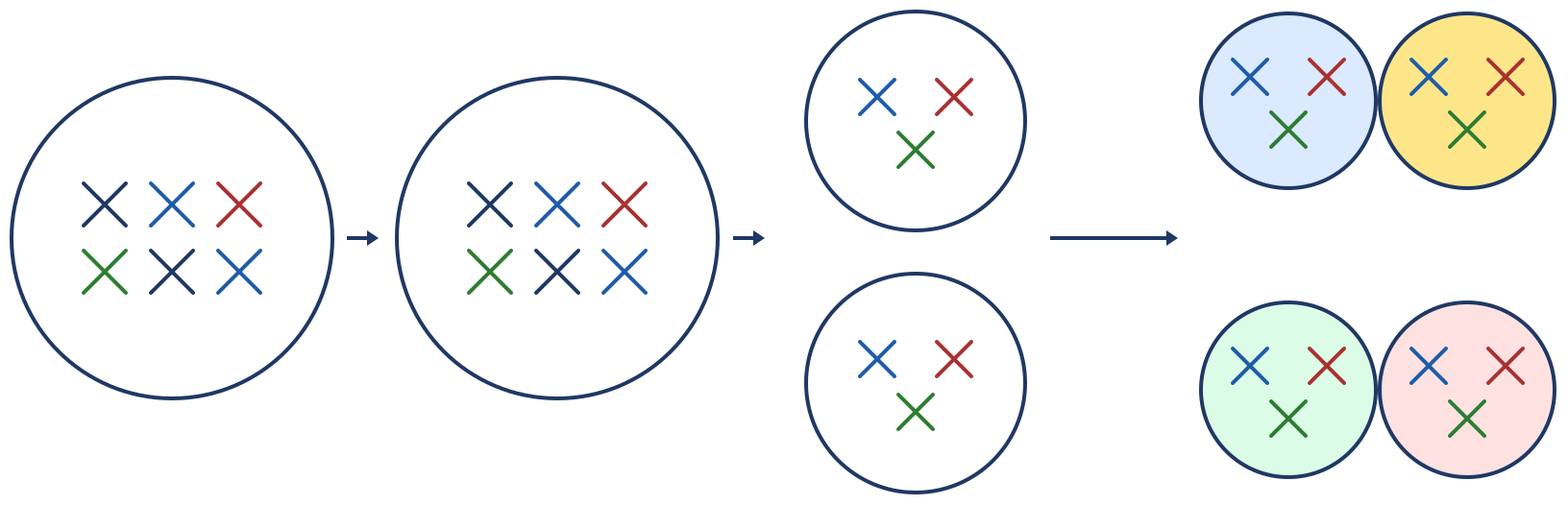
Trace meiosis: one diploid cell with 6 chromosomes.
Solution
Copy first: chromosomes duplicate, still one cell.
Divide twice: first homologous pairs separate, then chromatids separate.
Count: four cells, each with 3 chromosomes, all different.
The result is four haploid cells, each with 3 chromosomes.
How many cells does meiosis make, and are they identical?
Solution
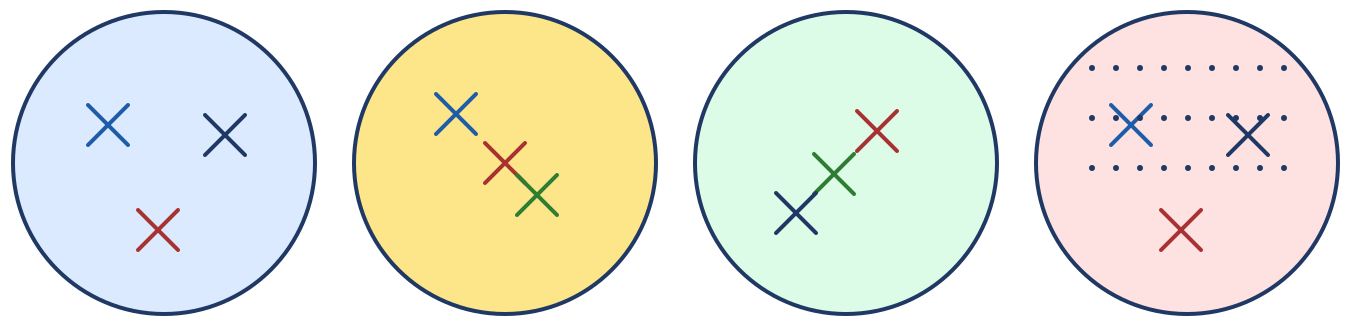
Count the products: meiosis makes four cells.
Compare: crossing over and independent assortment shuffle genes.
Conclude: four different haploid cells.
The result is four genetically different haploid cells.
Trace meiosis in a diploid cell with 10 chromosomes. How many cells form, how many chromosomes does each have, and are they identical?
Trace meiosis in a diploid cell with 8 chromosomes. How many cells form, and how many chromosomes does each have?
Why are the four cells from meiosis genetically different from each other?
How many cells does meiosis make, and are they identical to the parent cell? Explain.
What is crossing over, and when does it happen?
How many divisions are there in meiosis, and how many times are the chromosomes copied?
A diploid cell has 10 chromosomes. After meiosis, how many chromosomes does each gamete have?
Meiosis or mitosis: which makes gametes?
What is a gamete?
A diploid cell has 6 chromosomes. After the first division of meiosis only, how many cells are there, and how many chromosomes does each have?
Your score: 0 / 10
1. Four haploid cells, each with 5 chromosomes, all genetically different
2. Four haploid cells, each with 4 chromosomes
3. Crossing over and independent assortment shuffle the genes
4. Four cells, each with half the parent's chromosome number
5. Exchange of gene sections between homologous chromosomes, in prophase I
6. Two divisions, one chromosome copy step
7. 5
8. Meiosis
9. A haploid sex cell
10. Two cells, each with 3 chromosomes