1
Classify lead, nitrogen, and tellurium as metal, non-metal, or metalloid, giving one property-based reason for each.
SCIENCE FOUNDATIONS
This document was made by AI and there may be mistakes. If a question or answer looks wrong, use the Flag a mistake button to let Brett know so he can fix it.
This is how you pick the right material for a job, like copper wire to carry electricity, a plastic handle that stays cool, or a silicon chip to run a phone. A plumber chooses copper pipe because it carries heat and bends without breaking, while a pot handle is plastic so it stays cool to touch. An engineer picks silicon for a chip because it sits halfway between a conductor and an insulator. Knowing metals, non-metals, and metalloids tells you what a material will do before you build with it.
Metals, non-metals, and metalloids: a metal is shiny, conducts heat and electricity, and can be bent or hammered into shape. A non-metal is dull, a poor conductor, and brittle or a gas.
A metalloid sits on the staircase between metals and non-metals, looks metallic, and conducts poorly. Silicon and boron are metalloids.
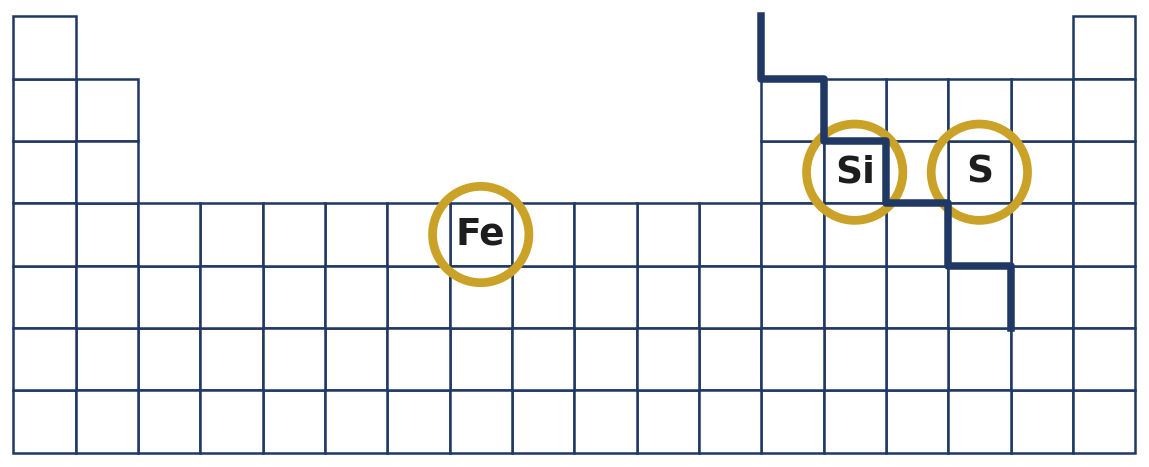
Classify iron, sulfur, and silicon.
Solution
Iron: shiny, conducts, malleable, so a metal.
Sulfur: dull yellow solid, poor conductor, so a non-metal.
Silicon: looks metallic but is a poor conductor, on the staircase, so a metalloid.
The result is iron metal, sulfur non-metal, silicon metalloid.
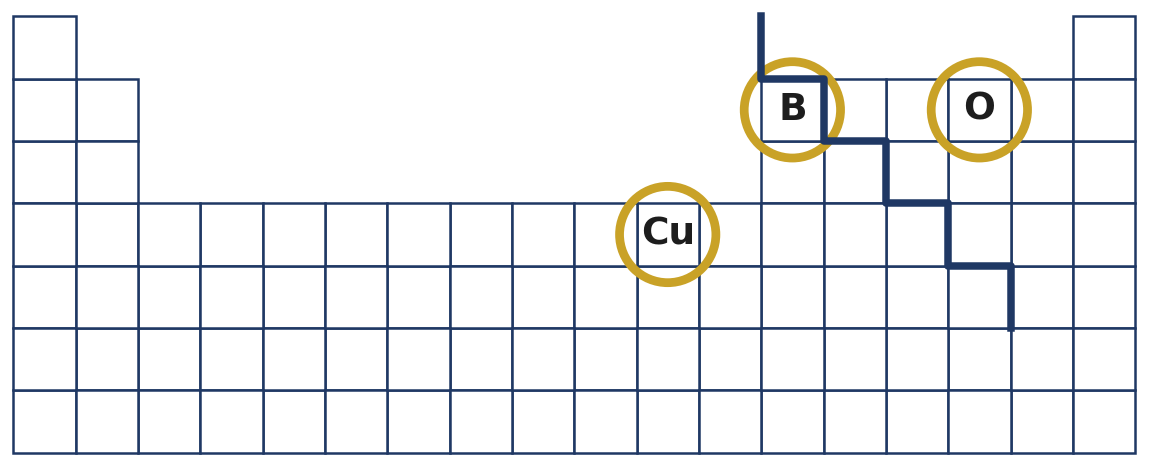
Classify copper, oxygen, and boron.
Solution
Copper: shiny and conducting, so a metal.
Oxygen: a gas, poor conductor, so a non-metal.
Boron: on the staircase with mixed properties, so a metalloid.
The result is copper metal, oxygen non-metal, boron metalloid.
Classify lead, nitrogen, and tellurium as metal, non-metal, or metalloid, giving one property-based reason for each.
A material is shiny, conducts electricity, and can be hammered into a thin sheet. Is it a metal, a non-metal, or a metalloid? Explain.
Why is silicon used to make computer chips instead of copper or sulfur?
Why is copper wire used to carry electricity instead of sulfur?
Name one property of metals.
Name one property of non-metals.
Where are metalloids found on the periodic table?
Do metals tend to lose or gain electrons?
Classify zinc, carbon, and antimony as metal, non-metal, or metalloid.
Is mercury a metal or a non-metal? Give one reason.
Your score: 0 / 10
1. Lead: metal, shiny and conducting; nitrogen: non-metal, a gas and poor conductor; tellurium: metalloid, on the staircase with mixed properties
2. Metal, because it is shiny, conducts, and is malleable.
3. Silicon is a metalloid whose conductivity can be controlled, while copper conducts too well and sulfur hardly conducts at all.
4. Copper is a metal, shiny and conducting, while sulfur is a non-metal, dull and a poor conductor.
5. Shiny, conducts heat and electricity, or malleable
6. Dull, poor conductor, or often a gas or brittle solid
7. Along the staircase line
8. Lose electrons
9. Zinc: metal; carbon: non-metal; antimony: metalloid
10. Metal, because it conducts electricity