1
A substitution changes one base in a codon from CAA to CAG. What happens to the protein, and why?
SCIENCE FOUNDATIONS
This document was made by AI and there may be mistakes. If a question or answer looks wrong, use the Flag a mistake button to let Brett know so he can fix it.
This is how a single change in DNA can give a flower a new colour, make bacteria resist an antibiotic, or sometimes cause a disease that runs in a family. A breeder looking for a new flower colour is hoping for a mutation that changes the pigment. A doctor tracking an outbreak watches for mutations that let a virus spread more easily. Knowing mutations tells you where new traits come from, why most changes are harmless, and why a few of them matter a great deal.
A substitution changes one base in a codon. What may happen?
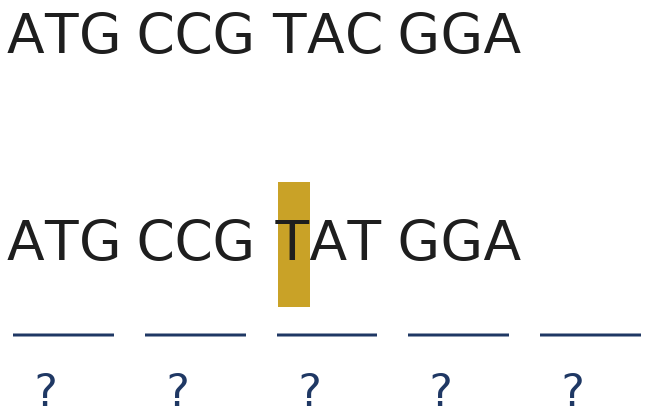
Solution
Read the codon before and after the swap.
Check the codon table: the new codon may call the same or a different amino acid.
Conclude: the protein may stay the same or change.
The result is same amino acid, or a different one, depending on the codon.
An insertion adds one base early in a gene. What may happen?
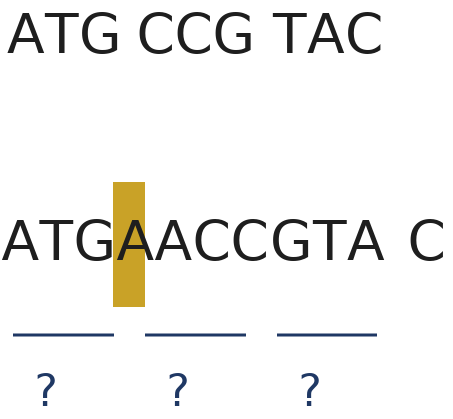
Solution
Count the shift: every codon after the insertion moves by one base.
The reading frame shifts, so later amino acids change.
Conclude: the protein is often badly changed.
The result is frameshift, later amino acids mostly changed.
A substitution changes one base in a codon from CAA to CAG. What happens to the protein, and why?
A substitution changes one base in a codon, and the new codon still calls the same amino acid. What happens to the protein?
An insertion adds three bases in the middle of a gene. What happens to the reading frame and the protein?
A deletion removes one base early in a gene. What happens to the reading frame and the protein?
What is a mutation?
What is a substitution?
What is a frameshift?
Can a mutation be harmless? Give a reason. Use the codon-change diagram.
Can a mutation ever be helpful?
A substitution changes a codon so it now calls a different amino acid. What happens to the protein?
Your score: 0 / 10
1. The protein stays the same, because CAA and CAG both call glutamine
2. The protein stays the same.
3. The reading frame stays in step, so one extra amino acid is added
4. The reading frame shifts, so later amino acids mostly change
5. A change in the DNA sequence
6. One base swapped for another
7. A shift in the reading frame, caused by an insertion or deletion
8. Yes, if it does not change the amino acid
9. Rarely, yes
10. The protein changes at that position.