1
A population has 70 births, 45 deaths, 20 immigrants, and 5 emigrants. What is the net change? Show the gains and losses.
SCIENCE FOUNDATIONS
This document was made by AI and there may be mistakes. If a question or answer looks wrong, use the Flag a mistake button to let Brett know so he can fix it.
This is how wildlife managers decide how many deer a forest can support, or how many fish can be caught each year without the stock collapsing. A town that allows too many deer to be hunted one year can find the herd takes years to recover. A fishery that sets its catch limit above what the stock can replace watches the catch shrink year after year. Knowing population dynamics tells you how births, deaths, and food supply balance out, and why taking too much today leaves too little tomorrow.
A population has
Solution
Net change = births + immigration - deaths - emigration
Add gains:
50 + 10 = 60
Add losses:
30 + 5 = 35
Subtract:
60 - 35 = 25
The result is net change +25.
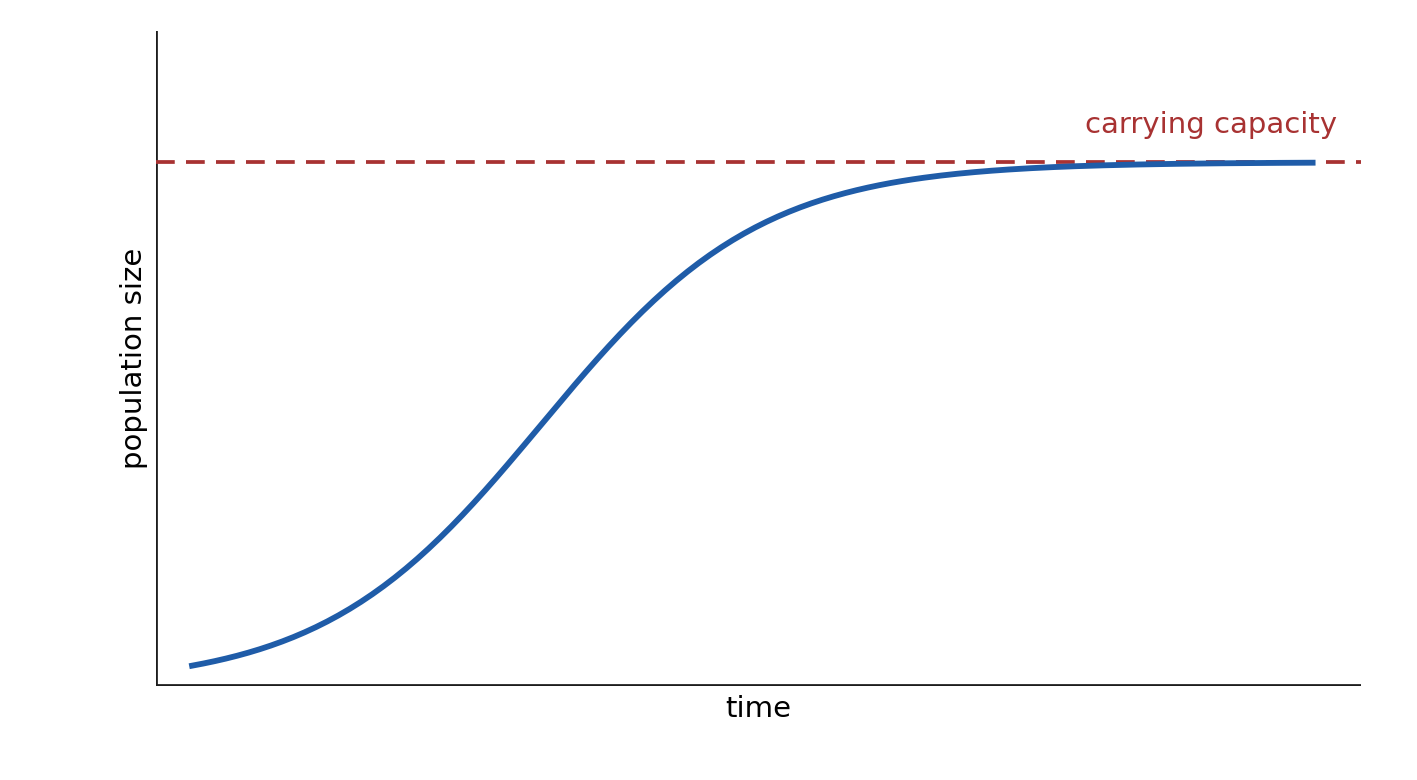
What happens as a population nears carrying capacity?
Solution
Recall the limit: food and space run short.
Growth slows as limiting factors bite.
Conclude: the population levels off near carrying capacity.
The result is growth slows and levels off.
A population has 70 births, 45 deaths, 20 immigrants, and 5 emigrants. What is the net change? Show the gains and losses.
A population grew by 30 in a year. It had 50 births, 20 deaths, and 10 immigrants. How many emigrants were there?
Which change would make a population shrink?
A rabbit population is near the carrying capacity of its meadow. What will happen to its growth, and why?
A disease spreads faster when deer are crowded together. Is disease a density-dependent or a density-independent limiting factor?
What is carrying capacity?
Name a limiting factor.
If births exceed deaths, does the population grow or shrink?
What is the formula for population change?
With unlimited resources, what shape does population growth take?
Your score: 0 / 10
1. Gains 90, losses 50, net change +40
2. 10 emigrants
3. Births fall and deaths rise
4. Growth slows and levels off, because food and space run short
5. Density-dependent
6. The largest population an area can support
7. Food
8. Grow
9. Births plus immigration minus deaths minus emigration
10. Rapid (exponential) growth