
1
A ball is thrown horizontally at 12 m/s from a cliff and falls for 3 s. How far does it travel horizontally?
SCIENCE FOUNDATIONS
This document was made by AI and there may be mistakes. If a question or answer looks wrong, use the Flag a mistake button to let Brett know so he can fix it.
This is how a basketball player judges a free throw and a golfer aims a long drive, because the ball keeps moving forward steadily while gravity pulls it down. A free throw works when the player gives the ball enough height to drop through the hoop as it comes down. A golfer aiming into a headwind knows the wind will shorten the flight. Knowing projectile motion tells you why the best path is an arc, not a straight line, and how speed and angle decide where the ball lands.
Projectile motion: the horizontal and vertical motions of a projectile are independent and share only time.
Ignoring air, the horizontal velocity stays constant and the vertical motion accelerates downward at 9.8 m/s², so the path is a curve called a parabola.
A ball is thrown horizontally at 10 m/s
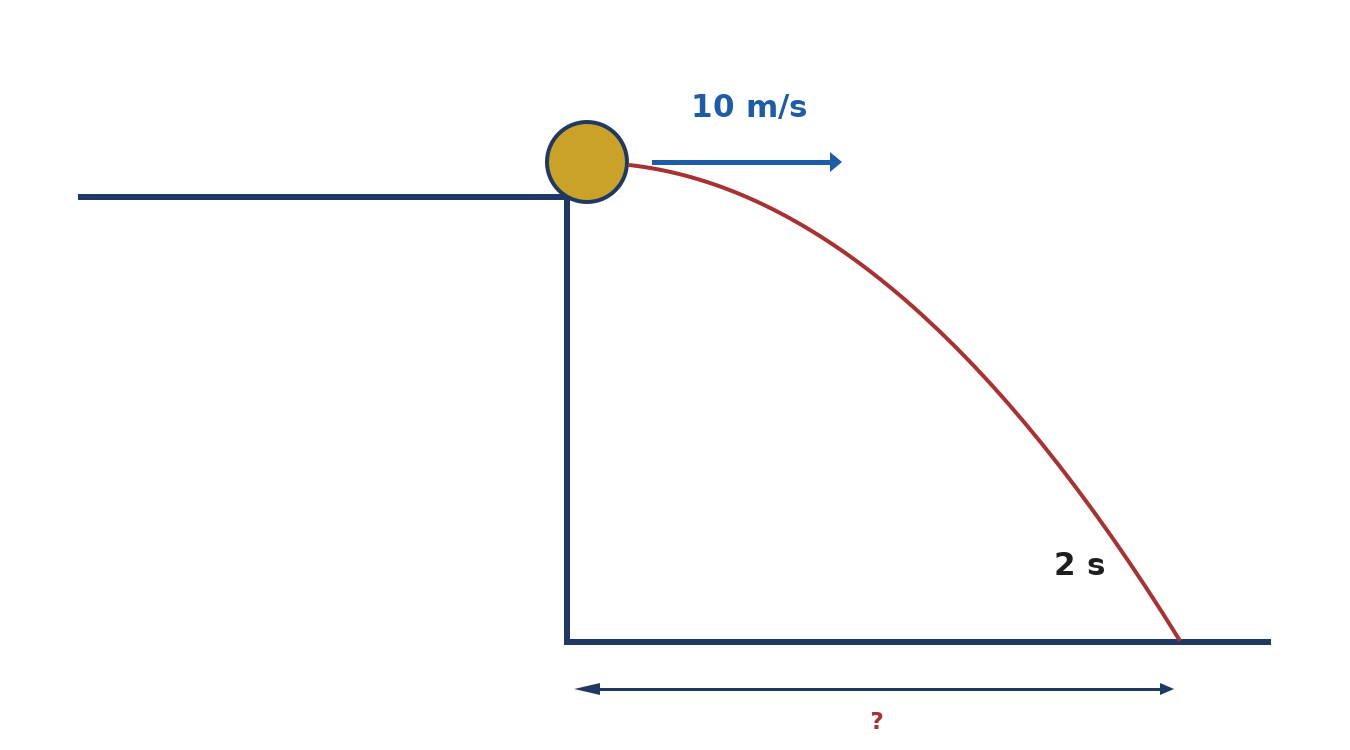
Solution
Separate the motions: horizontal velocity stays 10 m/s.
Time is shared: 2 s.
Horizontal distance = velocity × time
10 × 2 = 20 m
The result is 20 m horizontally.
Same ball: vertical distance fallen in 2 s?
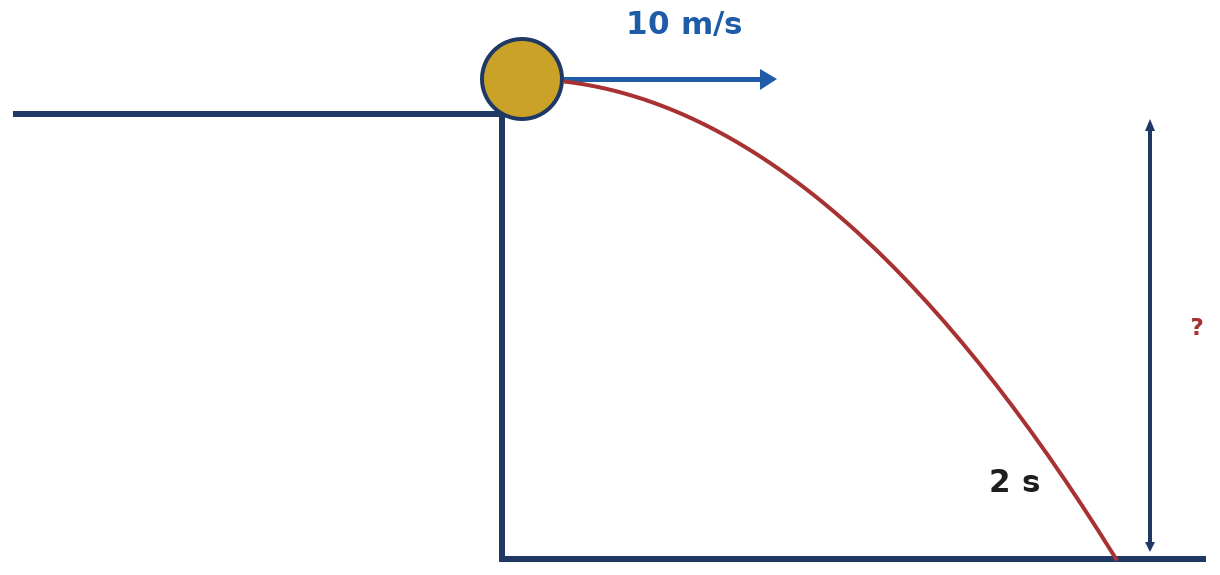
Solution
Separate the motions: vertical starts at 0 and accelerates at 9.8.
Use:
s = 12 × a × t²
Substitute:
s = 12 × 9.8 × 4 = 19.6 m
The result is 19.6 m vertically.
A ball is thrown horizontally at 12 m/s from a cliff and falls for 3 s. How far does it travel horizontally?
A ball is thrown horizontally at 10 m/s. How long does it take to travel 30 m horizontally?
The same ball thrown at 12 m/s falls for 3 s. How far does it fall vertically? Use g = 9.8 ms²
A ball is dropped from rest. After 1 s its vertical speed is 9.8 m/s. What is its vertical speed after 3 s?
What is the horizontal acceleration of a projectile (ignoring air)?
What is the vertical acceleration of a projectile?
What is the shape of a projectile's path?
What is shared between the horizontal and vertical motions?
At the top of a projectile path, what is the vertical velocity?
A ball is thrown horizontally at 20 m/s and falls for 1 s. How far does it travel horizontally, and how far does it fall vertically? Use g = 9.8 ms²
Your score: 0 / 10
1. 36 m
2. 3 s
3. 44.1 m
4. 29.4 m/s
5. 0
6. 9.8 ms² downward
7. A parabola
8. Time
9. 0
10. 20 m horizontally, 4.9 m vertically