
1
Three identical bulbs are in series across a 12 V supply. What is the voltage across each bulb, and why?
SCIENCE FOUNDATIONS
This document was made by AI and there may be mistakes. If a question or answer looks wrong, use the Flag a mistake button to let Brett know so he can fix it.
This is how you explain why one dead bulb kills a whole string of old Christmas lights, while in your house one blown bulb leaves the rest of the room lit. Old Christmas lights were wired in a single loop, so one break stopped everything. Your house wiring gives each light its own path, so one failure does not darken the room. Knowing series and parallel circuits tells you how the wiring decides whether things fail together or on their own.
Series and parallel circuits: in series, the parts share one path, so the voltages add to the supply voltage, and one break stops everything.
In parallel, each branch gets the full supply voltage, and each branch has its own path, so one break leaves the rest working. Check how many paths the current has: one path is series, more than one is parallel.
Two
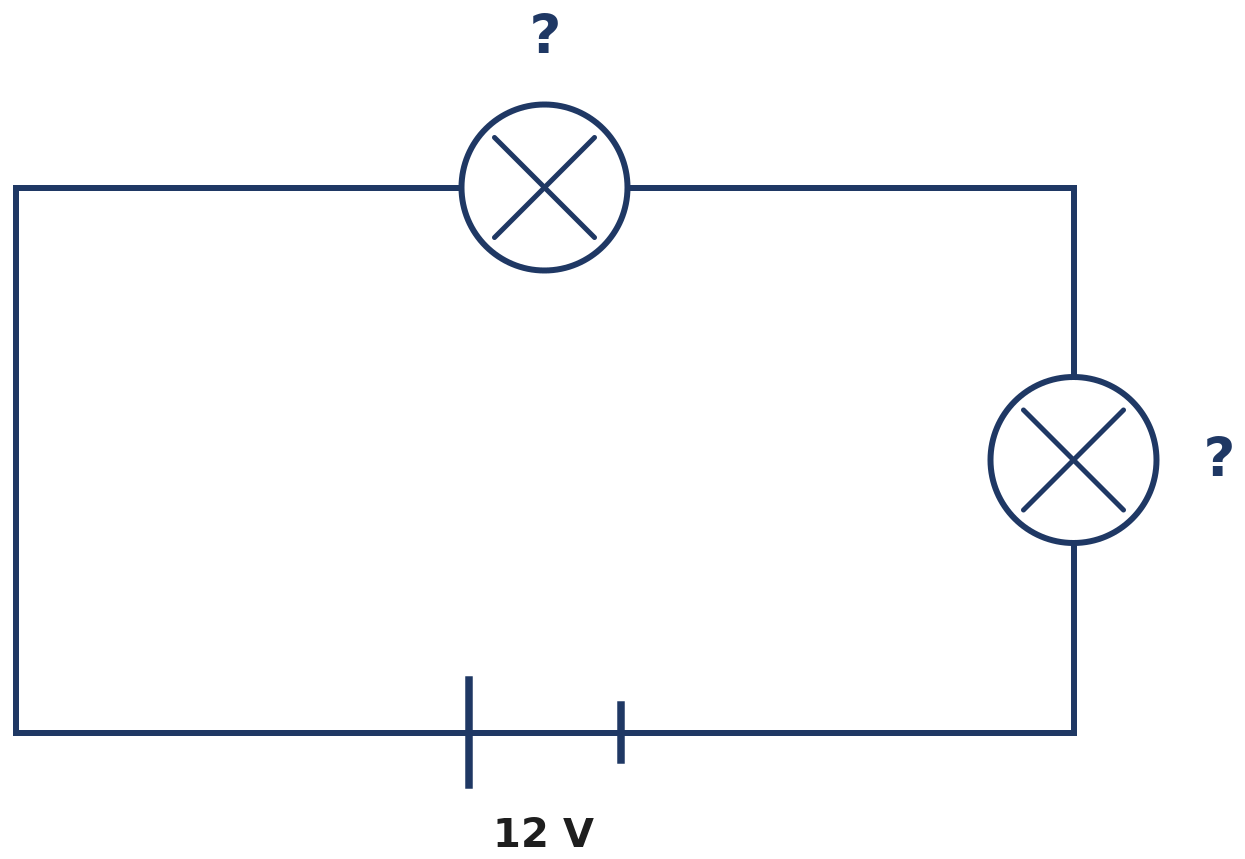
Solution
Recall series: voltages add to the supply voltage.
Two equal bulbs share equally:
12 ÷ 2 = 6 V.
State the voltage across each bulb.
The result is 6 V across each bulb.
Two bulbs in parallel across
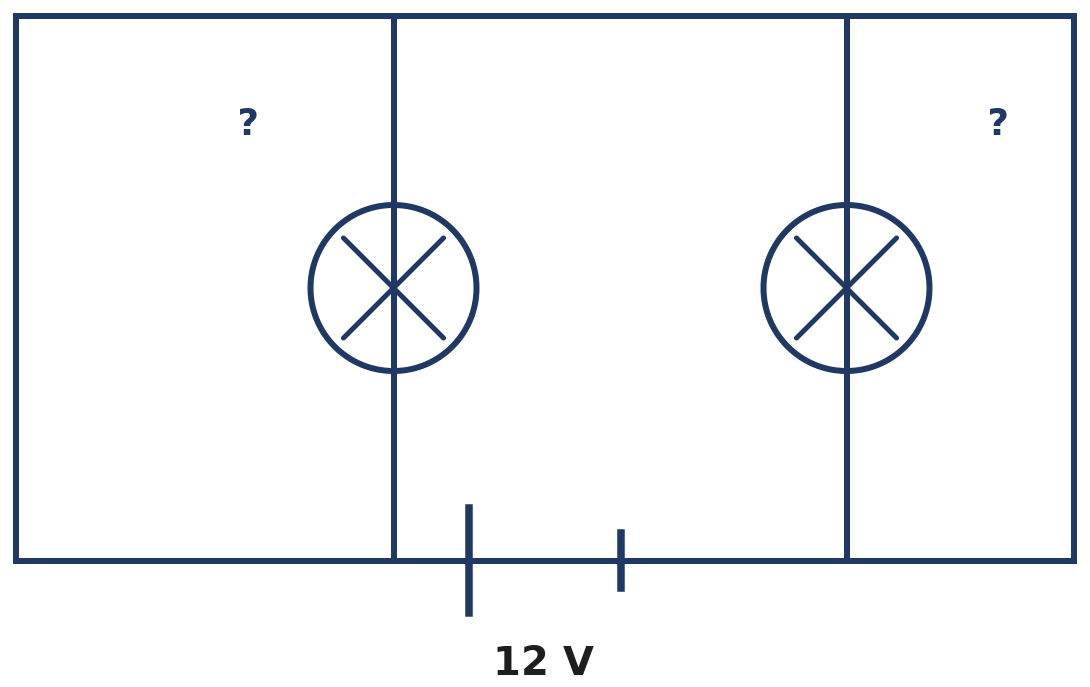
Solution
Recall parallel: each branch gets the full supply voltage.
Both branches connect across the same 12 V.
State the voltage across each bulb.
The result is 12 V across each bulb.
Three identical bulbs are in series across a 12 V supply. What is the voltage across each bulb, and why?
In a parallel circuit, the total current from the battery is 6 A. One branch takes 2 A. What is the current in the other branch?
Four bulbs are in parallel across a 6 V supply. What is the voltage across each bulb, and why?
In a parallel circuit, what happens to the total current from the battery when a second branch is added?
In a series circuit, is the current the same everywhere or shared?
In a parallel circuit, is the voltage the same across branches or shared?
A bulb fails in a series circuit. What happens?
A bulb fails in a parallel circuit. What happens?
Which layout is used in houses: series or parallel?
In a series circuit the current through two bulbs is 2 A. What is the current through each bulb?
Your score: 0 / 10
1. 4 V across each; in series the voltages add to the supply voltage and the equal bulbs share equally
2. 4 A
3. 6 V across each; in parallel each branch gets the full supply voltage
4. It increases
5. Same everywhere
6. Same across branches
7. The whole circuit stops
8. The other branches keep working
9. Parallel
10. 2 A