
1
A normal mother (XHXH) and an affected father (XhY) have a son. What is the chance the son has the trait?
SCIENCE FOUNDATIONS
This document was made by AI and there may be mistakes. If a question or answer looks wrong, use the Flag a mistake button to let Brett know so he can fix it.
This is how you explain why colour blindness shows up far more often in boys than in girls, since the gene sits on the X chromosome that boys only get one copy of. A boy with one copy of the gene shows the trait, while a girl needs two copies to show it, so she is more likely to carry it without showing it. A family history of colour blindness on the mother's side tells a counsellor where to look. Knowing sex-linked inheritance tells you why some traits run mostly through one sex, and why a mother can pass a trait to her son without having it herself.
Sex-linked inheritance: a male has only one X chromosome, so one recessive X-linked copy is enough for him to show the trait.
A female has two X chromosomes, so she needs two recessive copies to show it and is a carrier with one copy. That is why X-linked recessive traits are more common in males.
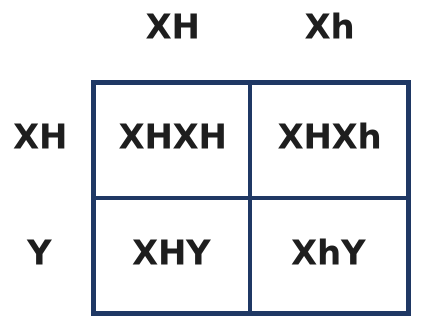
A carrier mother (XHXh) and a normal father (XHY) have a son. Chance he has the trait?
Solution
Sons get Y from father and one X from mother.
Mother passes XH or Xh equally: half the sons get Xh.
A son with XhY shows the trait.
The result is 1 in 2 chance (50 percent) for a son.
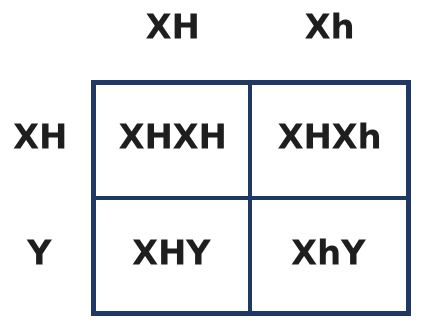
Same parents have a daughter. Chance she has the trait?
Solution
Daughters get XH from father and one X from mother.
Father's XH is dominant, so daughters do not show the trait either way.
Chance of showing it is zero, though half are carriers.
The result is 0 chance of showing; half are carriers.
A normal mother (XHXH) and an affected father (XhY) have a son. What is the chance the son has the trait?
A carrier mother (XHXh) and an affected father (XhY) have a son. What is the chance the son has the trait? Explain.
An affected mother (XhXh) and an affected father (XhY) have a daughter. What is the chance the daughter shows the trait?
A carrier mother (XHXh) and a normal father (XHY) have a daughter. What is the chance the daughter is a carrier? Explain. Use the Punnett square.
A male with one recessive X-linked copy: does he show the trait?
A female has two recessive X-linked copies (XhXh). Does she show the trait?
Why are X-linked recessive traits more common in males?
What is a carrier?
A son gets his X chromosome from whom?
A carrier mother and a normal father have a son. What is the chance the son is affected, and what is the chance a daughter is a carrier?
Your score: 0 / 10
1. 0
2. 1 in 2
3. 1
4. 1 in 2
5. Yes
6. Yes
7. Males have only one X chromosome
8. Someone with one recessive copy who does not show the trait
9. His mother
10. Son 1 in 2; daughter carrier 1 in 2