
1
Why would a shout on the Moon not reach a listener standing nearby without a radio?
SCIENCE FOUNDATIONS
This document was made by AI and there may be mistakes. If a question or answer looks wrong, use the Flag a mistake button to let Brett know so he can fix it.
This is how you explain why you hear thunder after the lightning, why a guitar string sounds higher when you tighten it, and why you cannot hear anything in the vacuum of space. You see the lightning first because light travels far faster than sound, so the thunder arrives late. A guitarist tightens a string to make it vibrate faster and sound higher. Knowing sound tells you that it needs something to travel through, and that pitch and loudness come from how the air is shaking.
Sound: sound is a longitudinal wave, which means the air shakes back and forth in the same direction the sound travels. Sound needs a medium, something to travel through, like air, water, or a solid, and it cannot travel through a vacuum, which has no medium.
Frequency, measured in hertz (Hz), is how fast something vibrates: higher frequency means higher pitch, and larger amplitude, a bigger shake, means a louder sound. An echo is sound reflected, bounced back, off a surface. Sound travels faster in solids than in gases, and at about 343 metres per second in air.
Why can astronauts not hear each other in space without radios?

Solution
Recall what sound needs: a medium to travel through.
Space is a vacuum, with no medium.
Conclude: sound cannot travel, so radios are needed.
The result is no medium in space, so no sound travel.
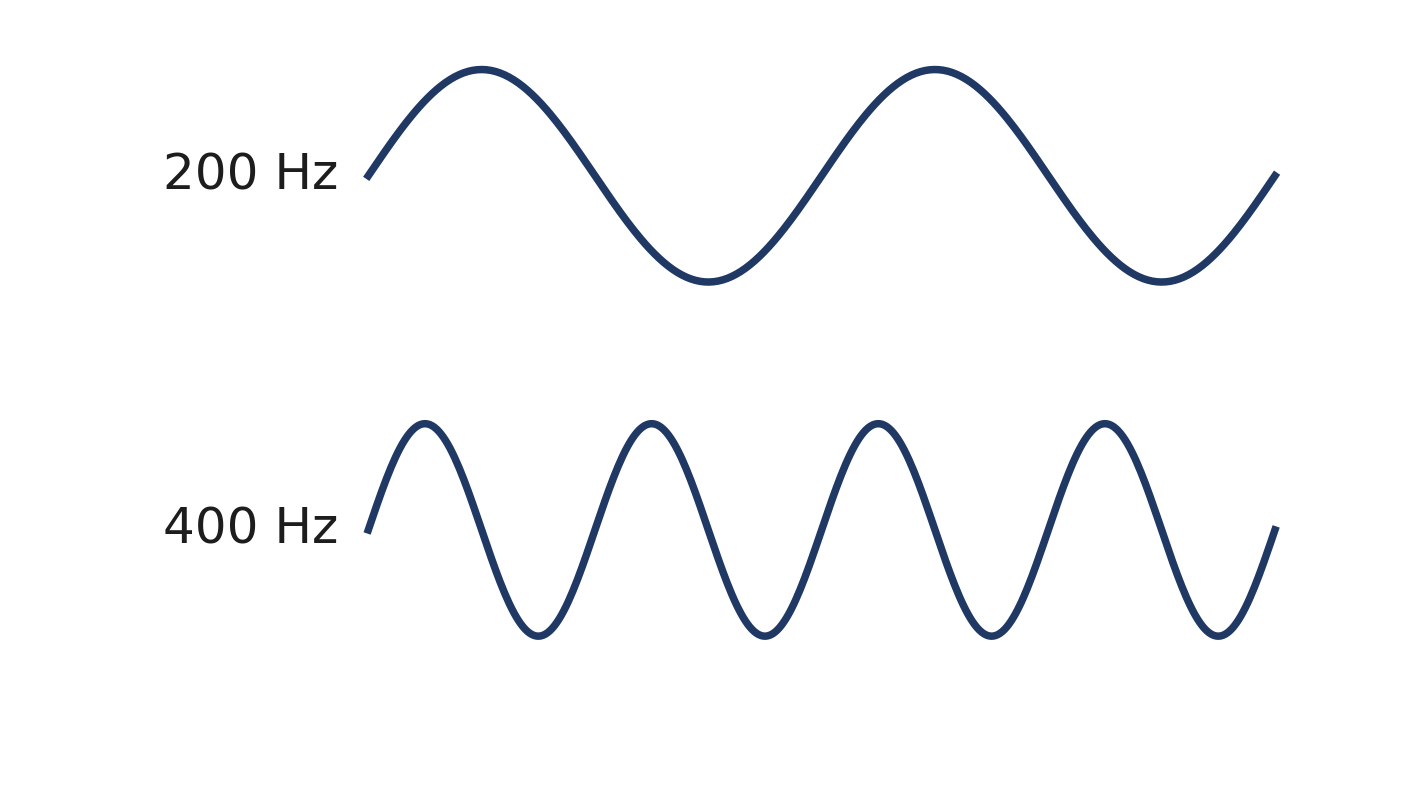
Which is higher pitched: a
Solution
Recall the rule: higher frequency means higher pitch.
Compare: 400 is higher than 200.
Conclude: the 400 Hz note is higher pitched.
The result is 400 Hz note.
Why would a shout on the Moon not reach a listener standing nearby without a radio?
Why do you see lightning before you hear the thunder?
Which is higher pitched: a 250 Hz note or a 500 Hz note?
A guitarist tightens a string. What happens to the pitch of the note it plays?
Is sound a transverse or a longitudinal wave?
Does sound travel faster in solids or in gases?
What does larger amplitude mean for loudness?
What is an echo?
What vibrates to make sound?
What is the speed of sound in air?
Your score: 0 / 10
1. Sound needs a medium, and the Moon has no air
2. Light travels much faster than sound
3. The 500 Hz note
4. It sounds higher
5. Longitudinal
6. Solids
7. Louder sound
8. Reflected sound
9. A vibrating object
10. 343 m/s