
1
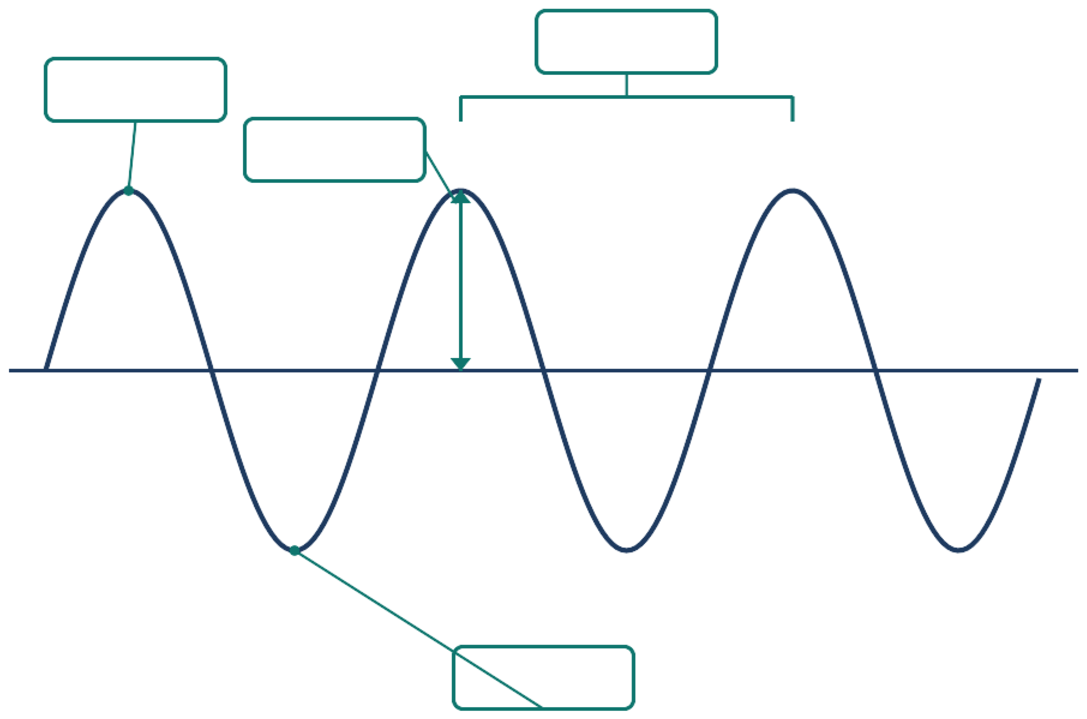
How many crests does the wave in the diagram show?
SCIENCE FOUNDATIONS
This document was made by AI and there may be mistakes. If a question or answer looks wrong, use the Flag a mistake button to let Brett know so he can fix it.
This is how you describe everything from ocean waves and stadium waves to sound and light, using the same ideas of height, spacing, and how often the wave repeats. A surfer reads the spacing between waves to judge when to paddle out, and a sound engineer reads the height of a sound wave to judge how loud it is. A radio engineer uses the same language to describe a broadcast signal. Knowing waves and wave properties tells you that very different waves can all be described the same way, so you can compare them directly.
Label a wave diagram: crest, trough, amplitude, wavelength.
Solution
Find the highest point: that is a crest.
Find the lowest point: that is a trough.
Measure amplitude from the middle line to a crest, and wavelength from crest to crest.
The result is crest top, trough bottom, amplitude and wavelength labelled.
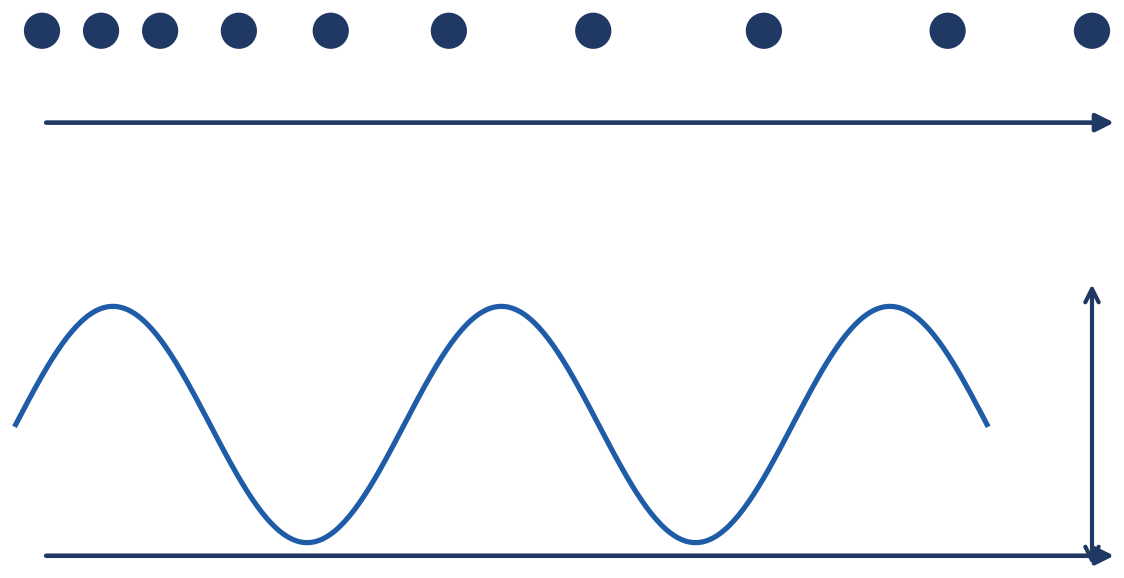
Classify sound and light waves.
Solution
Ask the vibration direction for sound: air vibrates along travel, so longitudinal.
Ask for light: fields vibrate at right angles to travel, so transverse.
Label each one.
The result is sound longitudinal, light transverse.
How many crests does the wave in the diagram show?
Where is the amplitude measured from and to, and where is the wavelength measured from and to?
Wave A is a wave on a rope that moves up and down as it travels along the rope, and Wave B is a sound wave in air. Classify each as transverse or longitudinal, and state the vibration direction for each.
A wave passes a point 10 times in 2 seconds. What is its frequency?
A double-headed arrow runs from the rest position up to a crest. What is that distance called?
A bracket spans from one crest to the next crest. What is that distance called?
What is the point at the top of a wave called?
What is the point at the bottom of a wave called?
Wave B has a larger amplitude than Wave A. What does a larger amplitude mean?
Wave B has a longer wavelength than Wave A, and both waves travel at the same speed. What does the longer wavelength mean for the frequency?
Your score: 0 / 10
1. 3
2. Amplitude: middle line to crest; wavelength: crest to crest
3. A: transverse, vibrating at right angles to travel; B: longitudinal, vibrating along the direction of travel
4. 5 Hz
5. Amplitude
6. Wavelength
7. Crest
8. Trough
9. More energy, so louder or brighter
10. Lower frequency