1
How many outcomes are in the sample space for flipping two coins?
MATHEMATICS · GRADES 7-9
This document was made by AI and there may be mistakes. If a question or answer looks wrong, use the Flag a mistake button to let Brett know so he can fix it.
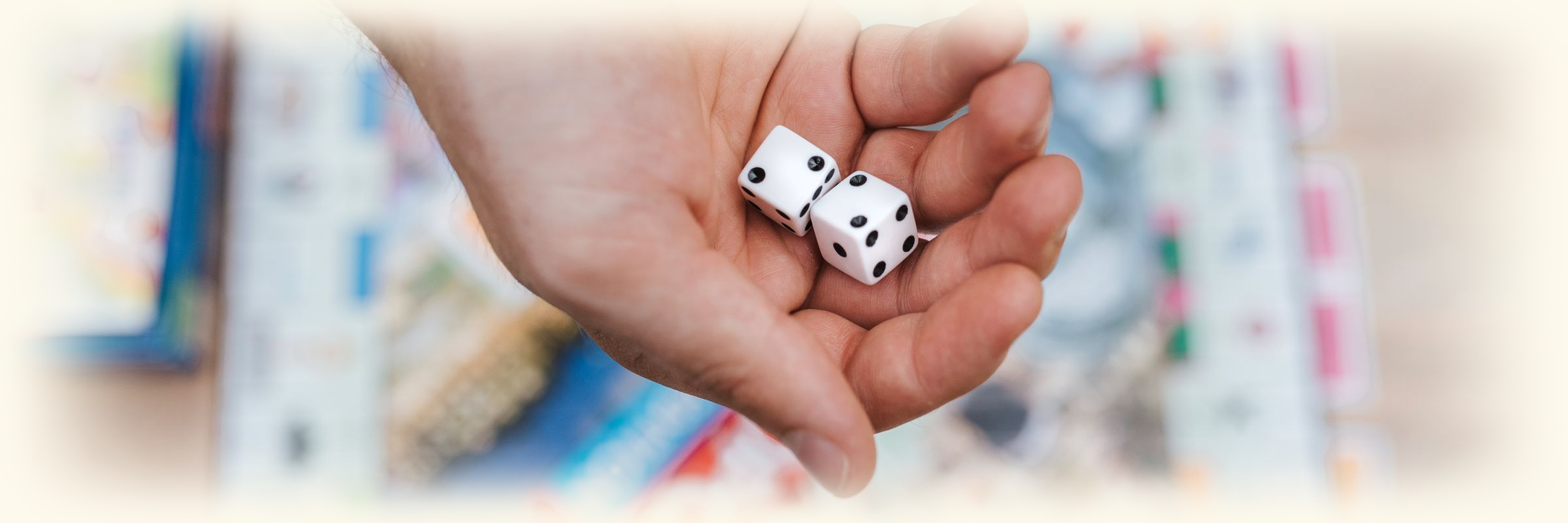
This is how you list every possible result of flipping two coins or rolling two dice, so you can work out the chance of each outcome without missing one (see Probability of Complementary Events). A board game player who lists every dice roll can tell which totals are common and which are rare. A teacher drawing names from a hat lists the whole sample space to make sure the draw is fair. Knowing sample spaces tells you how to count every possibility first, so your chance of an outcome is built on a complete list, not a guess.
List the sample space for flipping two coins
Solution
First flip: heads or tails.
Second flip: heads or tails.
Sample space: HH, HT, TH, TT. There are 4 outcomes.
List the sample space for rolling one die
Solution
A die has faces 1 to 6.
Each face is one outcome.
Sample space: 1, 2, 3, 4, 5, 6
How many outcomes are in the sample space for flipping two coins?
List the sample space for a spinner with four equal sections numbered 1 to 4.
A die is rolled. Which of these numbers is NOT in the sample space?
Flip two coins. What fraction of the outcomes have two heads?
Roll two dice. How many outcomes give a total of 7?
A coin is flipped and a die is rolled. Which list shows the sample space?
Flip two coins. How many outcomes have exactly one heads?
Flip two coins. List the outcomes that have exactly one heads.
A spinner with four equal sections is spun twice. How many outcomes are in the sample space?
A bag holds 3 red and 2 blue marbles. If you draw one marble, list the sample space by colour and give P(red).
Your score: 0 / 10
1. 4
2. 1, 2, 3, 4
3. 7
4. 14
5. 6
6. H1, H2, H3, H4, H5, H6, T1, T2, T3, T4, T5, T6
7. 2
8. HT, TH
9. 16
10. Red, blue; 35