
1
Flip a coin and roll a die. Find P(heads, then a number greater than 4).
MATHEMATICS · GRADES 7-9
This document was made by AI and there may be mistakes. If a question or answer looks wrong, use the Flag a mistake button to let Brett know so he can fix it.
This is how you work out the chance of two things happening in a row, like flipping a coin and then rolling a die, or drawing two names from a hat. A game player working out the odds of rolling two sixes in a row needs to combine the chance of each roll. A teacher drawing two names from a hat without putting the first one back has to allow for the smaller hat on the second draw. Knowing two-stage probability tells you how to work out the chance of a pair of events together, step by step.
Two-stage probability: P(first and second) = P(first) × P(second), where the second chance is worked out after the first has happened.
Multiply along the branches of the tree.
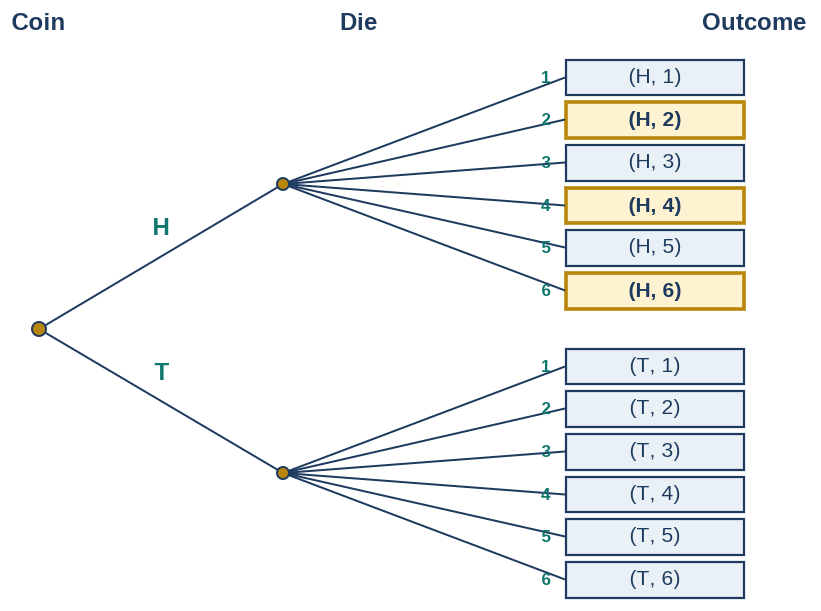
Find P(heads, then an even number) for a coin flip and a die roll
Solution
P(heads) = 12 . P(even) = 36, because three of the six faces (2, 4, and 6) are even. 36 = 12
The stages are independent, so multiply: 12 × 12 = 14 .
P is 14 .
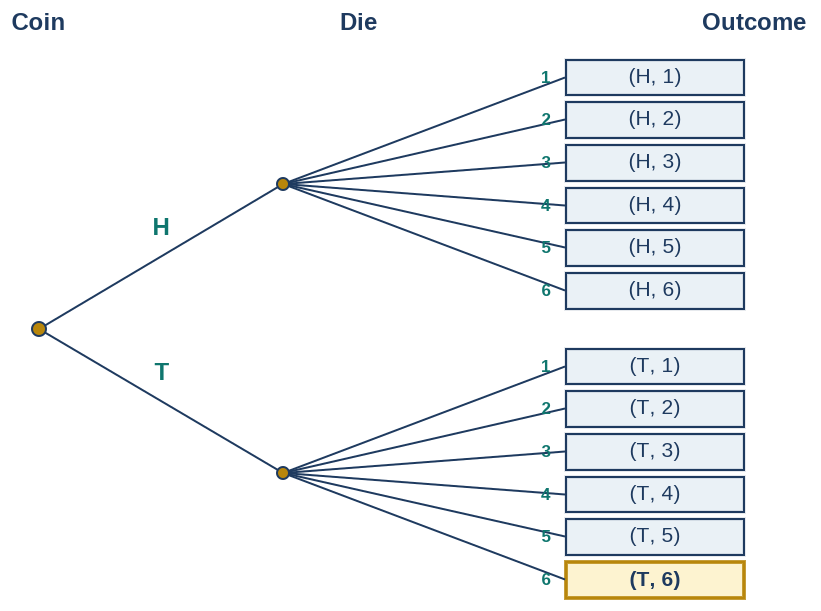
Find P(tails, then a
Solution
P(tails) = 12 . P(6) = 16
Multiply: 12 × 16 = 112 .
P is 112 .
Flip a coin and roll a die. Find P(heads, then a number greater than 4).
A bag has 3 red counters and 2 blue counters. One counter is taken out, then a second counter is taken out without putting the first one back. Find P(red, then blue).
Flip a coin and roll a die. Find P(heads, then 1).
Flip a coin and roll a die. Find P(tails, then odd).
Flip a coin twice. Find P(heads, then heads).
Roll a die twice. Find P(6, then 6).
A spinner lands on red with probability 12, then a coin is flipped. Find P(red, then heads).
The first stage has outcome A with probability 13, and the second stage has outcome B with probability 12. Find P(A, then B).
The first stage has outcome A with probability 14, and the second stage has outcome B with probability 14. Find P(A, then B).
A coin is flipped and then a die is rolled. How many different combined outcomes are possible?
Your score: 0 / 10
1. 16
2. 310
3. 112
4. 14
5. 14
6. 136
7. 14
8. 16
9. 116
10. 12