
1
Sketch y = sin x from 0 to 720 degrees.
MATHEMATICS · GRADES 10-12
This document was made by AI and there may be mistakes. If a question or answer looks wrong, use the Flag a mistake button to let Brett know so he can fix it.
This is how you read a repeating pattern, like the rise and fall of tides, the swing of a pendulum, or the sound wave from a speaker, all on one picture. Anything that goes up and down in a regular cycle can be drawn as a wave, and the graph shows you the whole pattern at once. You can read off how high it goes, how long each cycle takes, and where it starts. That is how a sailor reads the tides, a musician reads a sound, or an engineer reads a vibration.
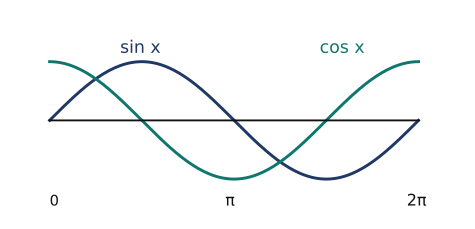
Sketch
Solution
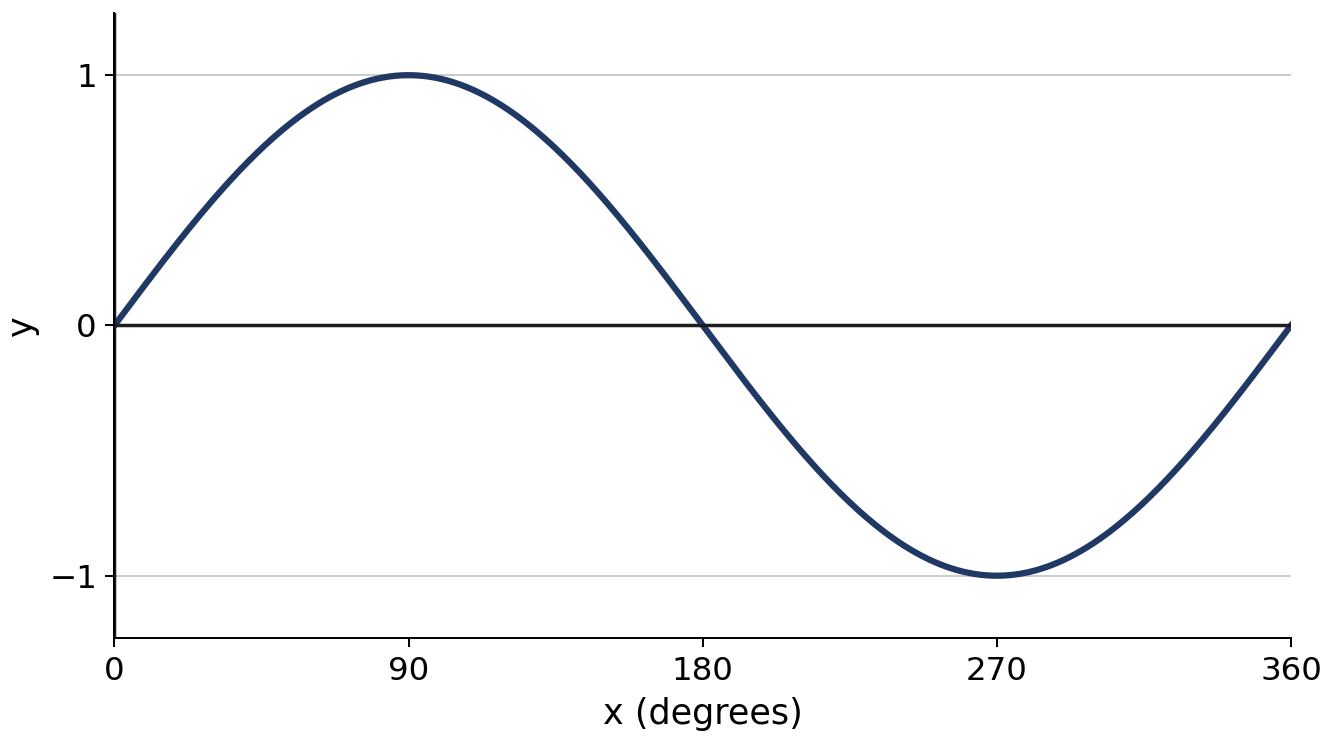
At 0 degrees, sin is 0, so the graph starts on the axis.
It rises to 1 at 90 degrees, back to 0 at 180, down to -1 at 270.
It returns to 0 at 360 degrees, completing one wave.
How does
Solution
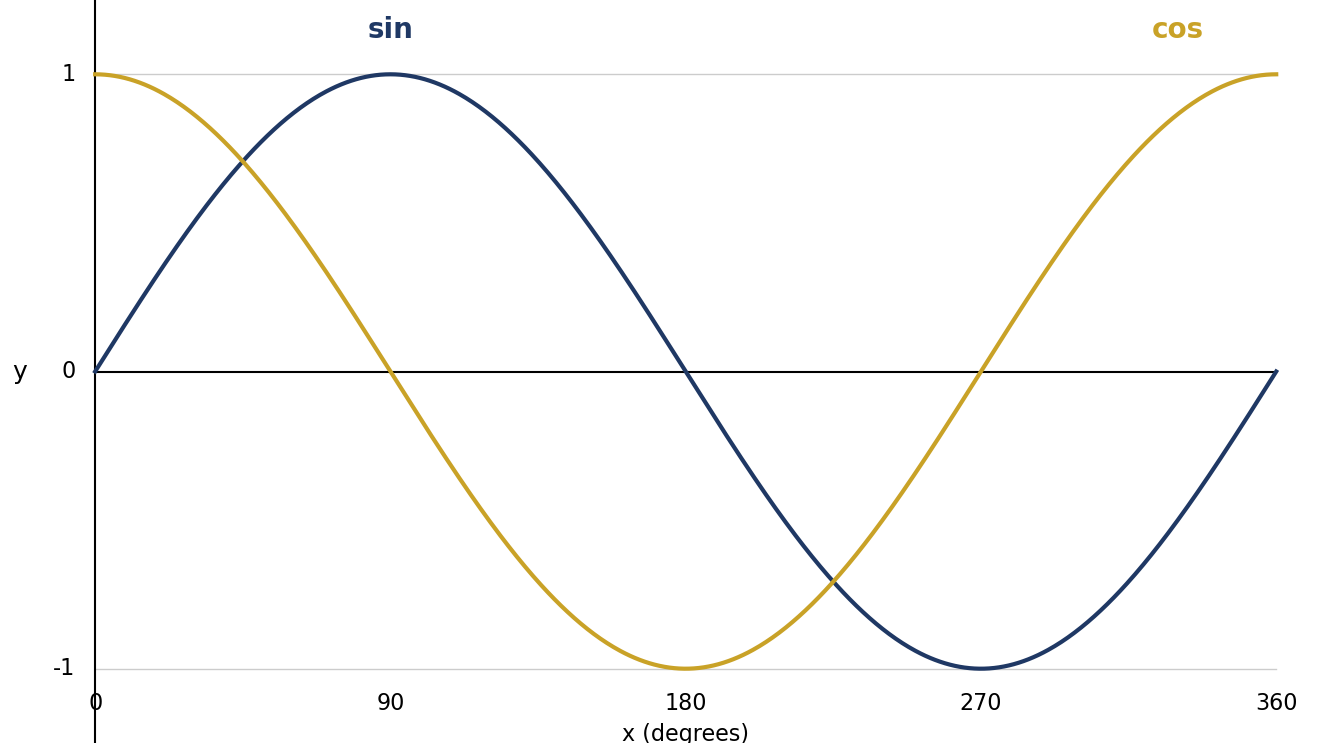
Cos starts at its highest point: cos 0 degrees = 1.
It falls to 0 at 90 degrees, to -1 at 180, and back to 1 at 360.
The cosine graph is the sine graph shifted left by 90 degrees.
Sketch y = sin x from 0 to 720 degrees.
Sketch y = cos x from 0 to 360 degrees.
What is y = cos x at 270 degrees, and what is y = sin x at 270 degrees?
Sketch y = sin x from 0 to 180 degrees.
Sketch y = -sin x from 0 to 360 degrees.
What is sin 0 degrees?
What is the amplitude of y = sin x (how high the wave goes above the middle)?
At what angle between 0 degrees and 360 degrees is cos x = -1?
What is the period of sin x (the length of one full wave), in degrees?
What is the range of sin x?
Your score: 0 / 10
1. Two identical waves, one from 0 to 360 and one from 360 to 720
2. Starts at 1, falls to 0 at 90 degrees, to -1 at 180, to 0 at 270, back to 1 at 360
3. cos 270 = 0, sin 270 = -1
4. Starts at 0, rises to 1 at 90 degrees, back to 0 at 180
5. Starts at 0, falls to -1 at 90 degrees, back to 0 at 180, rises to 1 at 270, back to 0 at 360
6. 0
7. 1
8. 180
9. 360
10. From -1 to 1