
1
Describe y = -x² + 2 compared to y = x²
MATHEMATICS · GRADES 10-12
This document was made by AI and there may be mistakes. If a question or answer looks wrong, use the Flag a mistake button to let Brett know so he can fix it.
This is how you describe a parabola that has moved, flipped, or stretched, like the path of a basketball shot from different spots on the court, without plotting lots of points. A parabola can shift up or sideways, flip upside down, or stretch taller or wider, and each change can be read straight from the equation. Knowing how to read those changes means you can sketch the new path without working out point after point. That is how you predict where a ball will go from a new spot, or how a curve changes when its rule changes.
Transformations of quadratic functions: a number inside the brackets shifts the graph sideways, a number outside shifts it up or down, a negative sign flips it over, and a number multiplying the whole function stretches or compresses it.
Inside the brackets, the shift goes the opposite way from the sign.
Describe
Solution
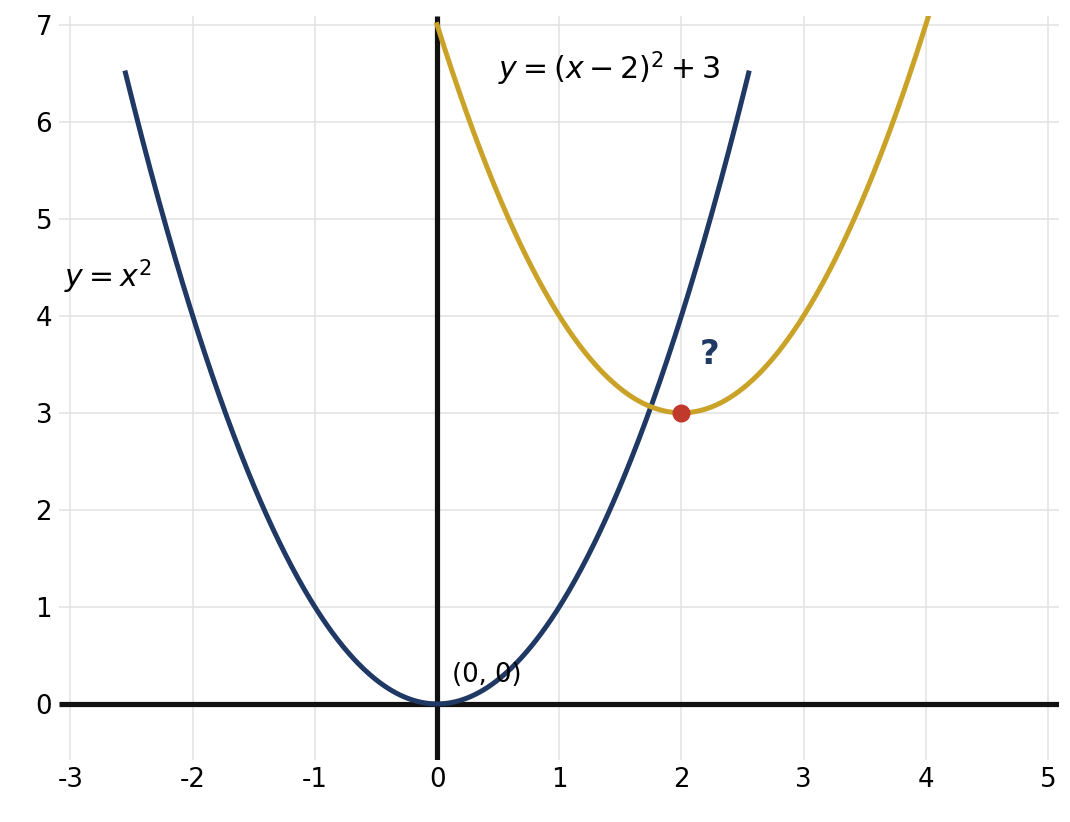
Look inside the bracket: x - 2 shifts the graph right by 2.
Look outside the bracket: + 3 shifts the graph up by 3.
So the vertex moves from (0, 0) to (2, 3), with no flip or stretch.
Describe
Solution
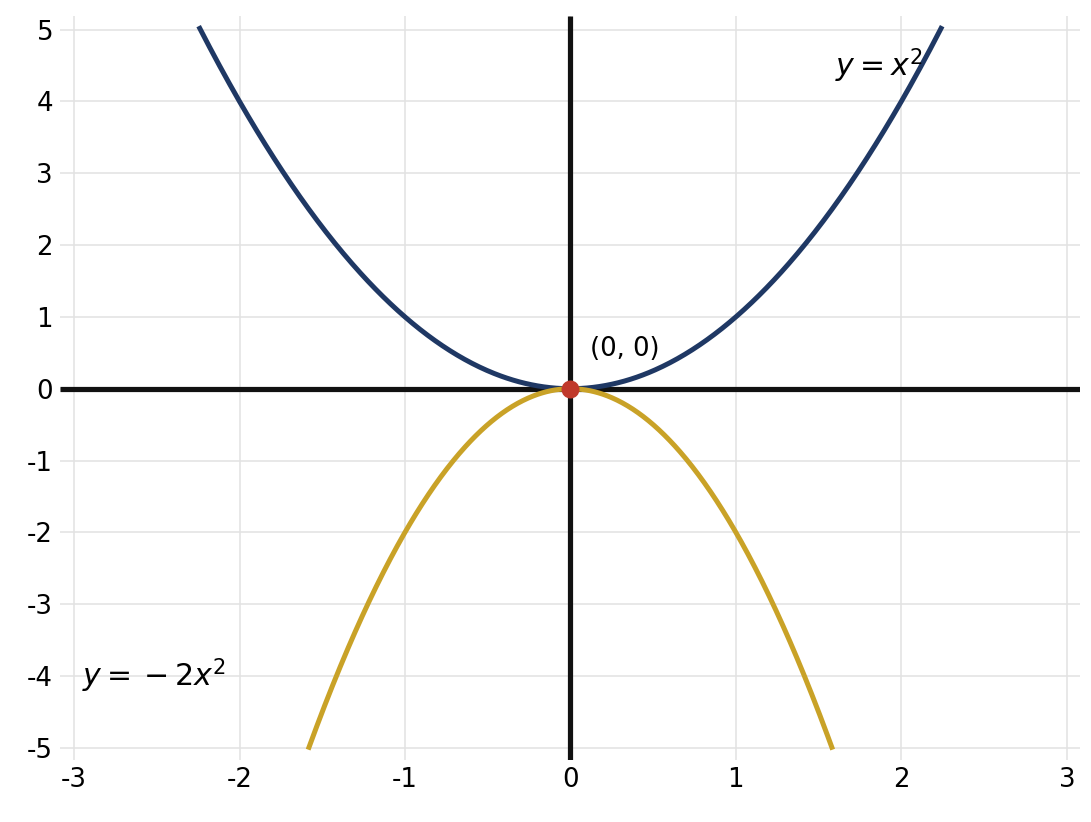
The negative sign reflects the graph across the x-axis, so it opens downward.
The 2 stretches the graph vertically by a factor of 2.
So the vertex stays at (0, 0), but the parabola is narrower and opens downward.
Describe y = -x² + 2 compared to y = x²
Describe y = -3x² compared to y = x²
Describe y = (12)x² compared to y = x²
Describe y = -x² compared to y = x²
Describe y = (x + 3)² compared to y = x²
Describe y = x² - 5 compared to y = x²
Describe y = (x - 1)² + 4 compared to y = x²
Describe y = 2x² compared to y = x²
A parabola is shifted right 3 and down 1 compared to y = x². What is its equation?
Describe y = -(x - 2)² + 3 compared to y = x²
Your score: 0 / 10
1. Reflect across the x-axis, shift up 2; vertex at (0, 2), opens downward
2. Reflect across the x-axis and stretch vertically by a factor of 3; vertex stays at (0, 0), narrower and opens downward
3. Vertical compression by a factor of 12; wider, opens upward
4. Reflect across the x-axis
5. Shift left 3
6. Shift down 5
7. Shift right 1 and up 4; vertex at (1, 4)
8. Vertical stretch by a factor of 2; narrower, opens upward
9. y = (x - 3)² - 1
10. Reflect across the x-axis, shift right 2 and up 3; vertex at (2, 3)