
1
A walk goes (1, 2) then (3, 4). Add the vectors.
MATHEMATICS · GRADES 10-12
This document was made by AI and there may be mistakes. If a question or answer looks wrong, use the Flag a mistake button to let Brett know so he can fix it.
This is how you combine two movements into one total movement, like walking to school and then to the park, or a boat crossing a river while the current pushes it sideways. Each movement has a size and a direction, and adding them gives the overall journey, from where you started to where you ended. Subtracting a movement does the reverse, taking one journey away from another. That is how you work out where you end up after two trips, or how a boat is pushed off course by a current.
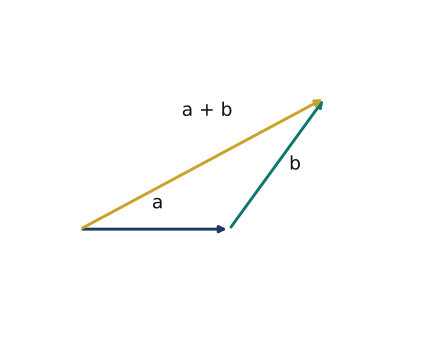
Vector addition and subtraction: to add or subtract vectors, add or subtract the matching components.
Add the x components together and the y components together, and do the same for subtraction.
Add
Solution
Add the x components: 2 + 4 = 6
Add the y components: 3 + 1 = 4
Sum: (6, 4)
Subtract
Solution
Subtract the x components: 4 - 1 = 3
Subtract the y components: 7 - 5 = 2
Difference: (3, 2)
A walk goes (1, 2) then (3, 4). Add the vectors.
A boat moves (5, 0) then (0, 5). What is the total movement?
Find (6, 5) - (2, 1).
A bird flies (-1, 3) then (4, -2). What is the total movement?
Add (2, 3) and the zero vector (0, 0).
Find (3, 3) - (3, 3).
Three trips are (2, 2), (1, 1), and (3, 0). Add them all.
Describe in words what adding vectors means geometrically.
Find (5, 9) - (0, 4).
A boat is pushed (10, -3) by its engine and (-4, 3) by the current. What is the total movement?
Your score: 0 / 10
1. (4, 6)
2. (5, 5)
3. (4, 4)
4. (3, 1)
5. (2, 3)
6. (0, 0)
7. (6, 3)
8. Placing them head to tail and joining the start to the end
9. (5, 5)
10. (6, 0)