1
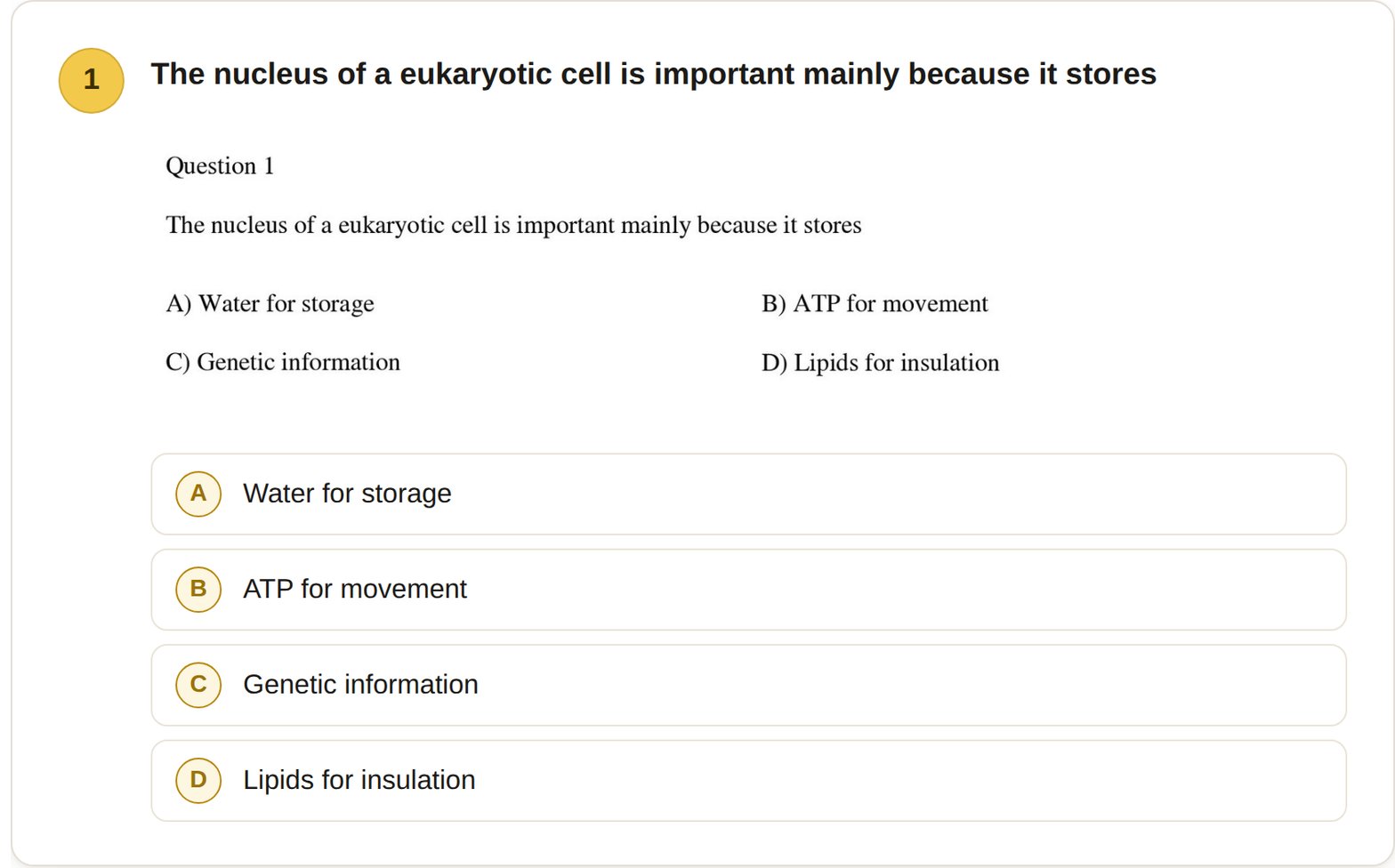
The nucleus of a eukaryotic cell is important mainly because it stores
Arizona Biology · Final Exam · 50 questions
This practice test was made by AI and there may be mistakes. If a question or answer looks wrong, use the Flag a mistake button to let Brett know so he can fix it.
The nucleus of a eukaryotic cell is important mainly because it stores
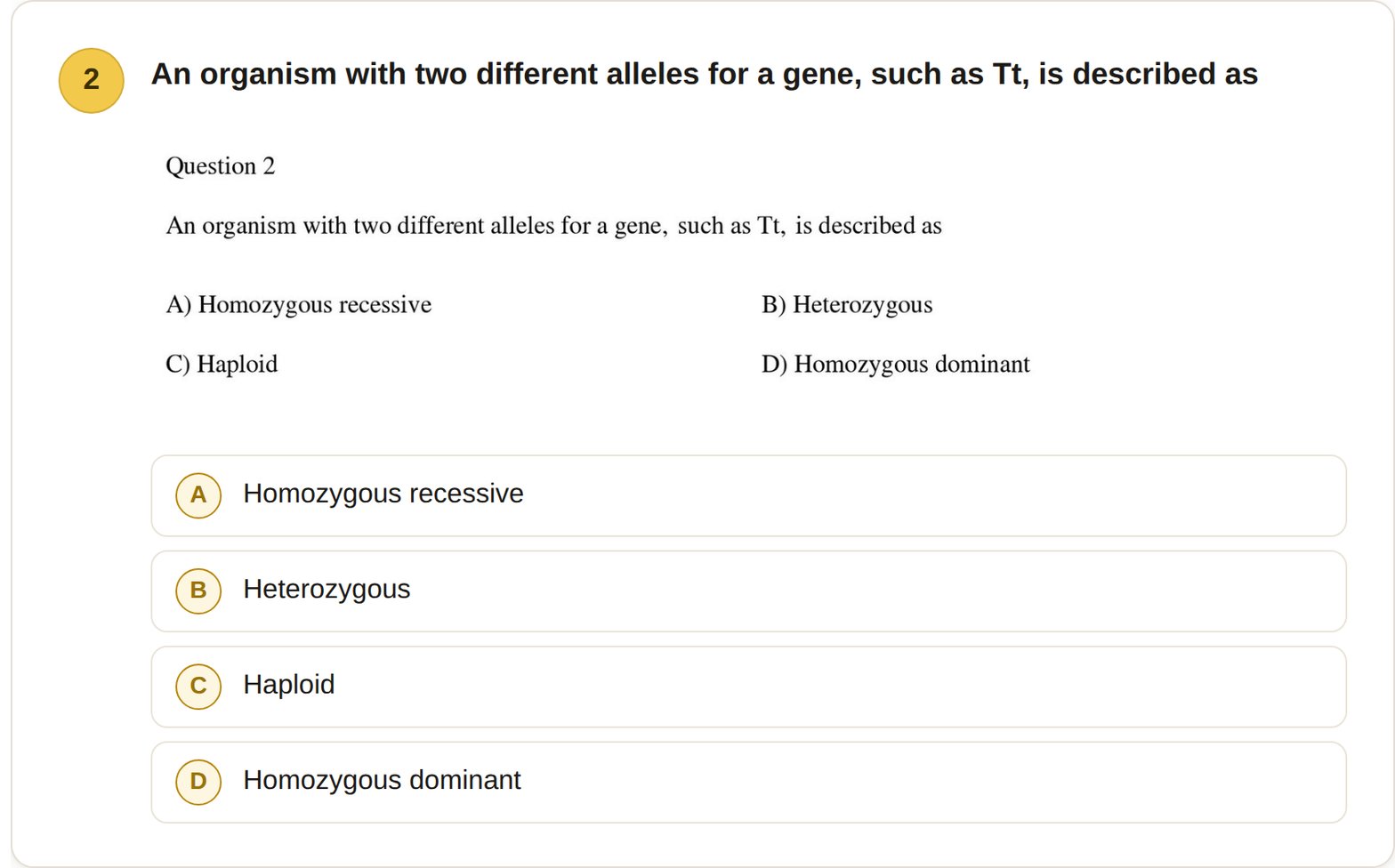
An organism with two different alleles for a gene, such as Tt, is described as
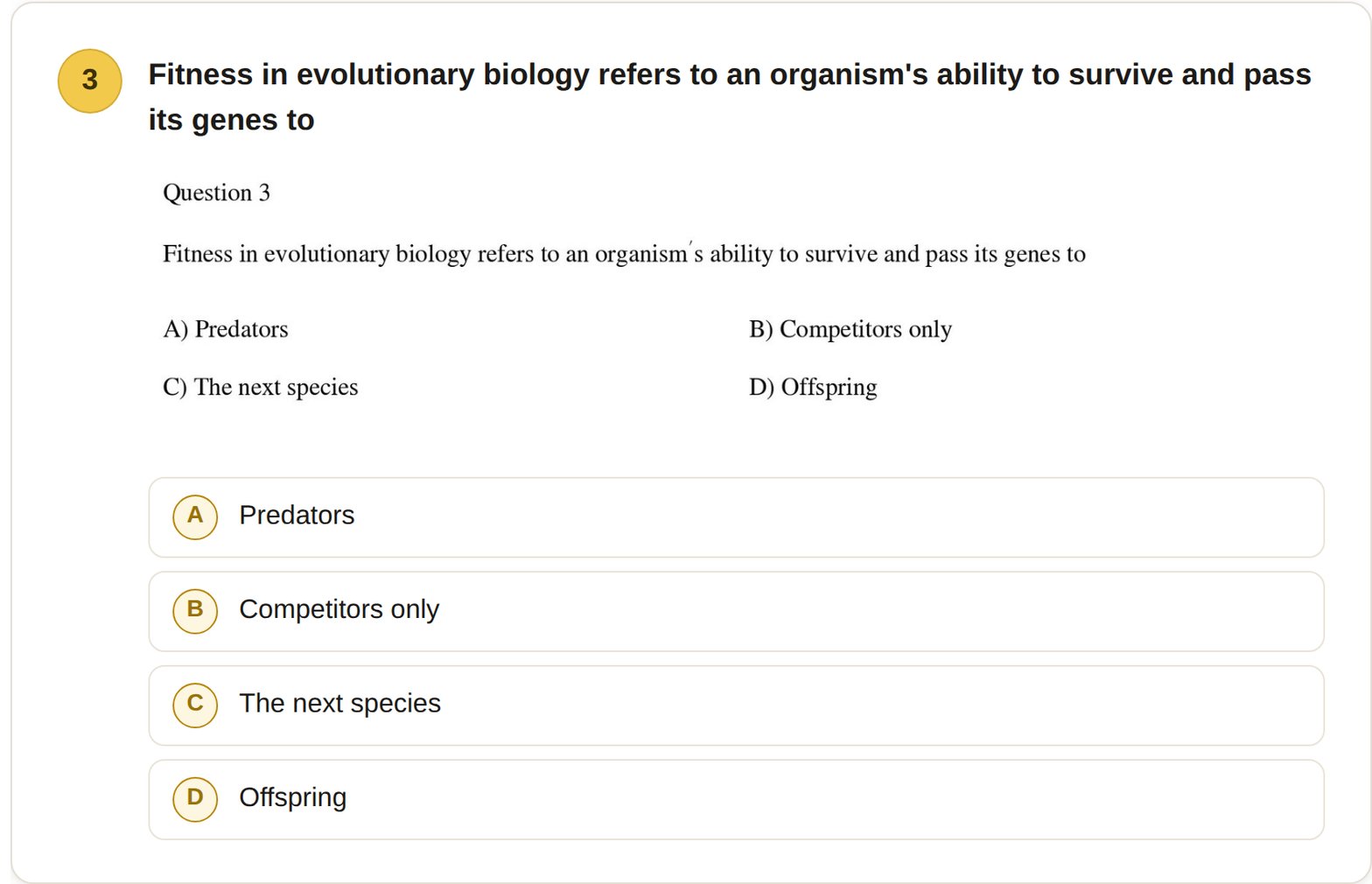
Fitness in evolutionary biology refers to an organism's ability to survive and pass its genes to
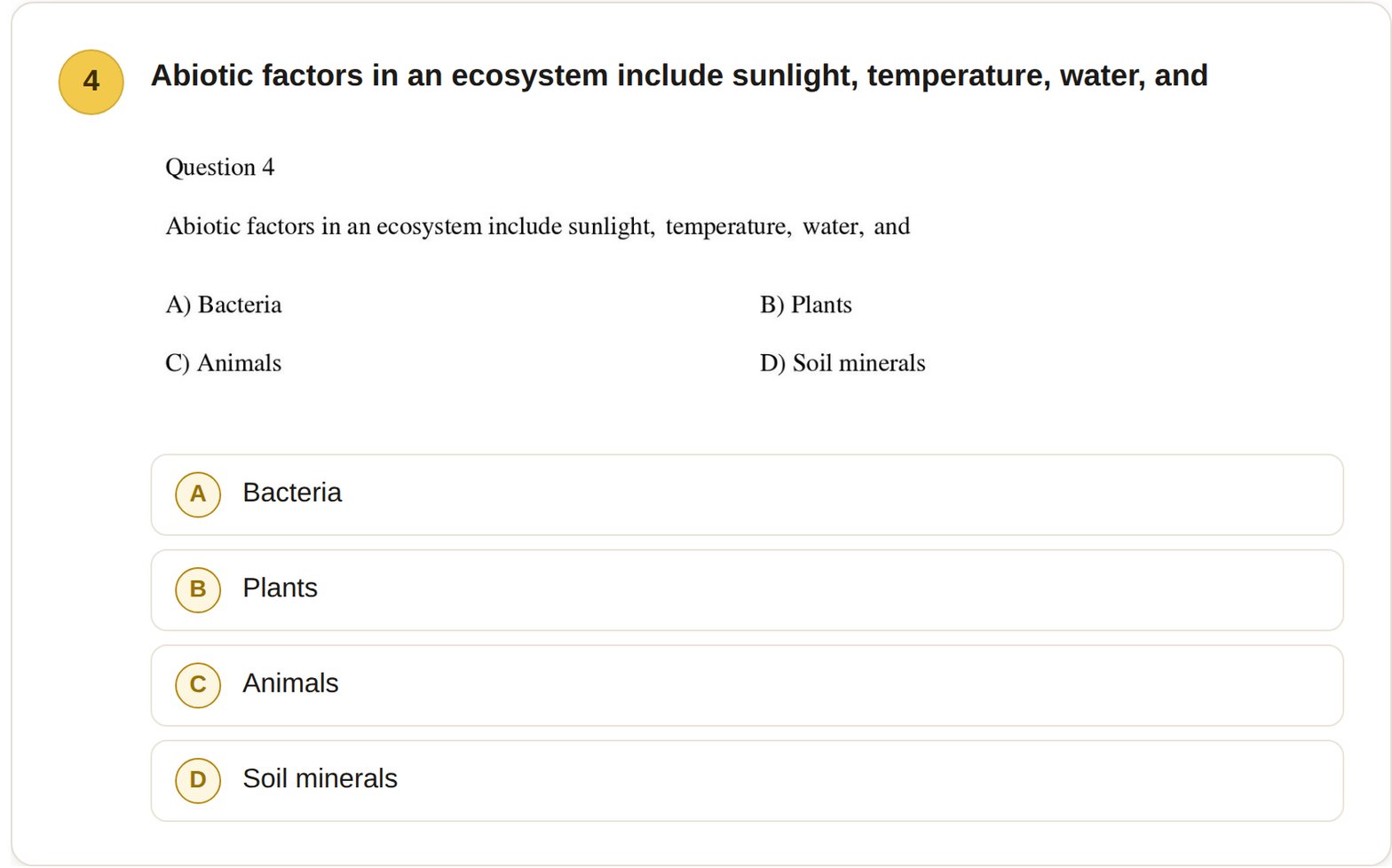
Abiotic factors in an ecosystem include sunlight, temperature, water, and
Ribosomes build proteins by joining amino acids together in the order coded by
Two heterozygous tall pea plants are crossed, where T is tall and t is short The expected ratio of tall offspring to short offspring is
Lamarck proposed that traits acquired during an organism's lifetime could be inherited, an idea that is not supported because acquired traits do not change
Decomposers, such as fungi and bacteria, break down dead organisms and return nutrients to the
A plant cell is supported and protected by a rigid structure outside its plasma membrane called the
A test cross is used to find the genotype of an organism showing a dominant trait by crossing it with an organism that is
Analogous structures, such as the wings of birds and insects, have similar functions but evolved separately, which is evidence of
Energy is lost as heat at each step of a food chain, so there are usually fewer organisms at higher
Oxygen enters a cell and carbon dioxide leaves mainly by the process of
Human blood type is controlled by multiple alleles, and a person with genotype IAi has blood type
DNA and protein similarities between two species are strong evidence of how closely the species are
Mutualism is a symbiotic relationship in which both species
Active transport differs from diffusion because active transport moves substances against a gradient and uses
A pedigree chart uses squares for males, circles for females, and shading to show individuals who
Artificial selection differs from natural selection because humans choose which organisms
A limiting factor, such as a shortage of water in a desert, limits the size of a
An enzyme and its substrate fit together at a specific region of the enzyme called the
Crossing over during meiosis exchanges segments between homologous chromosomes and increases
A cladogram shows evolutionary relationships, and species that share a more recent branching point share a more recent
Logistic growth levels off as a population approaches carrying capacity and forms an
The main function of nucleic acids in a cell is to store and transmit
Down syndrome in humans is most often caused by an extra copy of chromosome
A population in which an allele makes up 40 out of 200 total alleles has an allele frequency of
A keystone species has a large effect on its ecosystem relative to its abundance, so removing it can change the whole
A messenger RNA codon table is given UGC codes for cysteine CAU codes for histidine The sequence AUGUGC codes for methionine followed by
A mutation occurs in a sex cell rather than a body cell. What can happen to that mutation?
Variation within a population comes mainly from mutations, crossing over, and independent assortment during
The biosphere includes all regions of Earth where organisms
The cytoskeleton is a network of fibers that gives a cell shape and helps move materials inside the
The law of segregation states that the two alleles for a gene separate during the formation of
Biogeography studies where species live, and the unique species found on isolated islands support the idea of evolution from a
Tundra is a cold biome with a layer of permanently frozen soil called
A channel protein in a plasma membrane helps specific substances cross by
A plant with genotype Rr is crossed with a plant with genotype rr, where R is round seeds The expected number of round seeded plants out of 200 offspring is
Convergent evolution produces similar traits in unrelated species that live in similar
Eutrophication occurs when excess nutrients enter a lake, algae grow rapidly, and oxygen levels fall when the algae
As a cell grows larger, its volume grows faster than its surface area, so its surface area to volume ratio
A karyotype is a picture of all the chromosomes in a cell arranged by size and shape, and it can reveal
Classification groups organisms by shared characteristics, from the broadest group, domain, down to the most specific group,
In a predator-prey cycle, the predator population increases after the prey population increases because
Photosynthesis takes place in chloroplasts and produces glucose and oxygen from carbon dioxide, water, and
A DNA fingerprint is useful for identification because the pattern of DNA fragments differs between
Extinction occurs when the last member of a species dies and the species no longer
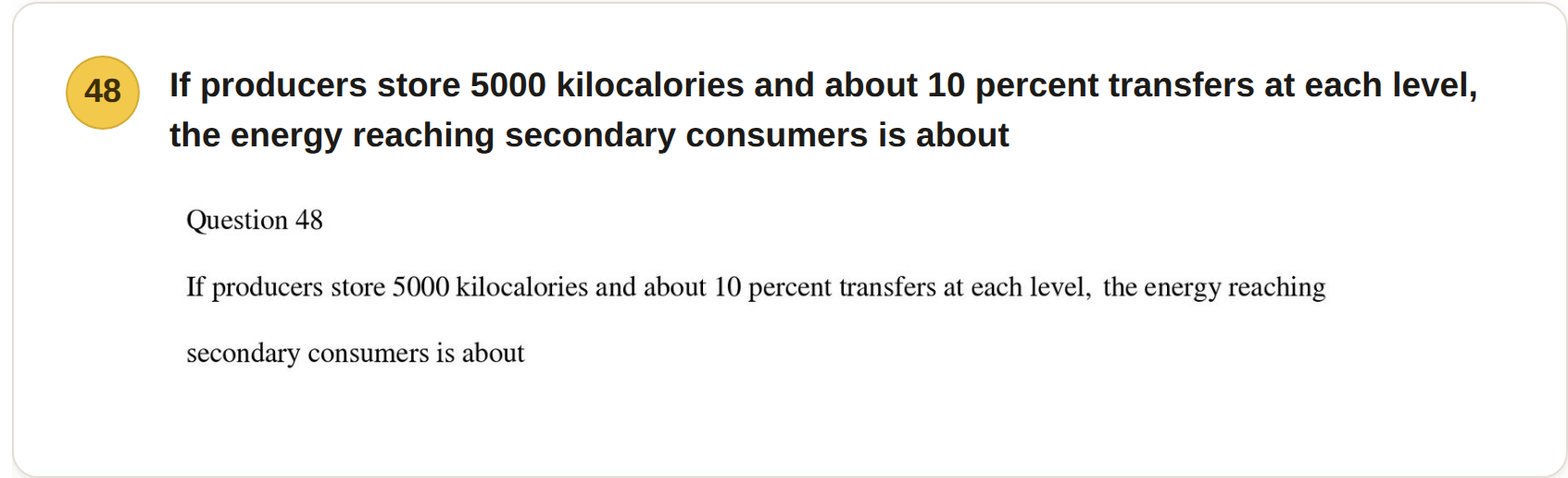
If producers store 5000 kilocalories and about 10 percent transfers at each level, the energy reaching secondary consumers is about
Uncontrolled cell division can form a mass of cells called a
Cloning produces genetically identical copies of an organism from a single
Your score: 0 / 50