1
Which change is a chemical change
A Dissolving salt in water B Breaking a glass C Melting ice D Rusting iron
What looks wrong with Question 1?
Send anonymously
Cancel
2
A covalent bond forms when atoms
A Transfer protons B Lose neutrons C Gain whole shells D Share electrons
What looks wrong with Question 2?
Send anonymously
Cancel
3
Using atomic masses 12 for carbon and 16 for oxygen, the molar mass of carbon dioxide, in grams per mole, is ____
What looks wrong with Question 3?
Send anonymously
Cancel
4
A gas occupies 4 L at 3 atm. At constant temperature and 6 atm, its volume, in liters, is ____
What looks wrong with Question 4?
Send anonymously
Cancel
5
The nucleus of an atom contains
A Protons and electrons B Neutrons and electrons C Protons and neutrons D Electrons only
What looks wrong with Question 5?
Send anonymously
Cancel
6
Which molecule is polar
A H₂ B O₂ C N₂ D HCl
What looks wrong with Question 6?
Send anonymously
Cancel
7
Methane has molar mass 16 grams per mole. The number of moles in 80 g of methane is ____
What looks wrong with Question 7?
Send anonymously
Cancel
8
A gas has pressure 2 atm and volume 6 L at temperature 300 K. At 3 atm and 600 K, its volume, in liters, is ____
What looks wrong with Question 8?
Send anonymously
Cancel
9
The chemical symbol for potassium is
A K B P C Po D Pt
What looks wrong with Question 9?
Send anonymously
Cancel
10
The formula of magnesium chloride is
A MgCl B MgCl₂ C Mg₂Cl D Mg₂Cl₂
What looks wrong with Question 10?
Send anonymously
Cancel
11
Sodium hydroxide has molar mass 40 grams per mole. The mass, in grams, of 1.5 mol of sodium hydroxide is ____
What looks wrong with Question 11?
Send anonymously
Cancel
12
In kinetic theory, the temperature of a gas measures the average
A Mass of its particles B Size of its particles C Charge of its particles D Kinetic energy of its particles
What looks wrong with Question 12?
Send anonymously
Cancel
13
Which of these is a homogeneous mixture
A Salt water B Sand and water C Oil and water D Iron filings and sulfur
What looks wrong with Question 13?
Send anonymously
Cancel
14
The reaction
A Neutralization B Decomposition C Synthesis D Double displacement
What looks wrong with Question 14?
Send anonymously
Cancel
15
Adding water to a solution without adding solute
A Increases its concentration B Decreases its concentration C Leaves its concentration unchanged D Removes the solute
What looks wrong with Question 15?
Send anonymously
Cancel
16
An exothermic reaction has an enthalpy change that is
A Positive B Negative C Zero D Always large
What looks wrong with Question 16?
Send anonymously
Cancel
17
Elements in Group 1 of the periodic table are called
A Halogens B Noble gases C Alkali metals D Transition metals
What looks wrong with Question 17?
Send anonymously
Cancel
18
The oxidation number of nitrogen in nitrogen dioxide, NO₂, is ____
What looks wrong with Question 18?
Send anonymously
Cancel
19
At standard temperature and pressure, the volume, in liters, of 3 mol of gas is ____
What looks wrong with Question 19?
Send anonymously
Cancel
20
If the concentration of a reactant is increased, equilibrium shifts
A Not at all B Until the reaction stops C Toward the products D Toward the reactants
What looks wrong with Question 20?
Send anonymously
Cancel
21
An atom has 8 protons and 9 neutrons. Its mass number is ____
What looks wrong with Question 21?
Send anonymously
Cancel
22
Nitrogen has atomic number 7. How many valence electrons does a nitrogen atom have
A 3 B 5 C 7 D 2
What looks wrong with Question 22?
Send anonymously
Cancel
23
The concentration of a solution increases when
A Solute is added B Water is added C Solution is poured out D Solution is cooled
What looks wrong with Question 23?
Send anonymously
Cancel
24
A catalyst in a reversible reaction
A Speeds both directions and leaves the equilibrium position unchanged B Shifts equilibrium toward products C Shifts equilibrium toward reactants D Stops the reverse reaction
What looks wrong with Question 24?
Send anonymously
Cancel
25
A calcium ion carries a double positive charge and has 20 protons. The number of electrons it has is ____
What looks wrong with Question 25?
Send anonymously
Cancel
26
Which substance has only London dispersion forces between its molecules
A H₂ B HCl C H₂O D NH₃
What looks wrong with Question 26?
Send anonymously
Cancel
27
Carbon dioxide has molar mass 44 grams per mole. The number of moles in 132 g of carbon dioxide is ____
What looks wrong with Question 27?
Send anonymously
Cancel
28
A reaction releases 150 kJ per mole. The heat released, in kilojoules, by 3 mol is ____
What looks wrong with Question 28?
Send anonymously
Cancel
29
The idea that atoms of the same element are identical comes from
A Thomson B Schrodinger C Dalton D Bohr
What looks wrong with Question 29?
Send anonymously
Cancel
30
The reaction
A Double displacement B Single displacement C Synthesis D Decomposition
What looks wrong with Question 30?
Send anonymously
Cancel
31
Using atomic masses 23 for sodium and 35.5 for chlorine, the molar mass of sodium chloride, in grams per mole, is ____
What looks wrong with Question 31?
Send anonymously
Cancel
32
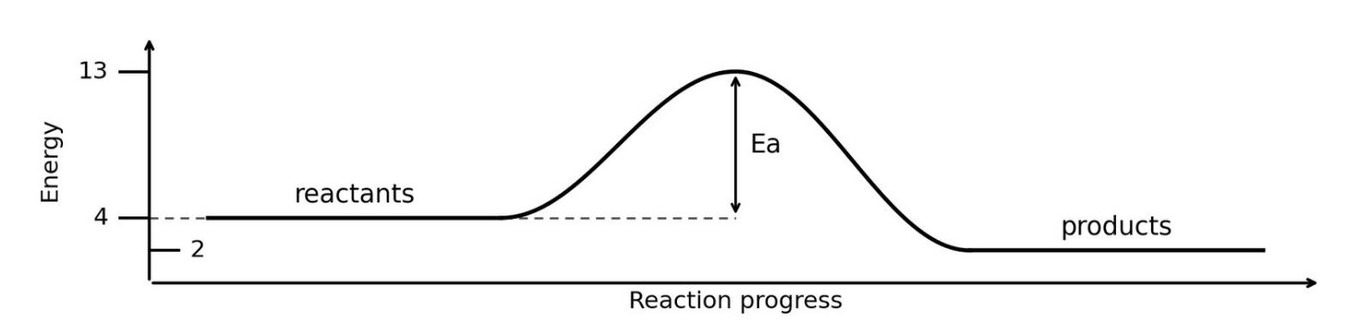
The energy diagram shows reactants, a peak, and products. The activation energy is the peak minus the reactants. With reactants at 4 , peak at 13 , and products at 2, the activation energy is
A 4 B 9 C 13 D 2
What looks wrong with Question 32?
Send anonymously
Cancel
33
Potassium 39 has atomic number 19. The number of neutrons in this atom is ____
What looks wrong with Question 33?
Send anonymously
Cancel
34
The oxidation number of manganese in manganese dioxide, MnO₂, is ____
What looks wrong with Question 34?
Send anonymously
Cancel
35
Which solution is more concentrated
A 0.5 mol per liter B 2 mol per liter C 4 mol per liter D 1 mol per liter
What looks wrong with Question 35?
Send anonymously
Cancel
36
A temperature of 127 degrees Celsius, in kelvin, is ____
What looks wrong with Question 36?
Send anonymously
Cancel
37
A sample has mass 120 g and volume 30 cm³. Its density, in grams per cm³, is ____
What looks wrong with Question 37?
Send anonymously
Cancel
38
In the balanced equation
What looks wrong with Question 38?
Send anonymously
Cancel
39
Magnesium oxide has molar mass 40 grams per mole. The mass, in grams, of 2.5 mol of magnesium oxide is ____
What looks wrong with Question 39?
Send anonymously
Cancel
40
An enthalpy change that is positive means the reaction is
A Catalyzed B Endothermic C Exothermic D At equilibrium
What looks wrong with Question 40?
Send anonymously
Cancel
41
A neutral sulfur atom has atomic number 16. The number of electrons it has is ____
What looks wrong with Question 41?
Send anonymously
Cancel
42
Carbon has atomic number 6. How many valence electrons does a carbon atom have
A 2 B 4 C 6 D 3
What looks wrong with Question 42?
Send anonymously
Cancel
43
Oxygen gas has molar mass 32 grams per mole. The number of moles in 64 g of oxygen gas is ____
What looks wrong with Question 43?
Send anonymously
Cancel
44
A large equilibrium constant means that at equilibrium
A Reactants are favoured B No reaction occurs C The reaction is slow D Products are favoured
What looks wrong with Question 44?
Send anonymously
Cancel
45
An atom has 11 protons and 12 neutrons. Its mass number is ____
What looks wrong with Question 45?
Send anonymously
Cancel
46
The oxidation number of chromium in chromium oxide, Cr₂O₃, is ____
What looks wrong with Question 46?
Send anonymously
Cancel
47
When a solution is diluted, the number of moles of solute
A Stays the same B Increases C Decreases D Becomes zero
What looks wrong with Question 47?
Send anonymously
Cancel
48
A gas has pressure 200 kPa at 400 K. At constant volume and 200 K, its pressure, in kilopascals, is ____
What looks wrong with Question 48?
Send anonymously
Cancel
49
A sample has mass 90 g and density 3 grams per cm³. Its volume, in cm³, is ____
What looks wrong with Question 49?
Send anonymously
Cancel
50
The total number of valence electrons in a carbon dioxide molecule, CO₂, is ____
What looks wrong with Question 50?
Send anonymously
Cancel