1
Egyptian civilization depended on the Nile River because its floods deposited rich silt that made farming
Arizona World History · Final Exam · 50 questions
This practice test was made by AI and there may be mistakes. If a question or answer looks wrong, use the Flag a mistake button to let Brett know so he can fix it.
Egyptian civilization depended on the Nile River because its floods deposited rich silt that made farming
In the feudal system a vassal received land called a fief from a lord and in return promised military service and
Copernicus proposed a heliocentric model in which Earth and other planets revolve around the
Trench warfare on the Western Front led to a long stalemate in which soldiers fought from fortified ditches with little
Sumerians developed cuneiform writing by pressing wedge shaped marks into clay tablets, which allowed them to keep
The Eastern Orthodox Church and the Roman Catholic Church split in 1054 in an event known as the Great
Montesquieu argued that government power should be divided into legislative, executive, and judicial branches so that power could be
The Great Depression of the 1930s caused widespread unemployment and bank failures, and it weakened democratic governments in several
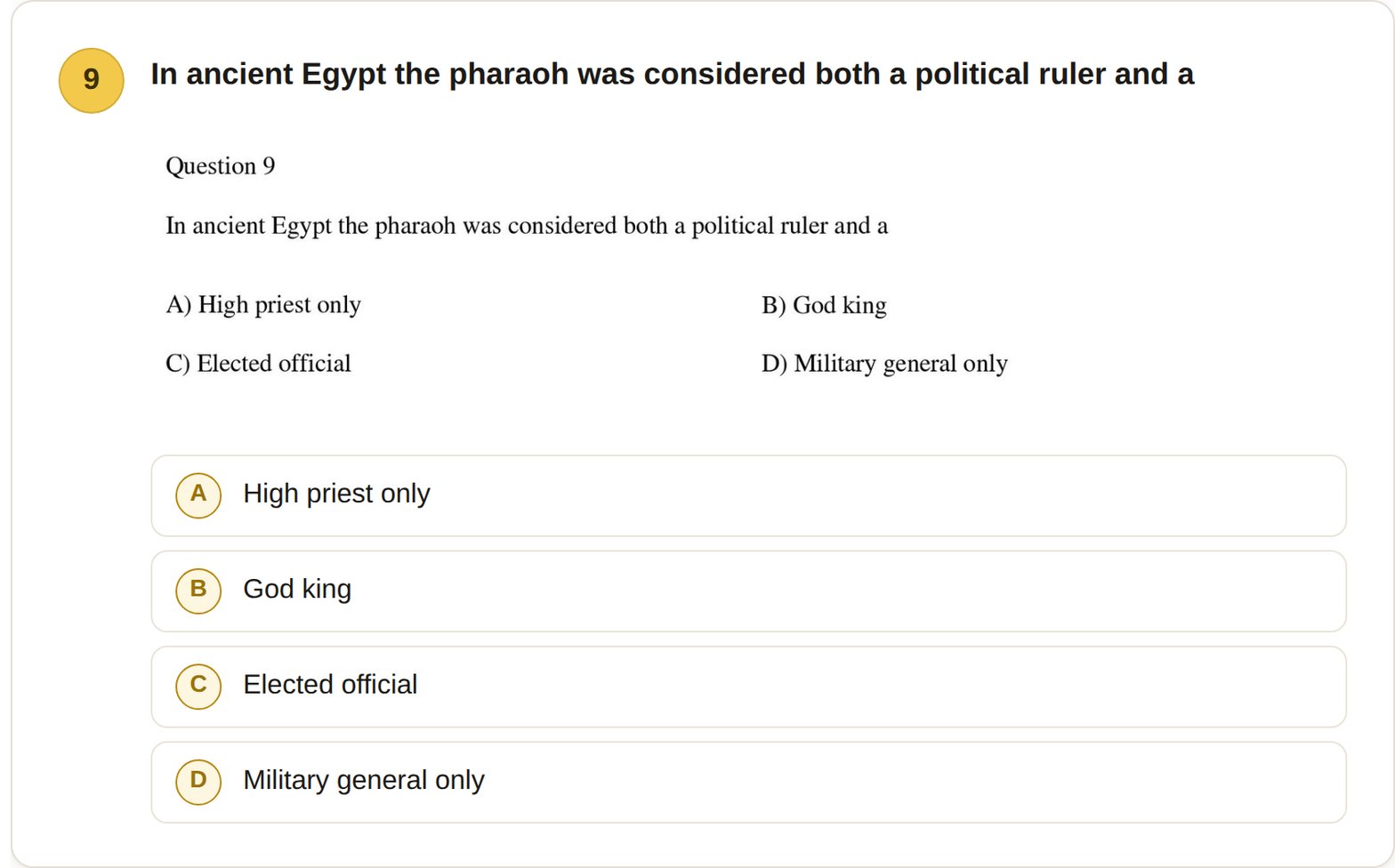
In ancient Egypt the pharaoh was considered both a political ruler and a
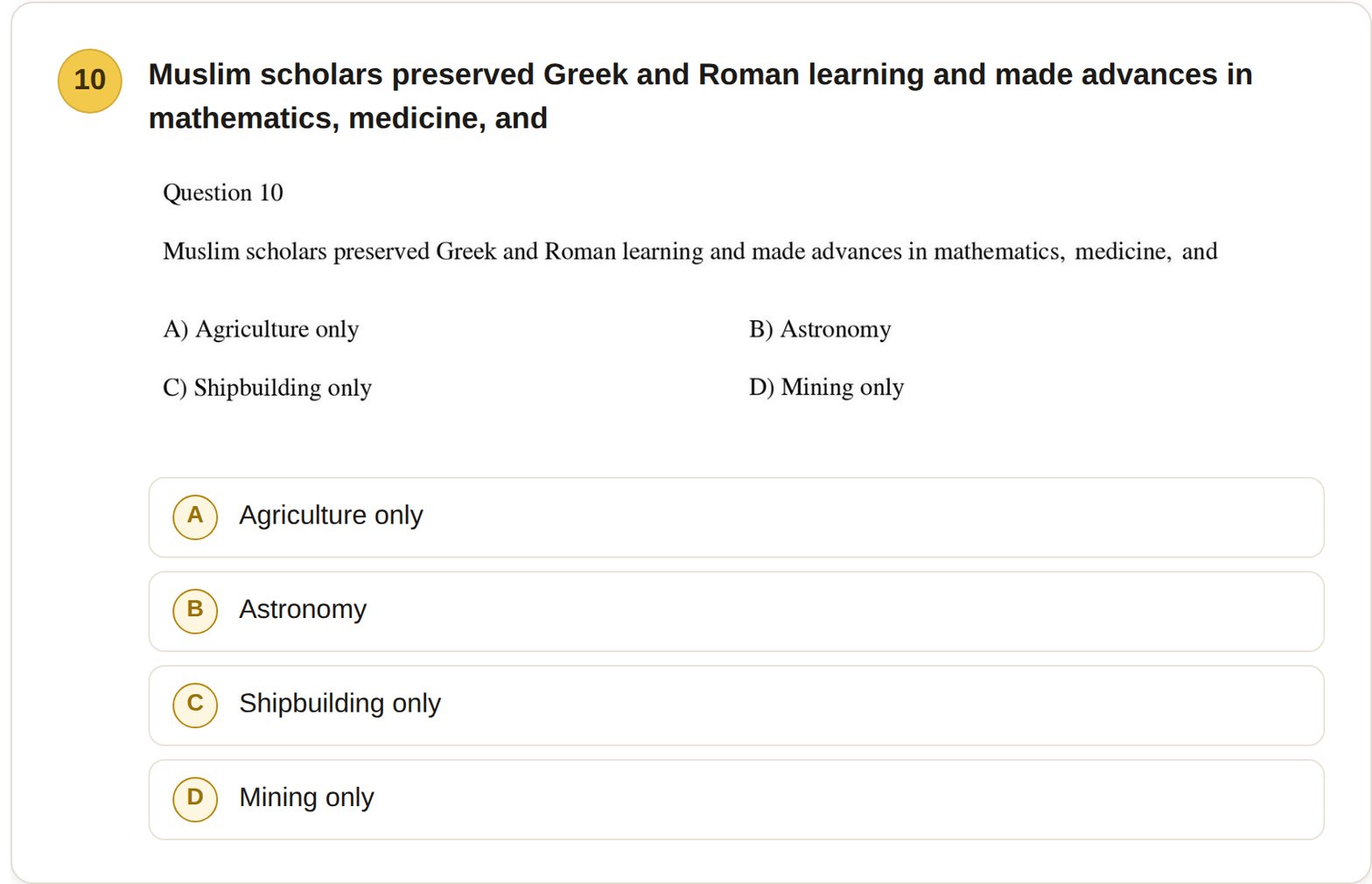
Muslim scholars preserved Greek and Roman learning and made advances in mathematics, medicine, and
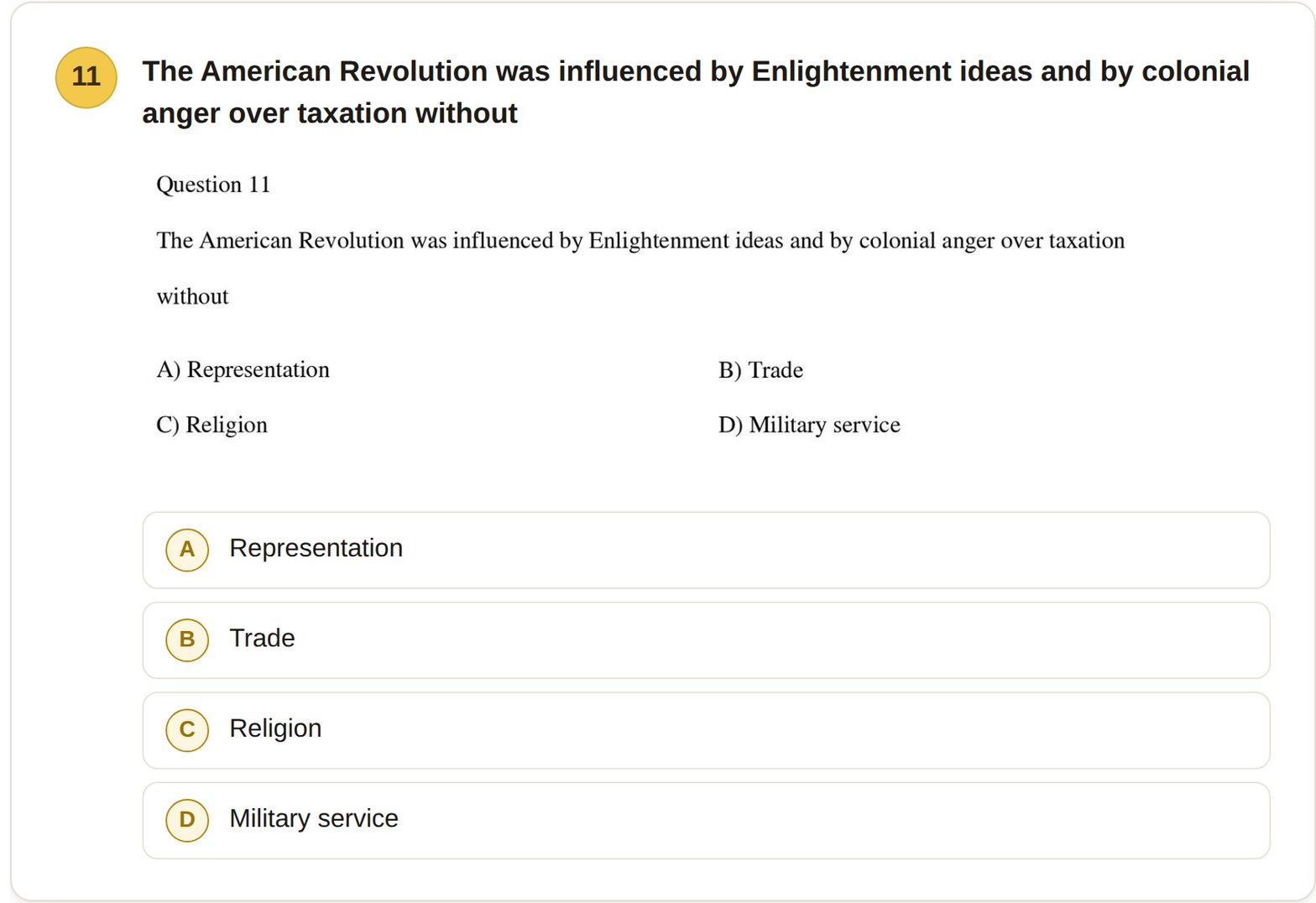
The American Revolution was influenced by Enlightenment ideas and by colonial anger over taxation without
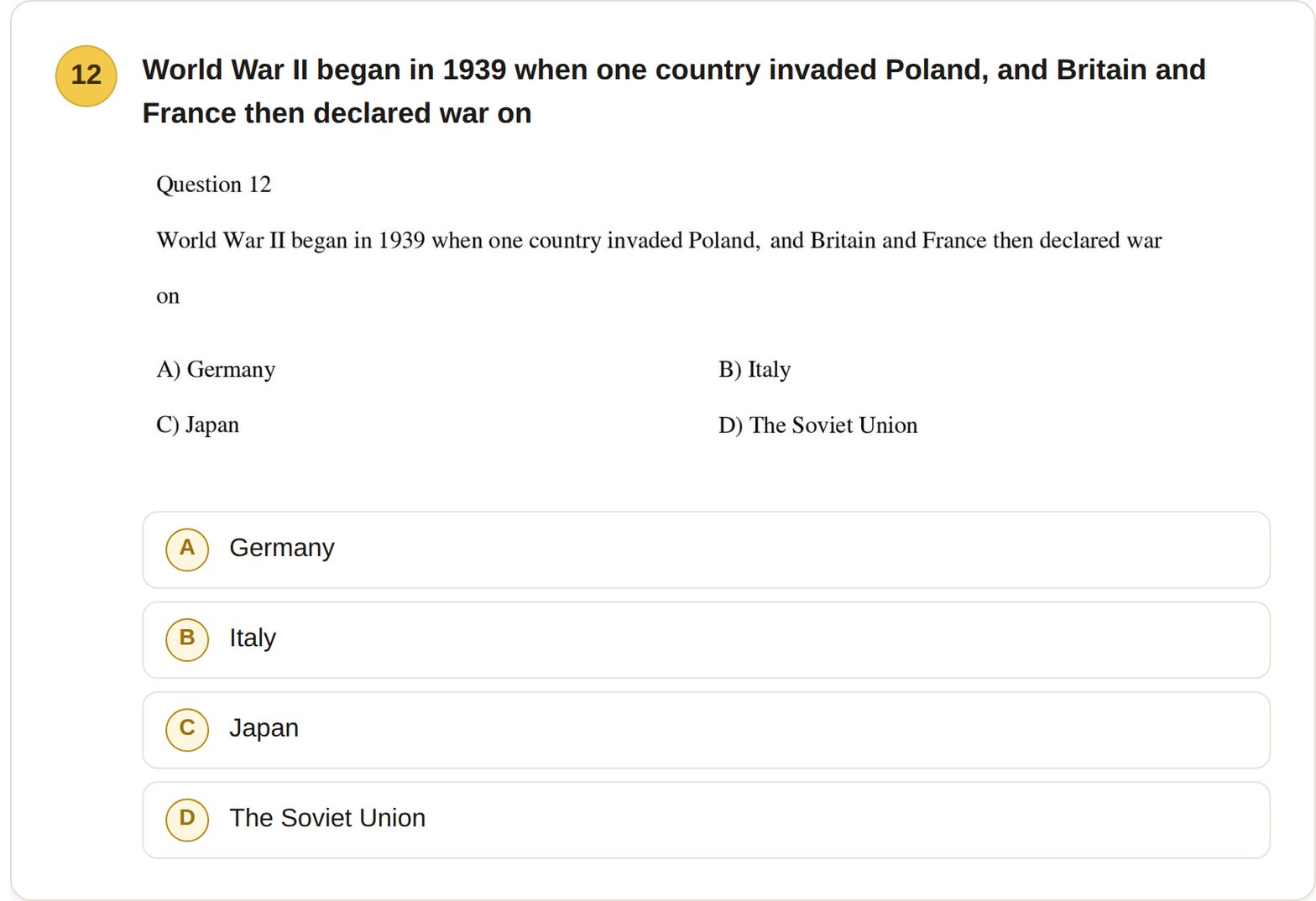
World War II began in 1939 when one country invaded Poland, and Britain and France then declared war on
In ancient India the caste system divided society into ranked groups that shaped a person's occupation and
The Crusades were a series of military expeditions by European Christians aimed mainly at regaining control of the
During the French Revolution the storming of the Bastille became a symbol of the people's challenge to royal
The D Day invasion of Normandy in 1944 opened a major western front against Germany and helped lead to the liberation of
Confucius taught that social harmony comes from respect for elders, proper behavior, and strong
The Mongol Empire under Genghis Khan created the largest continuous land empire in history, and Mongol rule helped make Eurasian trade routes
The Industrial Revolution began in Britain in the late 1700s because Britain had coal, iron, capital, and a growing supply of
The Korean War ended in an armistice in 1953 that left Korea divided along a line near the 38th
The Silk Road was a network of trade routes that connected China with Central Asia, India, and the
The Inca Empire in South America built a vast road network and used a system of knotted cords called quipu to keep
Urbanization during the Industrial Revolution meant that many people moved from farms to cities to work in
India gained independence from Britain in 1947 and was partitioned into India and
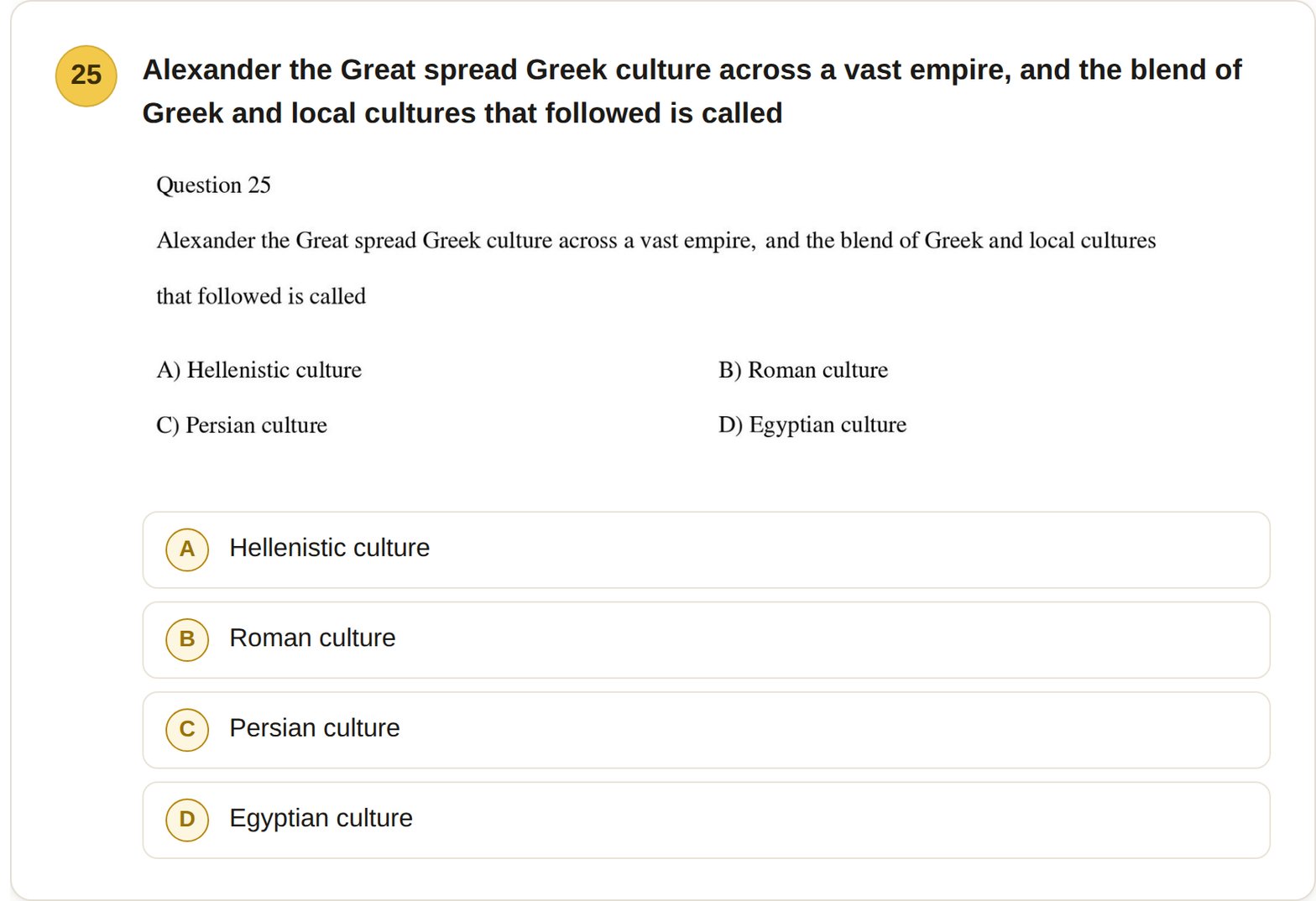
Alexander the Great spread Greek culture across a vast empire, and the blend of Greek and local cultures that followed is called
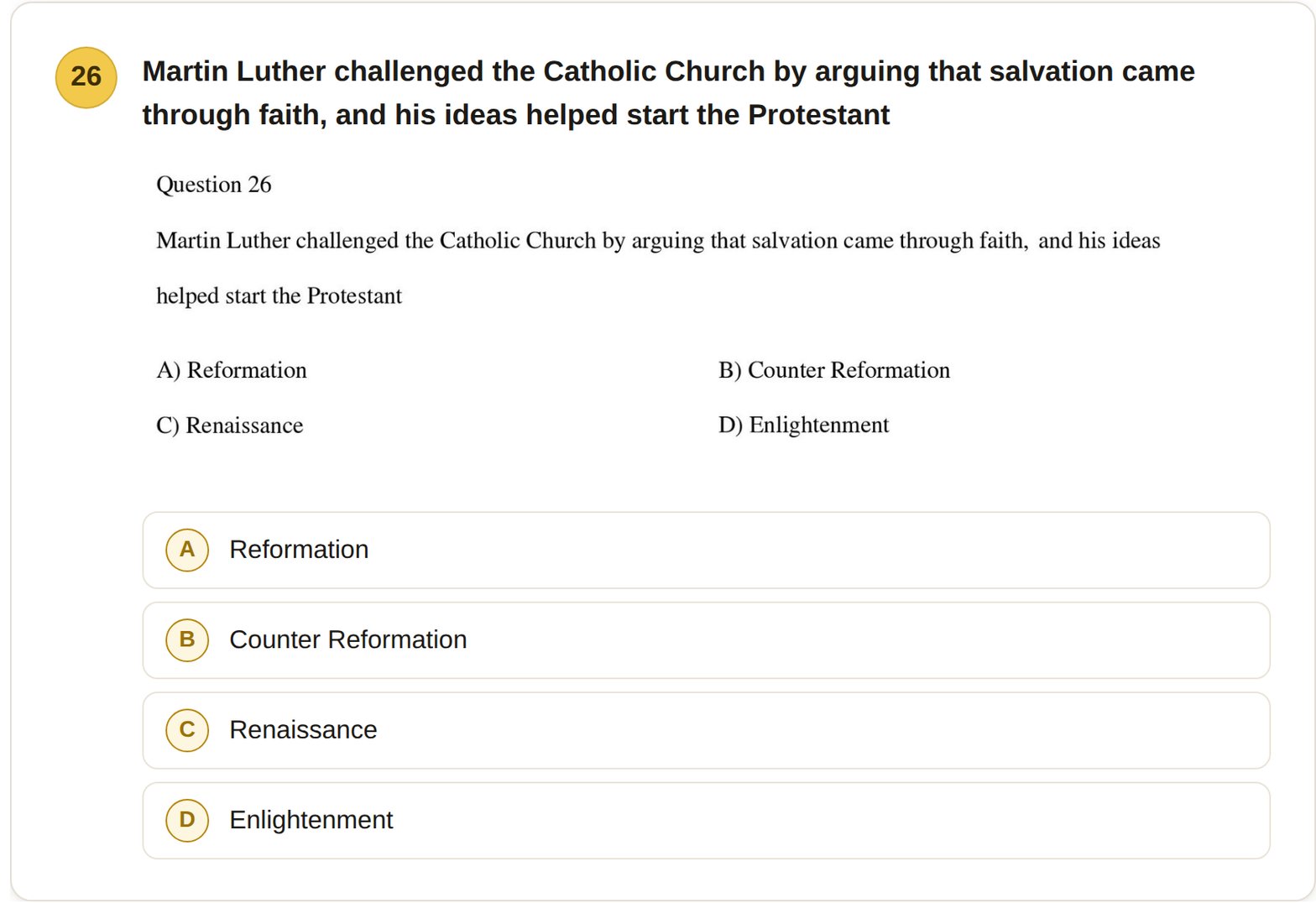
Martin Luther challenged the Catholic Church by arguing that salvation came through faith, and his ideas helped start the Protestant
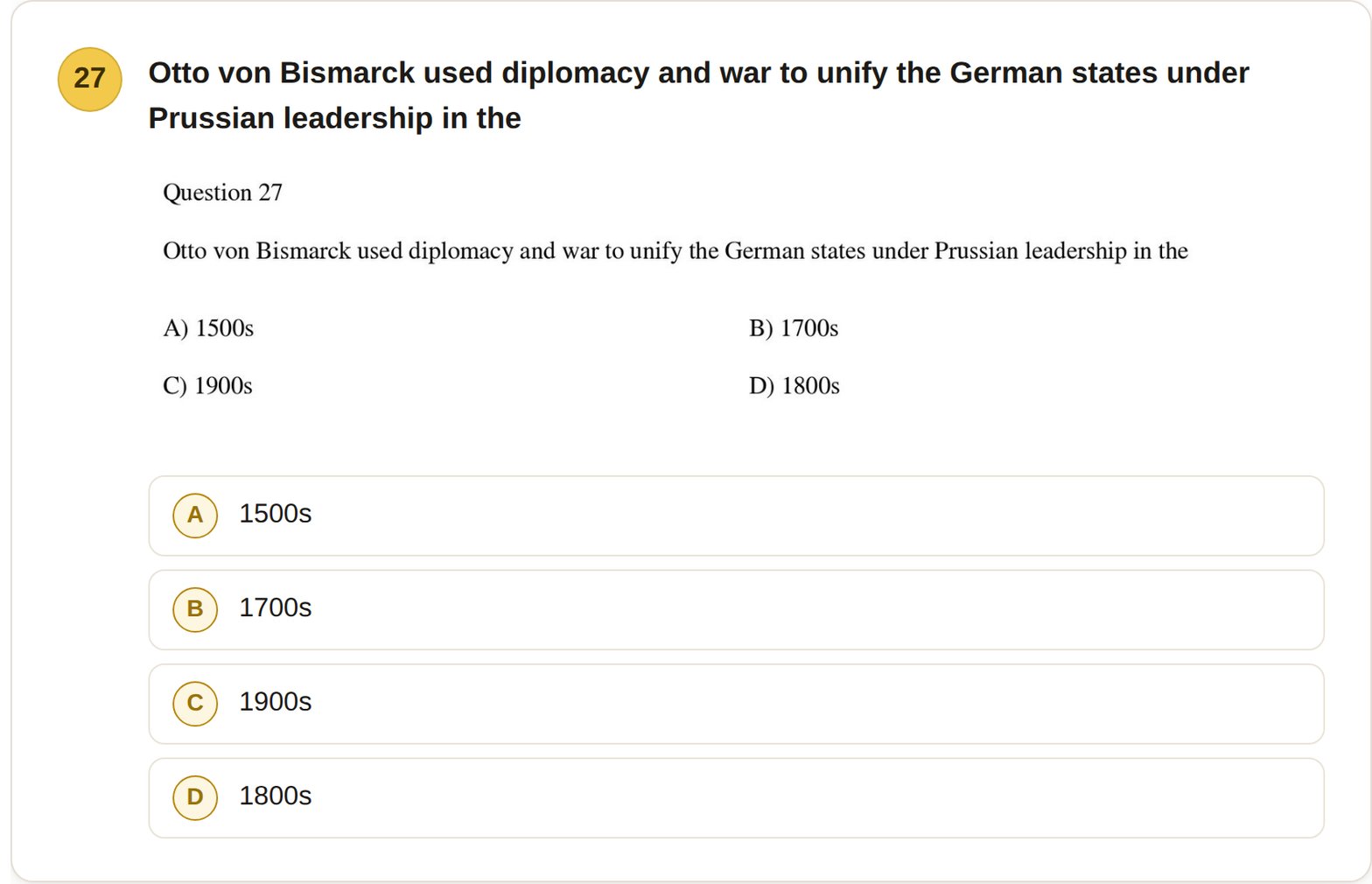
Otto von Bismarck used diplomacy and war to unify the German states under Prussian leadership in the
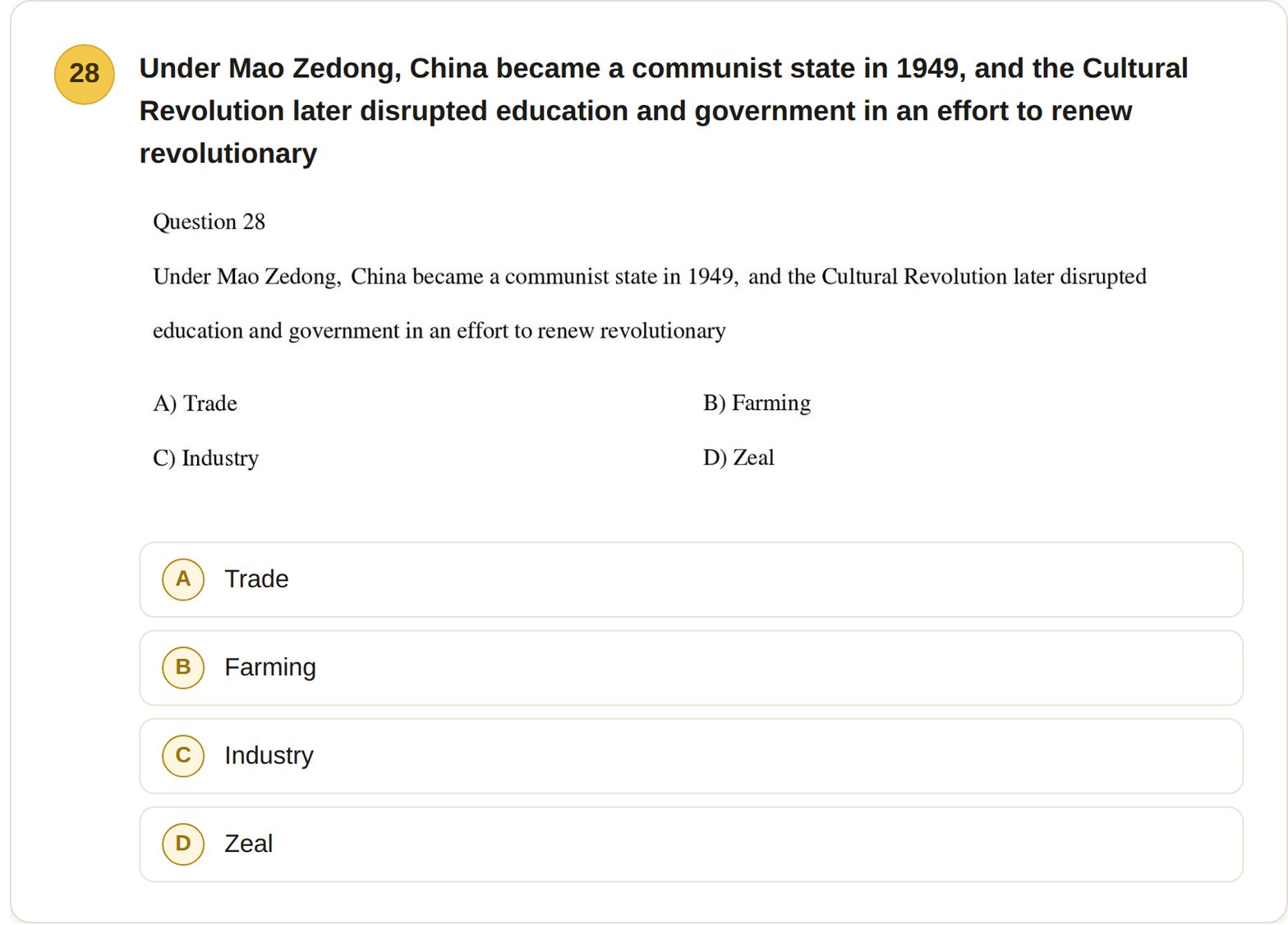
Under Mao Zedong, China became a communist state in 1949, and the Cultural Revolution later disrupted education and government in an effort to renew revolutionary
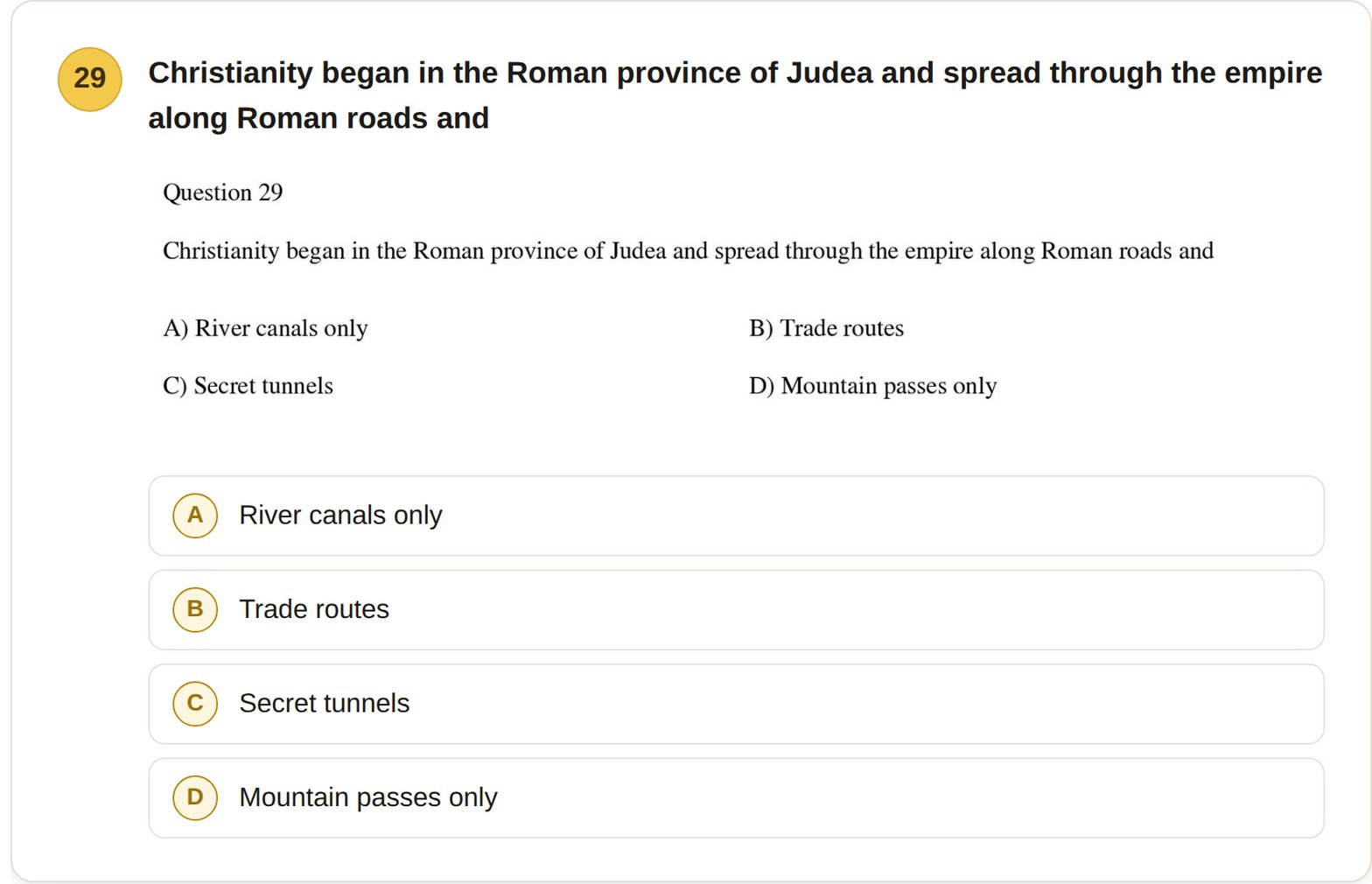
Christianity began in the Roman province of Judea and spread through the empire along Roman roads and
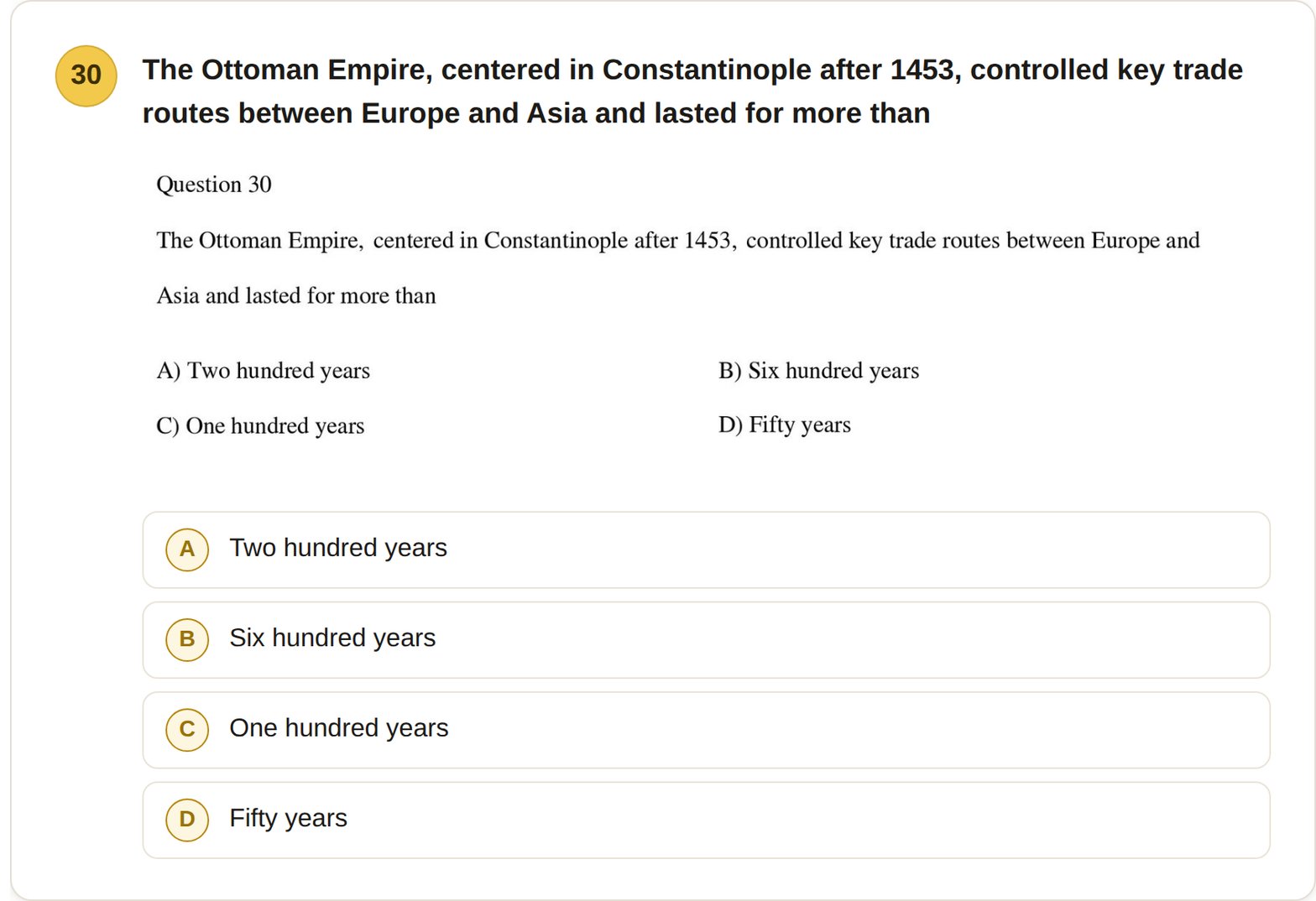
The Ottoman Empire, centered in Constantinople after 1453, controlled key trade routes between Europe and Asia and lasted for more than
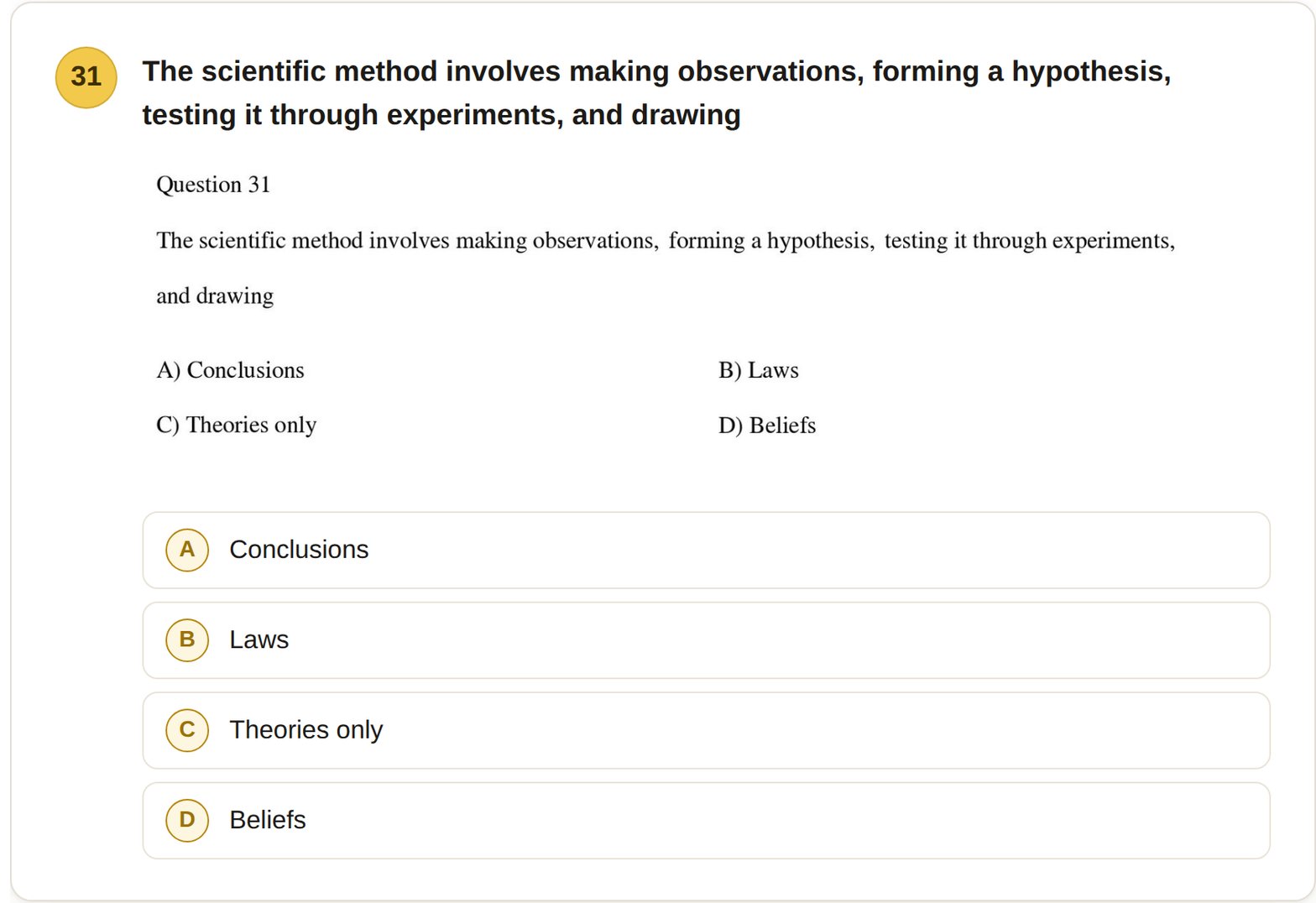
The scientific method involves making observations, forming a hypothesis, testing it through experiments, and drawing
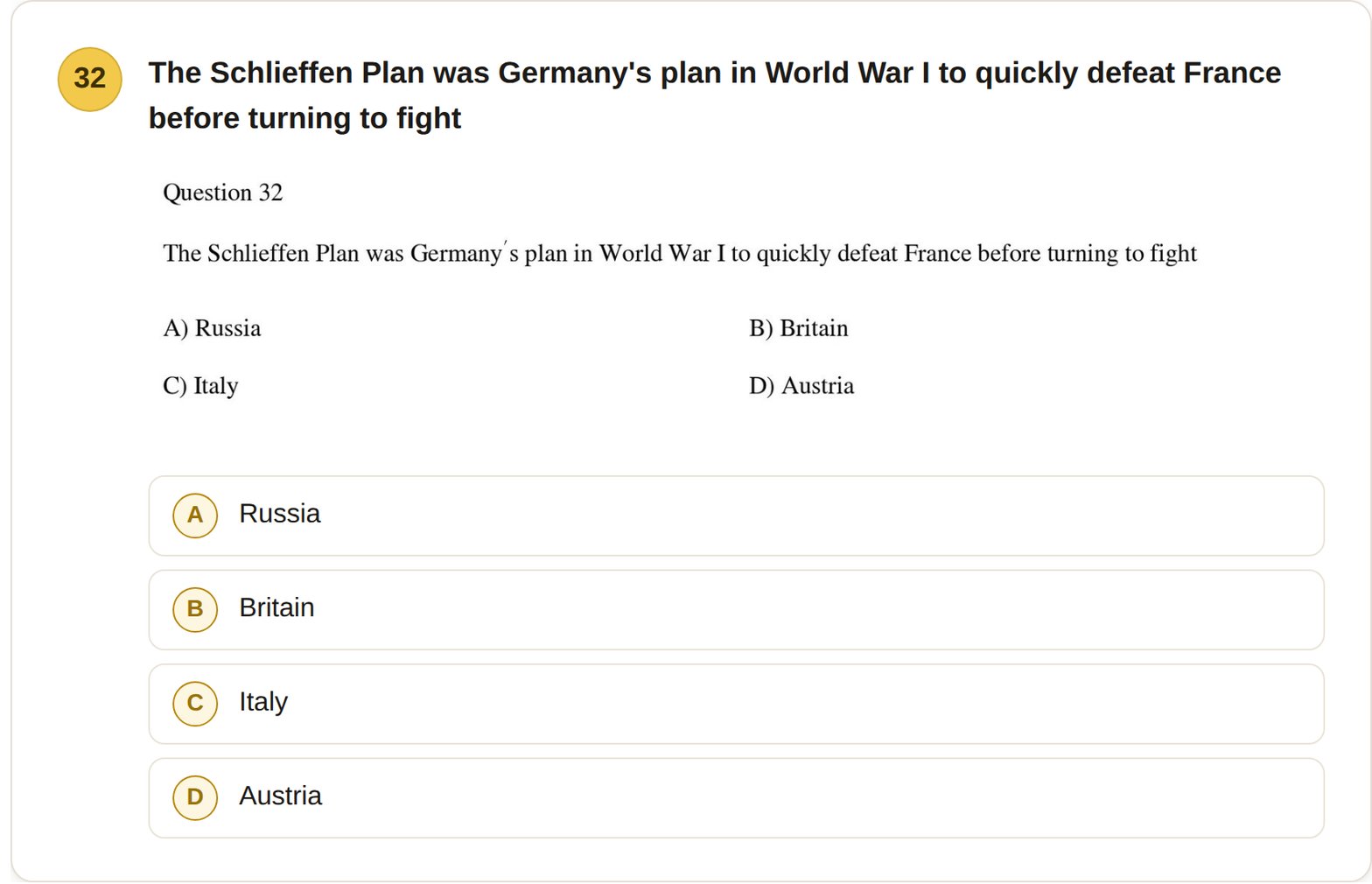
The Schlieffen Plan was Germany's plan in World War I to quickly defeat France before turning to fight
The development of agriculture led to permanent settlements, which in turn led to job specialization and the growth of
The Magna Carta, signed in England in 1215, limited the power of the king and established the principle that even a king must follow the
The Constitution created a federal system in which power is shared between the national government and the
The Marshall Plan provided American aid to help rebuild Western Europe after World War II and to strengthen resistance to
The pyramids of Egypt were built mainly as tombs for pharaohs and reflected Egyptian beliefs about
The Song dynasty in China saw growth in trade, urban life, and technology, including the use of paper money and advances in
Miguel Hidalgo helped spark Mexican independence by calling on people to rise against Spanish rule in
Apartheid in South Africa was a system of racial segregation that ended in the early 1990s, and Nelson Mandela was elected president in
The Zhou dynasty in China is known for introducing the idea that a dynasty could lose the Mandate of Heaven if it became
John Calvin taught that God had already chosen who would be saved, an idea known as
Karl Marx argued that history was driven by class struggle between owners of production and workers, and he called for workers to unite to change the
The European Union is an economic and political partnership of European countries that promotes cooperation, trade, and free movement of people and
Socrates, Plato, and Aristotle were Greek philosophers who questioned ideas about knowledge, justice, and the best form of
The Spanish conquest of the Aztec Empire was led by Hernan Cortes, whose forces were aided by rival Native groups and by European
The Suez Canal, opened in 1869, shortened the sea route between Europe and Asia by connecting the Mediterranean Sea to the
Advances in medicine, including vaccines and antibiotics, have greatly increased life expectancy and reduced deaths from infectious
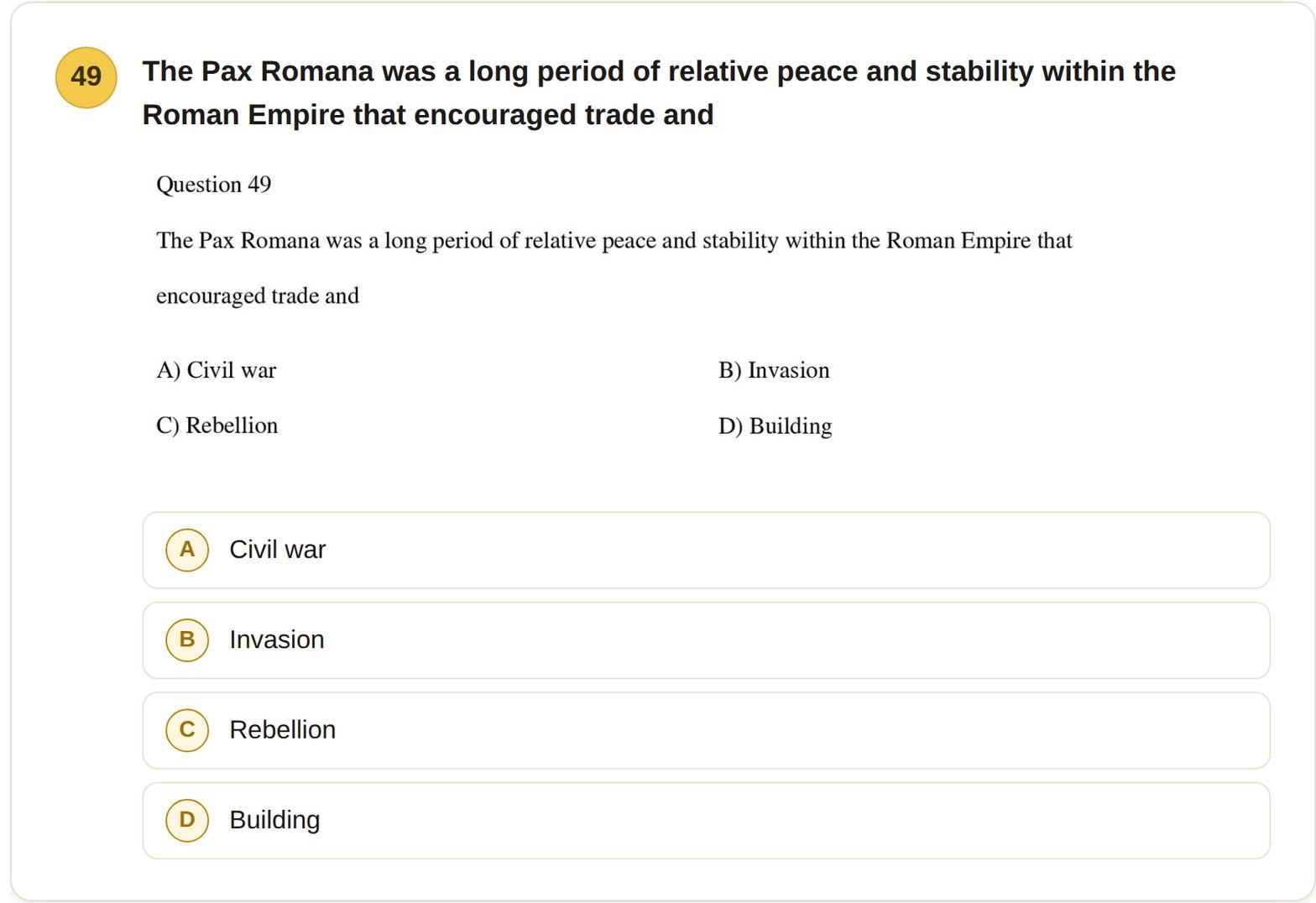
The Pax Romana was a long period of relative peace and stability within the Roman Empire that encouraged trade and
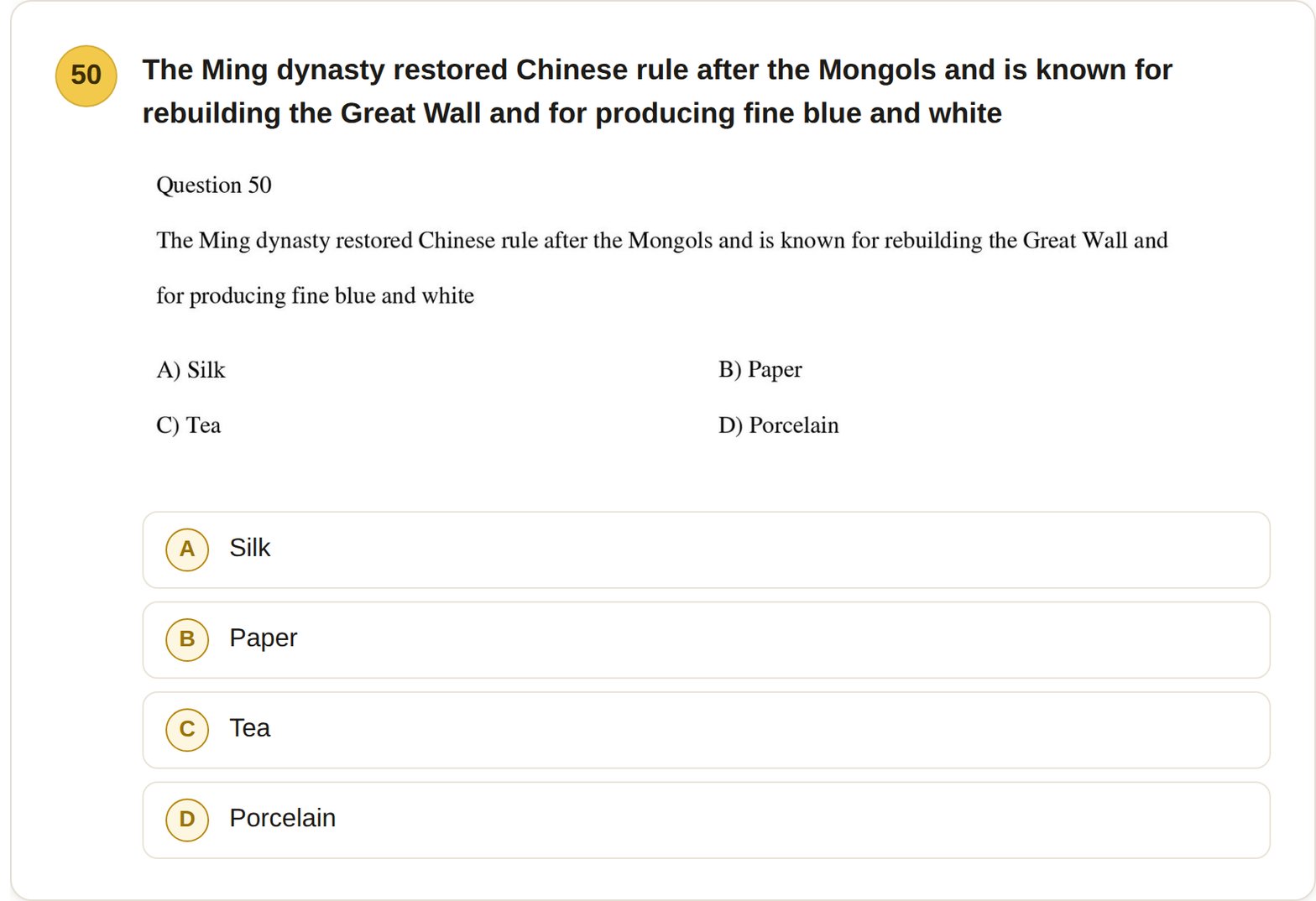
The Ming dynasty restored Chinese rule after the Mongols and is known for rebuilding the Great Wall and for producing fine blue and white
Your score: 0 / 50