View as PDF

British Columbia English Language Arts 10: Literary Studies and Composition · Unit A · 25 questions

Reading and Understanding Literature — Practice Test

This practice test was made by AI and there may be mistakes. If a question or answer looks wrong, use the Flag a mistake button to let Brett know so he can fix it.

Reading I - The Blue Bicycle

Use this reading for questions 1 to 6.

Mara found the bicycle at the back of her grandmother's shed, half hidden behind stacked boxes and an old ladder. Its blue paint was chipped, its tires were flat, and a thin coat of dust covered the handlebars. A small brass bell still hung from the handlebar, and when Mara touched it, it gave a faint, clear ring.

All through June, Mara worked on the bicycle after school. She cleaned the chain, pumped up the tires, and tightened every bolt she could reach. Some evenings she wanted to quit, especially when a bolt would not move or when grease stained her hands. She kept going anyway, because she had promised herself she would ride it before summer ended.

On the last Saturday of July, Mara rode the bicycle down the quiet road to the library. The wind pulled at her jacket, the bell rang each time she crossed a bump, and the town seemed smaller and brighter than it had before. When she returned, her grandmother was waiting on the porch, smiling in a way that told Mara she understood exactly how the ride had felt.

1

According to Reading I, what is the main idea of the passage?

Cyclist riding a bicycle along a country road
Understand It with Pulse
2

According to Reading I, which word best describes Mara?

Understand It with Pulse
3

According to Reading I, why does the author describe the chipped paint, flat tires, and dust?

Understand It with Pulse
4

According to Reading I, from which point of view is the story told?

Understand It with Pulse
5

According to Reading I, what is the main conflict in the story?

Understand It with Pulse
6

According to Reading I, what can the reader infer about why Mara's grandmother smiles on the porch?

Understand It with Pulse

Reading II - Winter Light

Use this reading for questions 7 to 11.

The snow came down like a held breath, soft and slow over the roofs.

Morning light lay thin across the yard, and the fence posts wore white caps.

I stood at the window and watched the road disappear, then come back again.

Nothing hurried. Nothing asked to be hurried. The world kept its quiet promise.

When the sun broke through at noon, the snow answered with a thousand small lights.

I stepped outside, and the cold air woke my face like a splash of clear water.

7

According to Reading II, what is the main idea of the poem?

Snow-covered residential street on a cold winter morning, bare trees and glowing street lamps
Understand It with Pulse
8

According to Reading II, the line about snow falling like a held breath is an example of

Understand It with Pulse
9

According to Reading II, which word best describes the mood of the poem?

Understand It with Pulse
10

According to Reading II, what does the speaker do at the end of the poem?

Understand It with Pulse
11

According to Reading II, why does the poet repeat the idea that nothing hurried?

Understand It with Pulse

Reading III - Why Cities Plant Street Trees

Use this reading for questions 12 to 17.

Many cities are planting more trees along their streets, and the reasons go beyond good looks. On a hot summer day, a street shaded by trees can be up to 5 degrees cooler than a street in full sun. Shade from a leafy canopy lowers the temperature of the pavement, which helps people walking, cycling, and waiting for buses feel more comfortable.

Trees also help clean the air. Their leaves trap dust and take in gases that come from cars and trucks. In heavy rain, tree roots and the soil around them soak up water that might otherwise flood a road or a basement. Birds and insects find food and shelter in city trees, so even a single row of trees can support more wildlife than a bare street.

Planting trees is not free, and cities must plan for the cost. Young trees need watering in their first years, and older trees need pruning so their branches do not block signs or power lines. Still, many city planners argue that the benefits are worth the work, because a healthy street tree can serve a neighbourhood for fifty years or more.

12

According to Reading III, what is the main idea of the passage?

A quiet city street shaded by a dense canopy of green trees, parked cars along the curb
Understand It with Pulse
13

According to Reading III, by how much can a shaded street be cooler than a street in full sun?

Understand It with Pulse
14

According to Reading III, what is the author's main purpose?

Understand It with Pulse
15

According to Reading III, in this passage the word canopy most nearly means

Understand It with Pulse
16

According to Reading III, which text structure does the author mainly use?

Understand It with Pulse
17

According to Reading III, which statement is supported by the passage?

Understand It with Pulse

Reading IV - Join the School Garden Club

Use this reading for questions 18 to 22.

This poster hangs by the main office of a school. At the top, in large green letters, it reads: GROW SOMETHING GOOD. Below the headline is a photograph of three students planting small seedlings in a raised bed, their hands covered in soil and their faces turned toward the sun.

Under the photograph, the poster gives three facts in bold print. Meetings are every Tuesday after school in the greenhouse behind the gym. No experience is needed, and all tools are provided. New members will plant their own row of vegetables in the spring garden.

At the bottom, in smaller print, the poster says: Bring a friend. Snacks provided at the first meeting.

18

According to Reading IV, what is the main purpose of the poster?

Tall sunflower in full bloom in a sunny garden
Understand It with Pulse
19

According to Reading IV, when and where does the garden club meet?

Understand It with Pulse
20

According to Reading IV, who is the intended audience of the poster?

Understand It with Pulse
21

According to Reading IV, why does the poster show students planting small seedlings?

Understand It with Pulse
22

According to Reading IV, which persuasive technique does the headline GROW SOMETHING GOOD use?

Understand It with Pulse
23

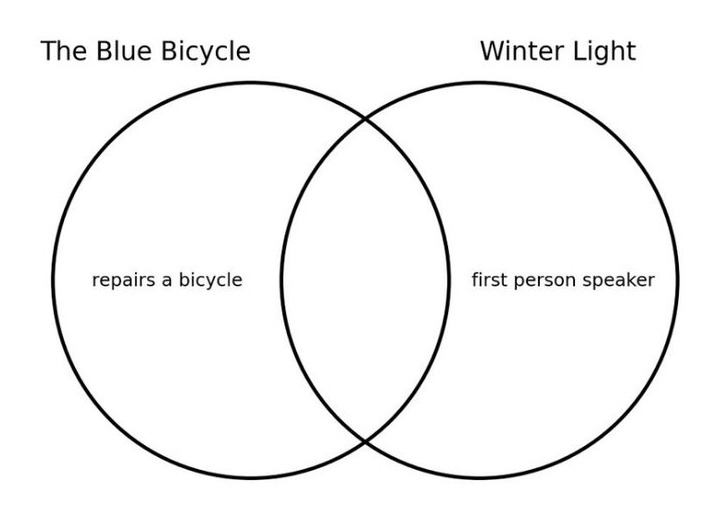
In the diagram, which idea belongs in the overlapping middle region shared by both texts?

Diagram for Question 23
Understand It with Pulse
24

Which statement best explains the difference between a topic and a theme?

Understand It with Pulse
25

A character packs a bag the night before a trip, checks the bus time twice, and sets two alarms. What can the reader most reasonably infer?

City bus stopped at a bus stop on a city street
Understand It with Pulse