1
The organelle that releases most of the usable energy in an animal cell is the
A mitochondrion B nucleus C ribosome D vacuole
What looks wrong with Question 1?
Send anonymously
Cancel
2
The organelle where proteins are assembled from amino acids is the
A lysosome B ribosome C Golgi body D cell membrane
What looks wrong with Question 2?
Send anonymously
Cancel
3
The structure that controls which substances enter and leave a cell is the
A Vacuole B Nucleus C Cell membrane D Cytoskeleton
What looks wrong with Question 3?
Send anonymously
Cancel
4
In an animal cell, most of the DNA is stored in the
A mitochondrion B ribosome C Golgi body D nucleus
What looks wrong with Question 4?
Send anonymously
Cancel
5
The organelle that packages proteins for transport out of a cell is the
A Golgi body B lysosome C nucleus D vacuole
What looks wrong with Question 5?
Send anonymously
Cancel
6
The organelle that breaks down worn out cell parts with enzymes is the
A Ribosome B Lysosome C Mitochondrion D Cell membrane
What looks wrong with Question 6?
Send anonymously
Cancel
7
In a DNA molecule, the base adenine always pairs with
A guanine B cytosine C thymine D uracil
What looks wrong with Question 7?
Send anonymously
Cancel
8
The shape of a DNA molecule is best described as a
A Single strand B Triple helix C Flat sheet D Double helix
What looks wrong with Question 8?
Send anonymously
Cancel
9
The monomer that makes up a protein is an
A Amino acid B Fatty acid C Nucleotide D Glucose unit
What looks wrong with Question 9?
Send anonymously
Cancel
10
The monomer that makes up a nucleic acid is a
A Amino acid B Nucleotide C Fatty acid D Glycerol unit
What looks wrong with Question 10?
Send anonymously
Cancel
11
An enzyme speeds up a chemical reaction in a cell by
A Raising the temperature of the whole cell B Being used up in the reaction C Lowering the activation energy needed D Adding energy to the products
What looks wrong with Question 11?
Send anonymously
Cancel
12
The process in which a DNA sequence is copied into messenger RNA is called
A Translation B Replication C Mutation D Transcription
What looks wrong with Question 12?
Send anonymously
Cancel
13
Transcription in a human cell takes place in the
A nucleus B ribosome C lysosome D Golgi body
What looks wrong with Question 13?
Send anonymously
Cancel
14
During translation, the molecule that carries an amino acid to a ribosome is
A DNA B transfer RNA C glucose D ATP
What looks wrong with Question 14?
Send anonymously
Cancel
15
A group of three bases on messenger RNA that codes for one amino acid is a
A Gene B Chromosome C Codon D Anticodon
What looks wrong with Question 15?
Send anonymously
Cancel
16
The number of bases in one codon is
What looks wrong with Question 16?
Send anonymously
Cancel
17
The graph shows the number of cells in a culture as the cells divide by mitosis. Between hour 1 and hour 3, the cell count
A stayed at 20 B increased from 20 to 80 C decreased from 80 to 20 D increased from 20 to 40
What looks wrong with Question 17?
Send anonymously
Cancel
18
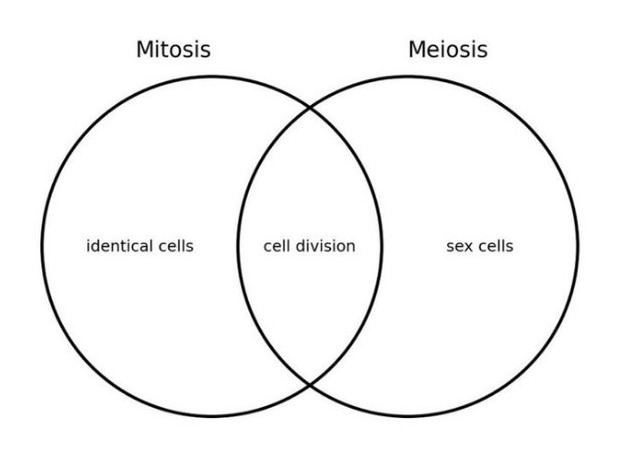
The diagram compares mitosis and meiosis. The feature shared by both kinds of cell division is that they
A produce sex cells only B halve the chromosome number C divide a cell into daughter cells D produce identical daughter cells
What looks wrong with Question 18?
Send anonymously
Cancel
19
After mitosis, each daughter cell normally has the same number of chromosomes as the
A parent cell B sex cell C gamete D egg cell
What looks wrong with Question 19?
Send anonymously
Cancel
20
In a human body cell with 46 chromosomes, a gamete formed by meiosis normally has
What looks wrong with Question 20?
Send anonymously
Cancel
21
The phase of mitosis in which sister chromatids are pulled apart is
A Prophase B Anaphase C Telophase D Interphase
What looks wrong with Question 21?
Send anonymously
Cancel
22
The graph shows enzyme activity at different temperatures. Enzyme activity is highest at
A 10 degrees B 20 degrees C 37 degrees D 60 degrees
What looks wrong with Question 22?
Send anonymously
Cancel
23
Identical twins have the same genes but can differ in traits such as skin tone. This difference is best explained by
A different numbers of chromosomes B the environment affecting gene expression C different DNA base pairs D mutations in every gene
What looks wrong with Question 23?
Send anonymously
Cancel
24
A phenotype is best described as the
A set of alleles a person inherits B DNA sequence of one gene C observable traits that result from genes and environment D number of chromosomes in a cell
What looks wrong with Question 24?
Send anonymously
Cancel
25
A change in a DNA sequence that can be passed to offspring must occur in a
A skin cell B muscle cell C nerve cell D gamete cell
What looks wrong with Question 25?
Send anonymously
Cancel