1
Chemical digestion of starch begins in the
A mouth B stomach C large intestine D liver
What looks wrong with Question 1?
Send anonymously
Cancel
2
The enzyme in saliva that begins starch digestion is
A pepsin B amylase C lipase D trypsin
What looks wrong with Question 2?
Send anonymously
Cancel
3
The stomach produces acid and the enzyme pepsin to begin digestion of
A starch B fat C protein D fibre
What looks wrong with Question 3?
Send anonymously
Cancel
4
The wave like muscle contractions that move food along the gut are called
A villi B absorption C emulsification D peristalsis
What looks wrong with Question 4?
Send anonymously
Cancel
5
Most chemical digestion and nutrient absorption take place in the
A small intestine B stomach C large intestine D oesophagus
What looks wrong with Question 5?
Send anonymously
Cancel
6
Villi in the small intestine increase absorption mainly by
A making stronger stomach acid B increasing surface area C storing bile D producing insulin
What looks wrong with Question 6?
Send anonymously
Cancel
7
Bile helps fat digestion by
A breaking fat into small droplets B digesting protein in the stomach C absorbing water in the colon D making stomach acid
What looks wrong with Question 7?
Send anonymously
Cancel
8
Bile is produced in the
A pancreas B liver C gallbladder D small intestine
What looks wrong with Question 8?
Send anonymously
Cancel
9
The main job of the large intestine is to absorb
A amino acids B glucose C water D fatty acids
What looks wrong with Question 9?
Send anonymously
Cancel
10
The pancreas releases enzymes into the
A stomach B liver C large intestine D small intestine
What looks wrong with Question 10?
Send anonymously
Cancel
11
The flap that keeps food out of the windpipe during swallowing is the
A epiglottis B diaphragm C alveolus D bronchus
What looks wrong with Question 11?
Send anonymously
Cancel
12
The trachea is held open by
A smooth muscle B rings of cartilage C bone D elastic fibres
What looks wrong with Question 12?
Send anonymously
Cancel
13
Gas exchange between air and blood takes place mainly in the
A bronchi B trachea C alveoli D bronchioles
What looks wrong with Question 13?
Send anonymously
Cancel
14
During inhalation, the diaphragm
A relaxes and moves up B stops moving C pushes air out D contracts and moves down
What looks wrong with Question 14?
Send anonymously
Cancel
15
At an alveolus, oxygen moves from the air into the blood by
A active transport B diffusion C osmosis of air D peristalsis
What looks wrong with Question 15?
Send anonymously
Cancel
16
Most oxygen in blood is carried by
A plasma B platelets C haemoglobin D white cells
What looks wrong with Question 16?
Send anonymously
Cancel
17
The graph shows breathing rate before, during and after exercise. Breathing rate is highest
A at rest B after recovery C before exercise D during exercise
What looks wrong with Question 17?
Send anonymously
Cancel
18
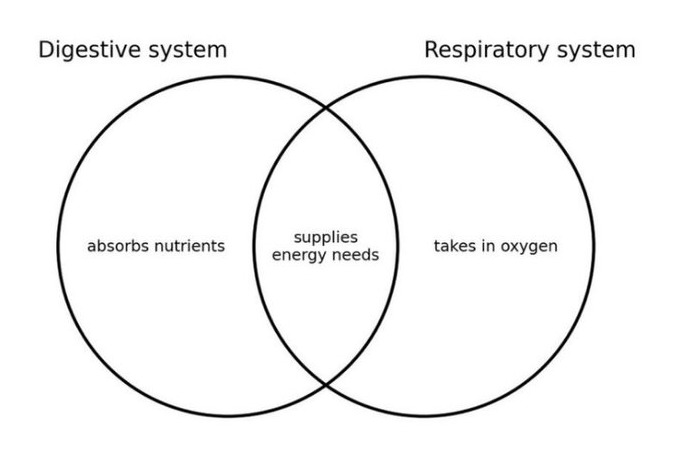
The diagram compares the digestive system and the respiratory system. The role shared by both systems is that they
A break down food B supply materials the body needs for energy C filter blood D make hormones
What looks wrong with Question 18?
Send anonymously
Cancel
19
Carbon dioxide produced by cells is removed from the body mainly through the
A kidneys B skin C liver D lungs
What looks wrong with Question 19?
Send anonymously
Cancel
20
A rise in blood carbon dioxide normally causes breathing rate to
A increase B decrease C stop D stay the same
What looks wrong with Question 20?
Send anonymously
Cancel
21
The graph shows oxygen use during rest and exercise. Oxygen use during exercise compared with rest is
A lower B the same C higher D zero
What looks wrong with Question 21?
Send anonymously
Cancel
22
When blood glucose rises after a meal, the digestive and endocrine systems together
A release insulin to lower blood glucose B stop all digestion C raise breathing rate only D remove glucose in urine
What looks wrong with Question 22?
Send anonymously
Cancel
23
The main function of mucus in the airways is to
A carry oxygen B make sound C absorb nutrients D trap dust and microbes
What looks wrong with Question 23?
Send anonymously
Cancel
24
In the lungs, the wall of an alveolus is thin so that
A air can be stored B gases diffuse quickly C blood flows slowly D mucus is made
What looks wrong with Question 24?
Send anonymously
Cancel
25
A person with asthma has narrowed airways. The most direct effect is that
A less air reaches the alveoli B food digestion stops C blood pressure drops to zero D kidneys stop filtering
What looks wrong with Question 25?
Send anonymously
Cancel