1
According to Reading I, how does the student remember the stories best?
A avoiding the river after the first visit B walking the path again and noticing new details C writing the stories down and never returning D asking someone else to remember for her
What looks wrong with Question 1?
Send anonymously
Cancel
2
According to Reading I, how does the parent explain the limit on fishing?
A other families do not matter B the river will never run out C fishing rules are only for visitors D the river must feed people in coming years
What looks wrong with Question 2?
Send anonymously
Cancel
3
According to Reading I, what often happened to children in residential schools who spoke their languages?
A rewarded for speaking their languages B punished for speaking their languages C allowed to speak any language freely D never separated from their families
What looks wrong with Question 3?
Send anonymously
Cancel
4
According to Reading I, what do hereditary leaders in the discussion speak about?
A only about budgets B only about other nations C nothing about the land D long standing responsibilities to the territory
What looks wrong with Question 4?
Send anonymously
Cancel
5
What is a student overlooking who says that all First Peoples in British Columbia are the same?
A the diversity among nations in British Columbia B the fact that British Columbia has no First Nations C the idea that diversity is a new invention D the claim that all nations share one territory
What looks wrong with Question 5?
Send anonymously
Cancel
6
How does each First Nation traditional territory compare with the territories of other nations?
A the same territory as every other nation B a territory defined only by modern cities C its own traditional territory, distinct from other nations D no territory at all
What looks wrong with Question 6?
Send anonymously
Cancel
7
How did residential schools aim to assimilate Indigenous children?
A strengthening family and language ties B removing them from families, languages, and cultures C providing free choice of schooling D teaching only in Indigenous languages
What looks wrong with Question 7?
Send anonymously
Cancel
8
What does self government mean?
A outsiders making all decisions for a nation B a nation with no laws at all C decisions about one town only D its own decisions about lands, laws, services, and future
What looks wrong with Question 8?
Send anonymously
Cancel
9
How many distinct First Nations languages is British Columbia home to?
A only one First Nations language B no First Nations languages at all C languages that are all identical to each other D more than 30 distinct First Nations languages
What looks wrong with Question 9?
Send anonymously
Cancel
10
What do practices such as controlled burning and clam gardens show?
A never changed any landscape B actively managed landscapes long before the present C only arrived on landscapes recently D managed land only after European contact
What looks wrong with Question 10?
Send anonymously
Cancel
11
What were the effects of residential schools, and how long have they been felt?
A language loss, family disruption, and trauma across generations B only the students who attended, with no wider effects C only school buildings D only one community for one year
What looks wrong with Question 11?
Send anonymously
Cancel
12
What was the Nisga'a Treaty, which came into effect in 2000?
A a historic treaty from the 1800s B a treaty in another province C the first modern treaty in British Columbia, in 2000 D an agreement that gave no self government
What looks wrong with Question 12?
Send anonymously
Cancel
13
How are oral traditions best described?
A tales invented freshly at every telling B entertainment with no teaching purpose C stories and teachings passed carefully across generations D records that no one is allowed to question or check
What looks wrong with Question 13?
Send anonymously
Cancel
14
What can restoring an original Indigenous place name affirm?
A connection to territory and knowledge carried in the name B nothing beyond changing a sign C erasing all history of a place D a rule that applies only to one town
What looks wrong with Question 14?
Send anonymously
Cancel
15
How is status under the Indian Act different from membership in a nation?
A the same as nation membership in every case B a category created by nations themselves C a status that never affected anyone D a legal category, distinct from nation membership
What looks wrong with Question 15?
Send anonymously
Cancel
16
Which areas do the Calls to Action cover?
A only one area of life B child welfare, education, language, health, and justice C only sports and recreation D no areas affecting Indigenous peoples
What looks wrong with Question 16?
Send anonymously
Cancel
17
What does the First Peoples principle of holistic learning involve?
A only the mind, with no feeling or action B the whole person and not only memorised facts C only test scores D only one sense at a time
What looks wrong with Question 17?
Send anonymously
Cancel
18
What does land based learning teach together?
A only one subject at a time indoors B facts with no connection to place C skills that cannot be used outside school D ecology, language, and responsibility together
What looks wrong with Question 18?
Send anonymously
Cancel
19
What has happened to First Peoples languages, ceremonies, and governance despite bans and assimilation policies?
A disappeared entirely B survived only in museums C renewed only by outsiders D continued and are being renewed today
What looks wrong with Question 19?
Send anonymously
Cancel
20
The schematic map of Canada highlights one province. Which province is highlighted?
A Ontario alone B British Columbia C Quebec alone D a province outside Canada
What looks wrong with Question 20?
Send anonymously
Cancel
21
Which of the following best describes how identity works for a person?
A several layers at once, including nation, family, community, and school B only one layer, fixed for life C an identity chosen by strangers alone D an identity with no connection to family
What looks wrong with Question 21?
Send anonymously
Cancel
22
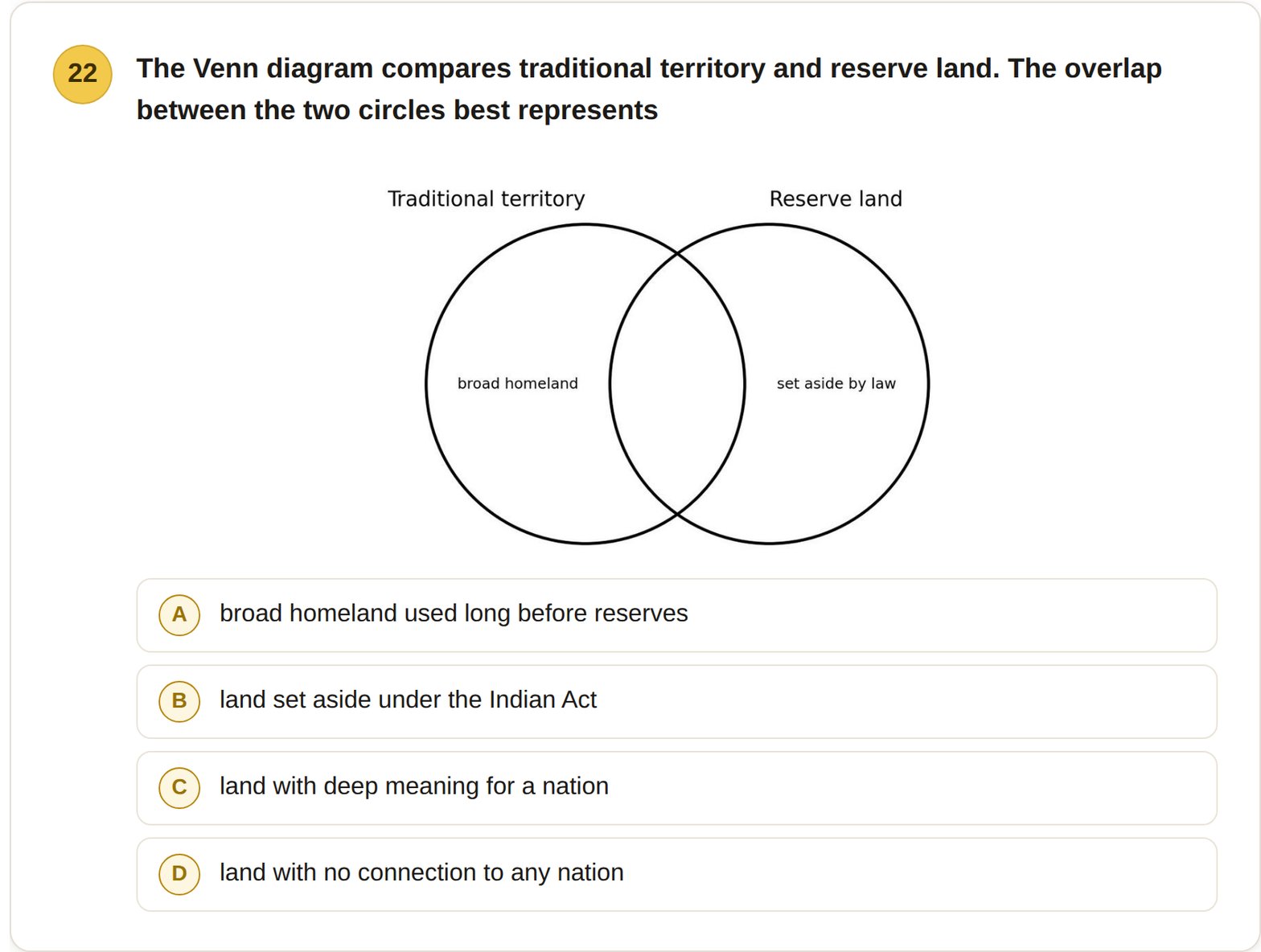
The Venn diagram compares traditional territory and reserve land. The overlap between the two circles best represents
A broad homeland used long before reserves B land set aside under the Indian Act C land with deep meaning for a nation D land with no connection to any nation
What looks wrong with Question 22?
Send anonymously
Cancel
23
Where did residential schools operate in Canada?
A only in eastern Canada B only outside Canada C across Canada, including British Columbia D never in British Columbia
What looks wrong with Question 23?
Send anonymously
Cancel
24
What does Reading I best illustrate about governance?
A traditional responsibilities with present services and youth voices B tradition with no present needs C present needs with no tradition D governance with no community input
What looks wrong with Question 24?
Send anonymously
Cancel
25
In many First Nations communities, how is the knowledge in an oral tradition kept accurate as it is passed on?
A listeners who know the story check it and ask questions B it is written down once and never changed C only one person is ever allowed to hear it D it is made up freshly at every telling
What looks wrong with Question 25?
Send anonymously
Cancel
Reading II - Mapping Place Names
Use this reading for question 26.
A community mapping project brings youth and elders together. Elders share place names and the stories behind them, and youth mark the places on a map. One name describes a safe crossing. Another name recalls a gathering place for trading and feasting. A third name warns about a steep bank after rain.
The map is kept by the community for teaching. It is not made to sell the land or to invite strangers to use places without permission. The youth learn that a name can hold directions, history, and rules for safe and respectful use, all at once.
- An invented account of a community project in British Columbia
26
What does Reading II mainly show about place names?
A only decoration on a map B information that is never shared C directions, history, and rules for respectful use D names with no practical purpose
What looks wrong with Question 26?
Send anonymously
Cancel
Reading II - A Language Nest Opens
Use this reading for question 27.
In a small community hall, elders and young parents open a language nest for small children. Each morning, the adults speak only the language with the children as they play, eat, and sing. At first, some parents are shy about speaking, because they did not grow up hearing the language every day.
Over the months, the children begin to use greetings and songs on their own. Parents practise in the evenings and share new words with grandparents. One elder says that the nest does not erase the past, but it builds a future in which children grow up hearing the language from birth.
- An invented account of a community language program in British Columbia
27
What does Reading II mainly show?
A community led renewal through daily use B language learning imposed by outsiders C children learning with no adult help D a program that erases the past
What looks wrong with Question 27?
Send anonymously
Cancel
28
What is reconciliation?
A a single event that ends the process B an apology with no follow up C truth telling, relationship building, and action over time D a process that involves only governments
What looks wrong with Question 28?
Send anonymously
Cancel
29
What does Reading II best illustrate about language revitalisation?
A keeping the language locked away from learners B teaching beginners without any speakers C replacing the language with a different subject D using the language in real life, not only studying old words
What looks wrong with Question 29?
Send anonymously
Cancel
30
What is true of many First Peoples today, and their connection to territory?
A in home territories and in cities, with connection remaining important B only in home territories in the past C only in cities with no territory connection D in neither place today
What looks wrong with Question 30?
Send anonymously
Cancel
31
What did colonial policies in Canada aimed at assimilation seek to replace?
A only European languages B Indigenous languages, cultures, and governance C nothing at all D only trade goods
What looks wrong with Question 31?
Send anonymously
Cancel
32
Why does governance differ among nations?
A identical governance imposed on all B no leadership traditions at all C governance borrowed from one nation only D its own history, laws, clans, and leadership traditions
What looks wrong with Question 32?
Send anonymously
Cancel
33
In many First Peoples worldviews, how is land understood?
A only a commodity to be sold quickly B a place with no meaning C a relative and a teacher, not only property D land that people have no responsibility for
What looks wrong with Question 33?
Send anonymously
Cancel
34
Why do seasonal cycles guide harvesting in many traditions?
A different foods and materials ready at different times B the same harvest every month C harvesting with no regard for seasons D a ban on seasonal knowledge
What looks wrong with Question 34?
Send anonymously
Cancel
35
What are art, storytelling, dance, and ceremony today?
A living cultural practices today B only historical artefacts C practices with no meaning today D art made only for museums
What looks wrong with Question 35?
Send anonymously
Cancel
36
What does the United Nations Declaration on the Rights of Indigenous Peoples affirm?
A no rights for Indigenous peoples B consent only after decisions are made C self determination and free, prior, and informed consent D self determination for governments alone
What looks wrong with Question 36?
Send anonymously
Cancel
37
What is central to experiential learning in First Peoples principles of learning?
A reading alone with no practice B doing, observing, and practising C listening once with no follow up D taking a test with no preparation
What looks wrong with Question 37?
Send anonymously
Cancel
38
The schematic map of Canada highlights one province. That province is best described as
A a province on the Atlantic coast B a province in central Canada C a territory in the far north only D the province on the Pacific coast in the west
What looks wrong with Question 38?
Send anonymously
Cancel
Reading I - Learning About the Indian Act
Use this reading for question 39.
A student reads that the Indian Act, passed in 1876, was a federal law that defined who counted as a status Indian, created reserves, and imposed elected band councils. The student learns that the Act also banned ceremonies such as the potlatch for many years, and that it controlled many parts of daily life.
In discussion, the class notes that the Act has been changed many times, but parts of it remain in force today. The teacher stresses that nations had their own governments and laws before the Act, and that many nations continue to work toward governing themselves in their own ways.
- An invented account of a classroom lesson in British Columbia
39
According to Reading I, what did the Indian Act define, create, and impose?
A treaties signed by every nation B provincial laws only C a law with no lasting effects D status, reserves, and imposed band councils
What looks wrong with Question 39?
Send anonymously
Cancel
40
The graph shows students in one youth leadership program. Between 2022 and 2025, enrolment
A fell by 20 students, from 45 to 25 B rose by 20 students, from 25 to 45 C stayed at 25 students D rose by 100 students
What looks wrong with Question 40?
Send anonymously
Cancel
41
The schematic map of Canada highlights one province. That province lies on which coast of Canada?
A the west coast of Canada, beside the Pacific Ocean B the east coast of Canada, beside the Atlantic Ocean C the centre of Canada, far from any ocean D an island in the Atlantic Ocean
What looks wrong with Question 41?
Send anonymously
Cancel
42
According to Reading I, how much does the group gather, and what do they leave untouched?
A every plant they can find B only the youngest plants C only a little, leaving the youngest plants untouched D plants from another territory without asking
What looks wrong with Question 42?
Send anonymously
Cancel
43
In 1985, what did Bill C-31 change about the Indian Act?
A it restored status to many women who had lost it by marrying a person without status B it restored status to no one at all C it restored status only to men in one province D it gave status to all Canadians at once
What looks wrong with Question 43?
Send anonymously
Cancel
44
What is true of court recognition of Aboriginal rights and title?
A never recognised any rights B completed reconciliation by themselves C recognised rights in some cases, but litigation alone is not enough D no role in Indigenous issues
What looks wrong with Question 44?
Send anonymously
Cancel
45
According to Reading I, how does the youth improve?
A trying each cut only once B avoiding mistakes by never cutting C watching without ever touching a tool D practising the same basic cuts over several weeks
What looks wrong with Question 45?
Send anonymously
Cancel
46
What does harvesting food from territory remain part of for many First Peoples today?
A a practice that ended entirely B culture and livelihood today, alongside store bought food C only a hobby with no cultural meaning D food that no one eats today
What looks wrong with Question 46?
Send anonymously
Cancel
47
What does the contrast between large traditional territories and small reserves show?
A that territories and reserves are identical B that no land was lost C that reserves are larger than territories D how much land was lost under colonial policy
What looks wrong with Question 47?
Send anonymously
Cancel
48
What do many First Peoples who live in cities maintain?
A no connection to any nation B strong connections to nations, families, and territories C connections that ended on moving to a city D urban life with no Indigenous community
What looks wrong with Question 48?
Send anonymously
Cancel
49
What did policies that punished children for speaking their languages in residential schools harm?
A only school buildings B only adult employment in one town C language transmission across generations D nothing beyond one school year
What looks wrong with Question 49?
Send anonymously
Cancel
50
Why does naming the specific nations in a territory acknowledgement matter?
A nothing, since all acknowledgements are identical B because a generic note can hide whose land a place is on C only the length of the acknowledgement D a rule against naming any nation
What looks wrong with Question 50?
Send anonymously
Cancel