Reading I - Returning to a Fishing Place
Use this reading for questions 1 to 3.
Each summer, a family returns to a fishing place used by their ancestors. The parents teach the children to take only what the family needs and to leave enough fish for the river and for other families. They clean the site before they leave, and they thank the river for what it gives.
On the walk home, a child asks why they do not take more when the fishing is good. A parent answers that the river must be able to feed people next year and in the years after that. Caring for the place, the parent says, is part of belonging to it.
- An invented account of a family in British Columbia
1
What does the family fishing practice in Reading I mainly show?
A taking as much as possible while fishing is good B leaving waste at the site C stewardship and care for the river for the future D fishing without any rules or limits
What looks wrong with Question 1?
Send anonymously
Cancel
2
According to Reading I, how does the parent explain the limit on fishing?
A other families do not matter B the river will never run out C fishing rules are only for visitors D the river must feed people in coming years
What looks wrong with Question 2?
Send anonymously
Cancel
3
What does Reading I best illustrate about connection to land?
A responsibility for the health of a place over time B ownership with no responsibility C visiting a place once and forgetting it D using a place until it is empty
What looks wrong with Question 3?
Send anonymously
Cancel
4
For many First Peoples, what does connection to land include?
A property value alone B food, identity, law, spirituality, and responsibility C recreation alone D a place to visit once a year only
What looks wrong with Question 4?
Send anonymously
Cancel
5
How does each First Nation traditional territory compare with the territories of other nations?
A the same territory as every other nation B a territory defined only by modern cities C its own traditional territory, distinct from other nations D no territory at all
What looks wrong with Question 5?
Send anonymously
Cancel
6
When is a territory acknowledgement most meaningful?
A a vague reference to the past only B a list of all nations in Canada C a claim that no one lives there now D specific nations and their ongoing presence
What looks wrong with Question 6?
Send anonymously
Cancel
7
What does land stewardship mean in many First Peoples traditions?
A leaving enough for future generations and other species B harvesting everything available at once C ignoring seasonal cycles D preventing any human use of land
What looks wrong with Question 7?
Send anonymously
Cancel
8
What do practices such as controlled burning and clam gardens show?
A never changed any landscape B actively managed landscapes long before the present C only arrived on landscapes recently D managed land only after European contact
What looks wrong with Question 8?
Send anonymously
Cancel
9
What are salmon central to for many coastal First Nations in British Columbia?
A only a minor food in one community B important only in the distant past C food, culture, and economies of many coastal nations D unrelated to coastal cultures
What looks wrong with Question 9?
Send anonymously
Cancel
10
What do Indigenous place names often describe?
A random sounds with no meaning B only the names of settlers C only numbers and codes D features, uses, or stories connected with the place
What looks wrong with Question 10?
Send anonymously
Cancel
11
What can restoring an original Indigenous place name affirm?
A connection to territory and knowledge carried in the name B nothing beyond changing a sign C erasing all history of a place D a rule that applies only to one town
What looks wrong with Question 11?
Send anonymously
Cancel
12
In many First Peoples traditions, what does harvesting come with?
A unlimited extraction with no obligations B responsibility to land and community C harvesting only for sale D a ban on all harvesting
What looks wrong with Question 12?
Send anonymously
Cancel
13
What do stories and teachings tied to land often carry?
A no guidance for daily life B only entertainment for children C rules about where and when to harvest D rules that apply only in winter
What looks wrong with Question 13?
Send anonymously
Cancel
14
What does land based learning teach together?
A only one subject at a time indoors B facts with no connection to place C skills that cannot be used outside school D ecology, language, and responsibility together
What looks wrong with Question 14?
Send anonymously
Cancel
15
The schematic map of Canada highlights British Columbia. The region directly east of British Columbia on the map is
A Prairies B Ontario C Quebec D Atlantic
What looks wrong with Question 15?
Send anonymously
Cancel
16
The graph shows hectares restored by one stewardship program. Between 2015 and 2025, the area restored
A fell by 50 hectares, from 70 to 20 B rose by 50 hectares, from 20 to 70 C stayed at 20 hectares D rose by 200 hectares
What looks wrong with Question 16?
Send anonymously
Cancel
17
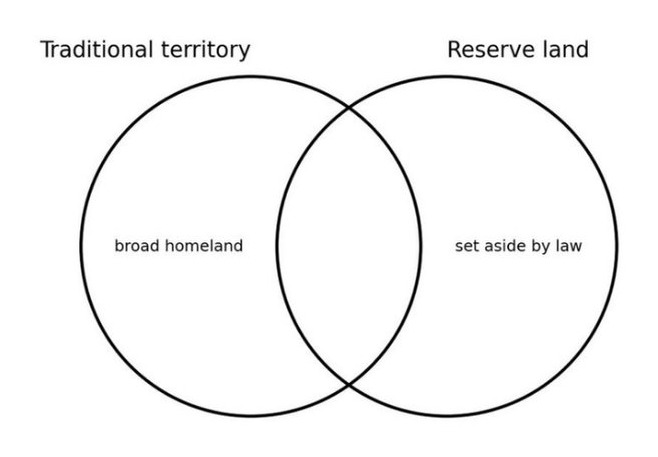
The Venn diagram compares traditional territory and reserve land. The overlap between the two circles best represents
A broad homeland used long before reserves B land set aside under the Indian Act C land with deep meaning for a nation D land with no connection to any nation
What looks wrong with Question 17?
Send anonymously
Cancel
18
How does a visitor to a territory show respect?
A assuming all territories have the same rules B entering restricted places without asking C ignoring local guidance entirely D learning whose territory it is and following local protocols
What looks wrong with Question 18?
Send anonymously
Cancel
19
How do many First Nations lead stewardship today?
A Guardian programs monitoring lands and waters B no role in land management at all C programs run only by outsiders D monitoring that ended long ago
What looks wrong with Question 19?
Send anonymously
Cancel
20
How does a place name that describes a river crossing help travellers?
A nothing about the place B useful information about the place itself C only the name of a settler D a secret code no one can use
What looks wrong with Question 20?
Send anonymously
Cancel
Reading II - Mapping Place Names
Use this reading for questions 21 to 23.
A community mapping project brings youth and elders together. Elders share place names and the stories behind them, and youth mark the places on a map. One name describes a safe crossing. Another name recalls a gathering place for trading and feasting. A third name warns about a steep bank after rain.
The map is kept by the community for teaching. It is not made to sell the land or to invite strangers to use places without permission. The youth learn that a name can hold directions, history, and rules for safe and respectful use, all at once.
- An invented account of a community project in British Columbia
21
What does Reading II mainly show about place names?
A only decoration on a map B information that is never shared C directions, history, and rules for respectful use D names with no practical purpose
What looks wrong with Question 21?
Send anonymously
Cancel
22
According to Reading II, what does the community keep its map for?
A for selling the land to strangers B for inviting anyone to use places freely C for hiding all knowledge from youth D for teaching, not for selling land or inviting use without permission
What looks wrong with Question 22?
Send anonymously
Cancel
23
What does Reading II best illustrate about place names?
A living knowledge taught by elders and learned by youth B dead knowledge from the past only C knowledge that youth cannot learn D names that belong to no community
What looks wrong with Question 23?
Send anonymously
Cancel
24
What is true of many First Peoples today, and their connection to territory?
A in home territories and in cities, with connection remaining important B only in home territories in the past C only in cities with no territory connection D in neither place today
What looks wrong with Question 24?
Send anonymously
Cancel
25
What is a nation practising when it sets seasonal harvesting rules, protects spawning areas, and teaches youth about the land?
A neglect of the land B stewardship through rules, protection, and teaching C a ban on all traditional practices D reliance on outsiders for every decision
What looks wrong with Question 25?
Send anonymously
Cancel